
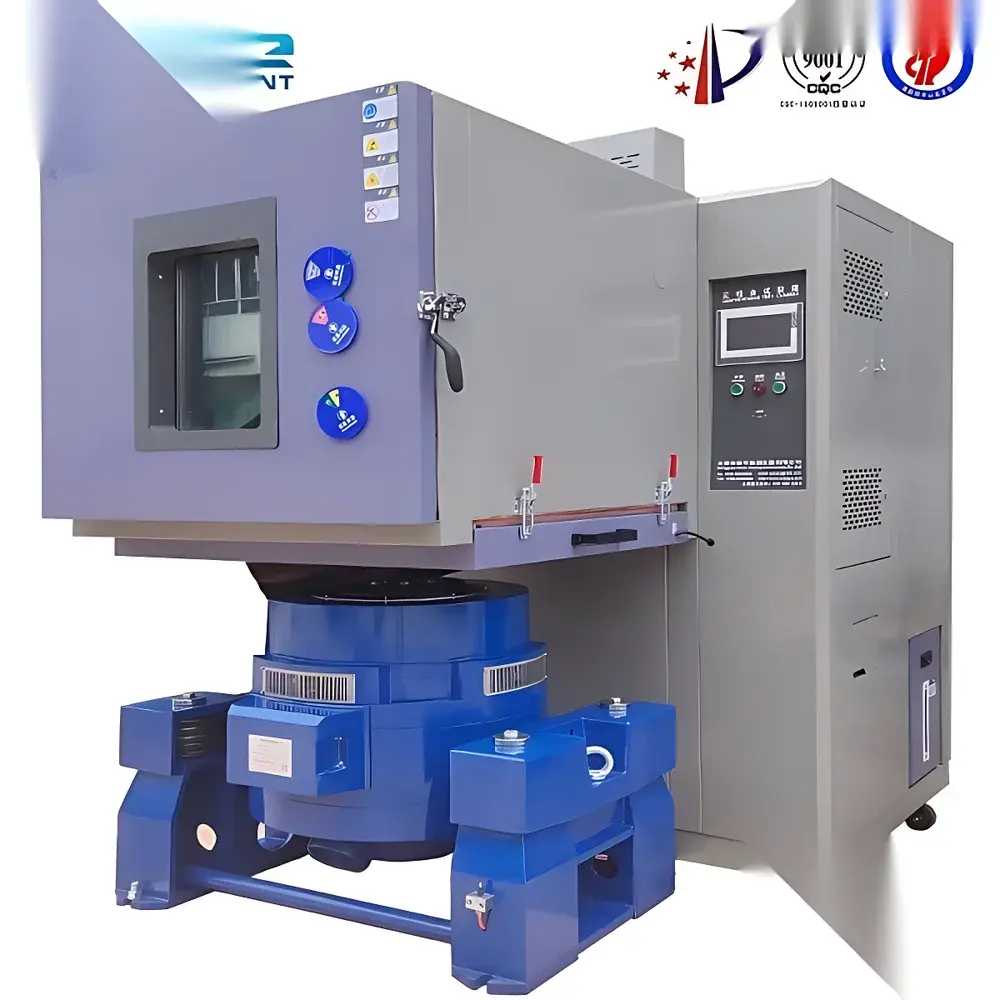
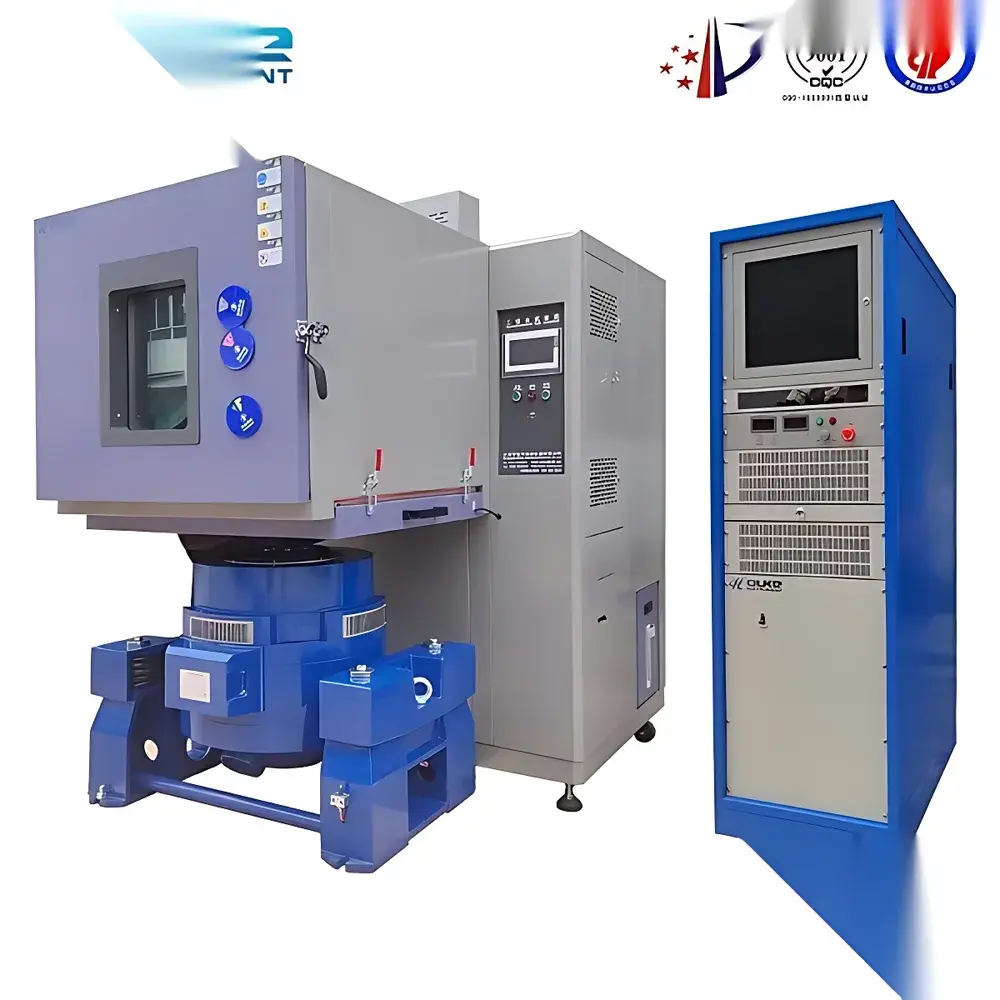
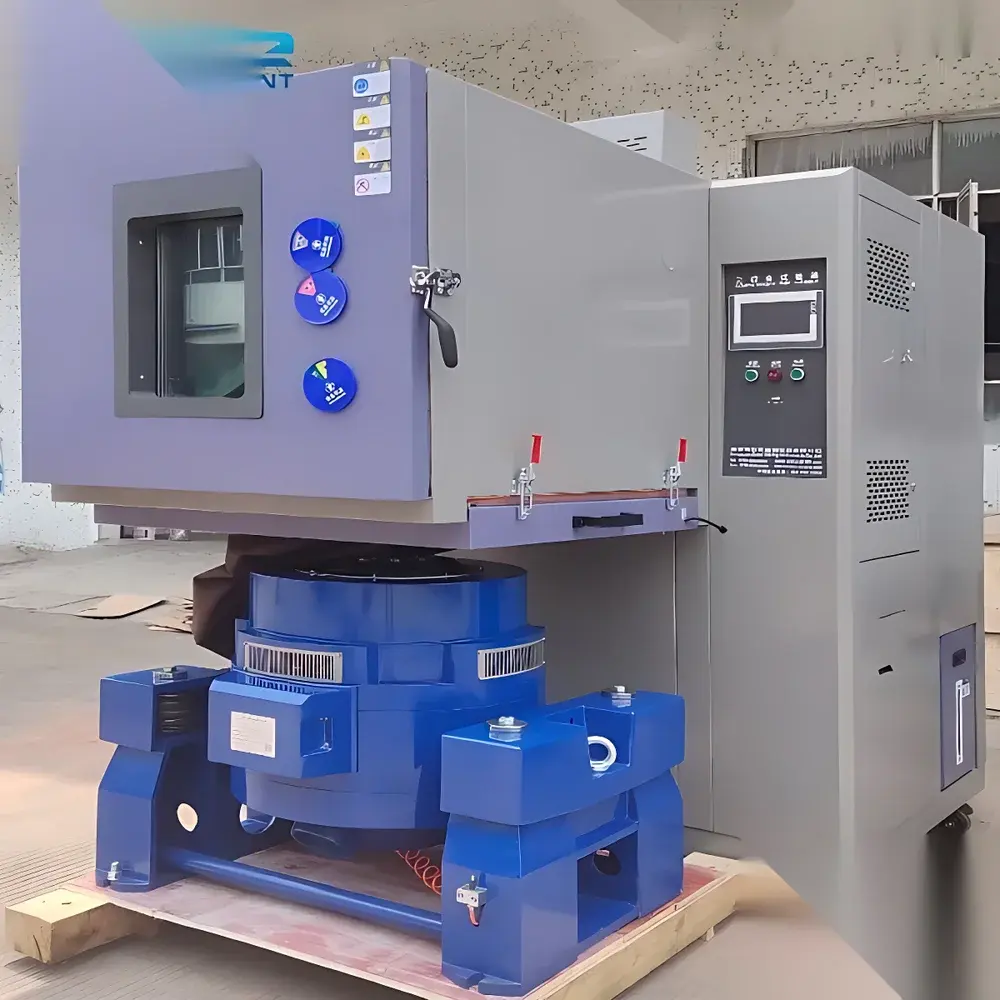
Combined Environmental Test Chamber with Temperature, Humidity and Multi-Axis Vibration Capability
| Brand | Other Brands |
|---|---|
| Origin | Imported |
| Manufacturer Type | Authorized Distributor |
| Frequency Range | 50 Hz, 1–600 Hz, 1–3000 Hz, 1–5000 Hz |
| Max. Acceleration | <20 g |
| Vibration Amplitude Range | 0–5 mm |
| Payload Capacity | 100 kg |
| Temperature Control Accuracy | ±0.1 °C |
| Temp. Resolution | 0.1 °C |
| Control System | PID + SSR with Auto-Tuning |
| Vibration Waveform | Sine (Half/Full Cycle) |
| Vibration Axes | Vertical (Z) + Horizontal (X/Y) |
| Test Duration Range | 1–65,000 s |
| Cycle Count Range | 1–65,000 cycles |
| Frequency Display Resolution | 0.01 Hz |
| Frequency Precision | 0.1 Hz |
| Power Supply | AC 220 V / 50 Hz or AC 380 V / 50 Hz |
| Chamber Dimensions (mm) | Vertical Unit 500 × 500 × 150 |
Overview
The Combined Environmental Test Chamber with Temperature, Humidity and Multi-Axis Vibration Capability is an integrated reliability validation platform engineered for accelerated life testing of electronic assemblies, automotive components, aerospace subsystems, and industrial control units under simultaneous thermal, hygrothermal, and dynamic mechanical stress conditions. Unlike sequential environmental testing setups, this system implements true concurrent operation—where temperature cycling (−70 °C to +180 °C), humidity control (10–98% RH), and broadband electrodynamic vibration (1–5000 Hz) are executed in synchronized real time. The chamber utilizes a dual-chamber architecture: a vertical shaker (Z-axis) and a horizontal shaker (X/Y-axis), both driven by high-fidelity linear power amplifiers and coupled to a rigid, low-resonance base structure. Thermal regulation employs a cascade refrigeration system with PID + SSR feedback control, referencing PT100 Class A platinum resistance sensors calibrated per IEC 60751. Humidity is generated via steam injection and controlled using capacitive RH sensors traceable to NIST standards. This design enables compliance with test profiles defined in MIL-STD-810H Method 514.7 (vibration), Method 502.7 (temperature), and Method 507.6 (humidity), as well as ISO 16750-4 and JEDEC JESD22-A108.
Key Features
- Simultaneous triple-stress operation: programmable temperature/humidity profiles running concurrently with broadband sine vibration across vertical (Z) and horizontal (X/Y) axes
- Dual-shaker configuration with independent motion control—vertical unit (500 × 500 × 150 mm) and horizontal unit (500 × 500 × 250 mm)—ensuring orthogonal excitation without cross-axis coupling
- PID + SSR temperature controller with auto-tuning algorithm; achieves ±0.1 °C accuracy and 0.1 °C resolution over full operating range
- Vibration system supports selectable frequency bands: fixed 50 Hz mode or swept ranges from 1–600 Hz, 1–3000 Hz, and 1–5000 Hz—compatible with modal analysis and resonance search protocols
- Programmable sine waveform generation with amplitude modulation (0–5 mm peak-to-peak) and acceleration limit (<20 g peak)
- Robust payload interface: reinforced mounting table rated for 100 kg static load with T-slot pattern conforming to ISO 22877
- Test sequence logic engine supporting up to 65,000 cycles and 65,000 seconds per segment, with breakpoint resume and alarm-triggered pause functions
Sample Compatibility & Compliance
This chamber accommodates DUTs ranging from PCB-level modules (e.g., ECUs, sensor nodes) to full subassemblies such as infotainment head units, battery management systems, and avionics enclosures. Internal chamber volume allows for fixtures with standard MIL-STD-1377 compliant mounting interfaces. All thermal and humidity sensors are calibrated in accordance with ISO/IEC 17025-accredited procedures. The system meets electromagnetic compatibility requirements per EN 61326-1 and safety standards per IEC 61010-1. It supports audit-ready data logging aligned with GLP and GMP environments, including user access control, electronic signatures, and 21 CFR Part 11-compliant audit trails when paired with optional validated software packages.
Software & Data Management
Control and monitoring are managed via a Windows-based HMI with deterministic real-time kernel. The embedded software supports script-based test definition using a proprietary syntax compatible with common test specification formats (e.g., RTCA DO-160 Section 21, ISO 16750-4 Annex B). Real-time waveform capture at up to 50 kHz sampling rate is stored in IEEE C37.118-compliant binary format (.tdms), enabling post-processing in MATLAB, Python (SciPy), or NI DIAdem. Data export options include CSV, PDF reports with timestamped metadata, and direct integration into enterprise LIMS via OPC UA or RESTful API. Optional firmware upgrade path includes Ethernet/IP and Modbus TCP support for factory-floor integration.
Applications
- Qualification testing of automotive electronics per ISO 16750-4 (combined temperature/humidity/vibration)
- Design verification of avionics cooling systems under cyclic thermal shock and mechanical resonance exposure
- Reliability screening of solder joints and wire bonds using accelerated combined stress profiles
- Validation of hermeticity and seal integrity in medical device housings under hygrothermal-vibrational stress
- Failure mode identification in MEMS accelerometers and gyroscopes through resonant frequency tracking during thermal transients
- Compliance testing for industrial IoT gateways subjected to harsh edge-environment conditions
FAQ
What standards does this system comply with for combined environmental testing?
It supports test execution per MIL-STD-810H Methods 502.7, 507.6, and 514.7; ISO 16750-4; JEDEC JESD22-A108; and RTCA DO-160 Section 21, with configurable profile libraries included.
Can the system perform random vibration alongside temperature and humidity?
Standard configuration supports sine vibration only. Random vibration capability requires optional electrodynamic shaker upgrade and dedicated controller module (not included in base model).
Is remote monitoring and control supported over LAN or industrial networks?
Yes—Ethernet connectivity is standard. OPC UA server and Modbus TCP gateway are available as field-installable firmware options.
How is calibration maintained across long-term operation?
The system includes built-in sensor self-diagnostic routines and supports external recalibration using NIST-traceable reference sources. Calibration certificates are issued per ISO/IEC 17025 upon request.
What is the maximum allowable DUT height when using both vertical and horizontal shakers simultaneously?
With full dual-axis engagement, the recommended DUT envelope is limited to 300 mm in height to maintain center-of-gravity stability and avoid mechanical interference between shaker tables.



