
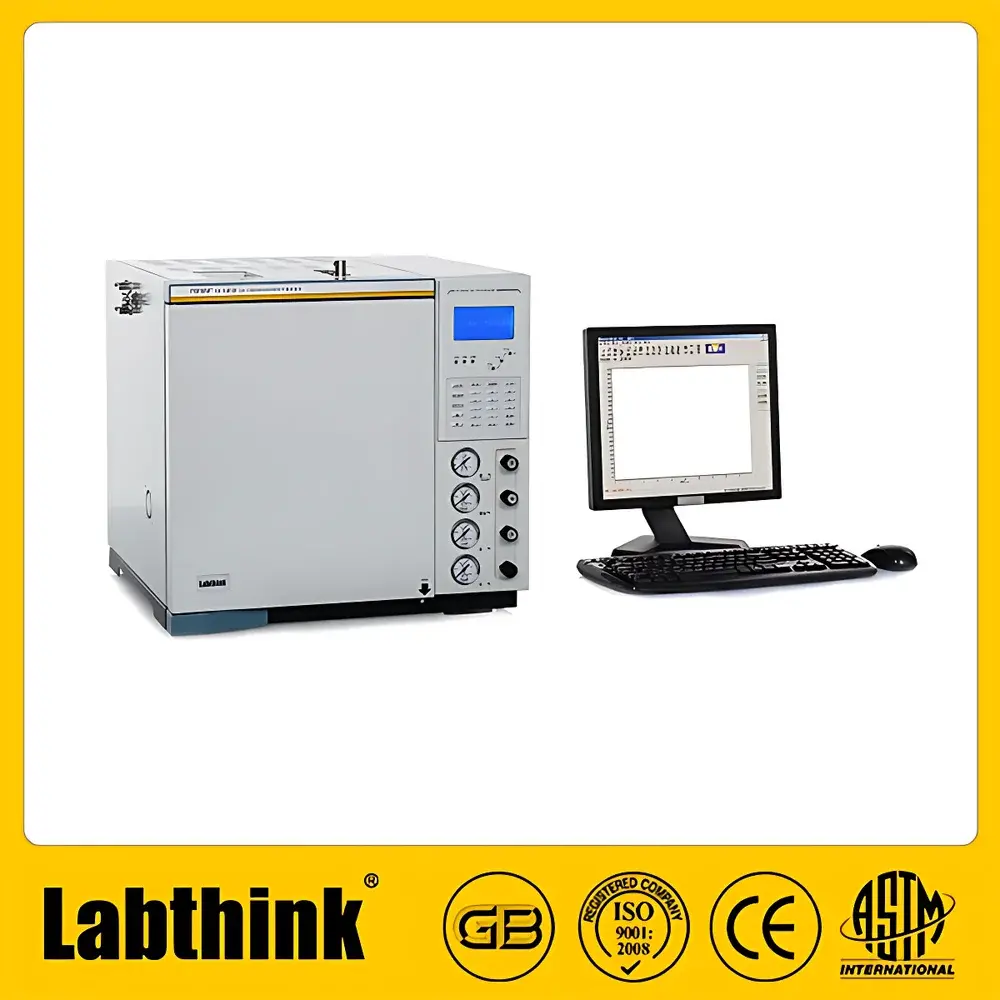
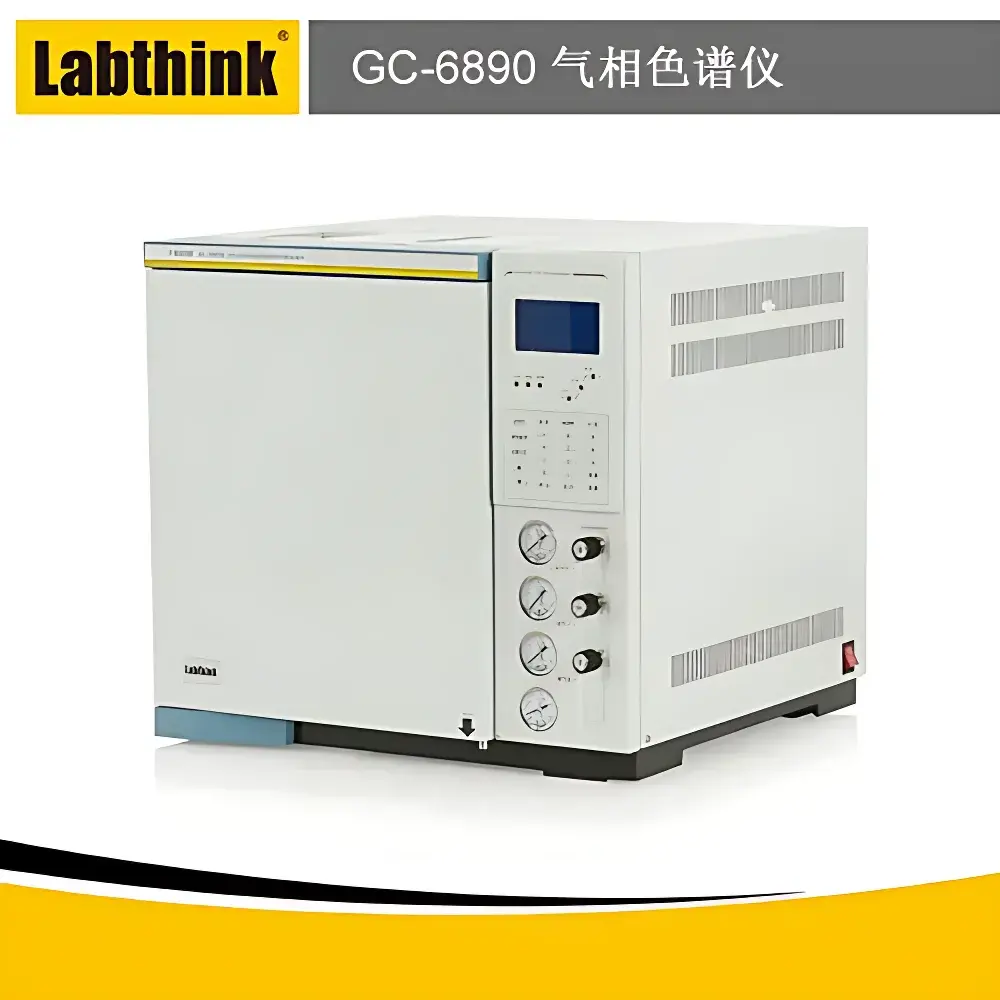
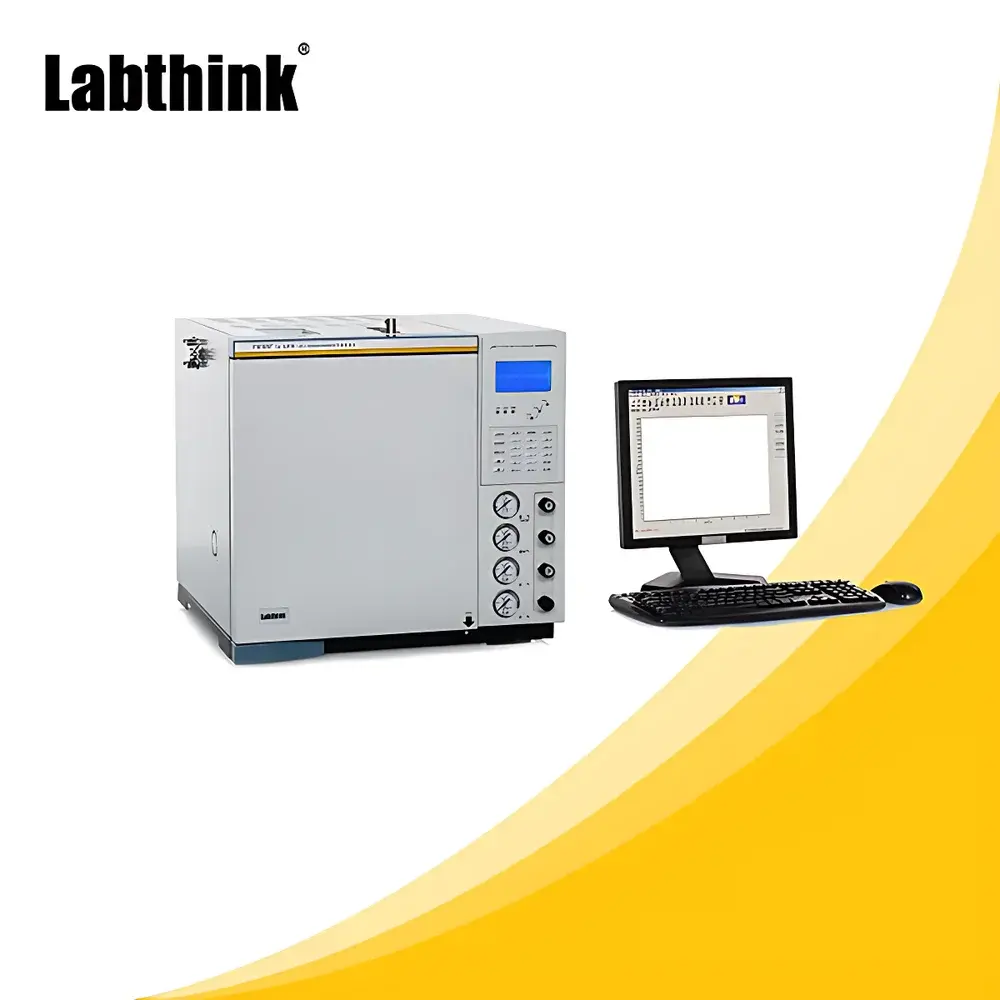
Labthink GC-6890 Gas Chromatograph for Solvent Residue Analysis in Packaging and Printing
| Brand | Labthink |
|---|---|
| Model | GC-6890 |
| Origin | Shandong, China |
| Manufacturer Type | Direct Manufacturer |
| Instrument Type | Laboratory Gas Chromatograph |
| Temperature Control Range | Ambient +3 °C to 399 °C |
| Heating Rate | 1–30 °C/min |
| Cooling Rate | ≤15 min (from 300 °C to 50 °C) |
| Detector | Flame Ionization Detector (FID) |
| Column Oven Temperature Stability | ±0.1 °C |
| FID Detection Limit | ≤5×10⁻¹¹ g/s (benzene) |
| Power Supply | AC 220 V, 50 Hz |
| Dimensions | 490 × 490 × 480 mm (L×W×H) |
| Weight | 45 kg |
Overview
The Labthink GC-6890 Gas Chromatograph is a dedicated laboratory-scale analytical instrument engineered for precise quantification of residual organic solvents in flexible packaging materials, printed films, laminates, and coated substrates. It operates on the fundamental principle of gas chromatography—separating volatile and semi-volatile compounds based on differential partitioning between a mobile phase (high-purity carrier gas, typically nitrogen or helium) and a stationary phase (capillary or packed column). As samples are thermally volatilized in the injection port and carried through the temperature-programmable column, individual analytes elute at characteristic retention times and are detected via flame ionization (FID), generating proportional electrical signals for quantitative analysis. Designed specifically for compliance-driven environments in packaging R&D, quality control, and third-party testing laboratories, the GC-6890 meets the technical requirements of key regulatory frameworks including GB/T 10004–2008 (Chinese national standard for solvent residue limits in plastic composite packaging), GB 9685–2016 (food contact material additive restrictions), and ISO 11843–2 (detection capability assessment for chromatographic methods). Its architecture supports trace-level detection of aromatic hydrocarbons (e.g., benzene, toluene, xylene isomers), ketones (e.g., MEK, MIBK), esters (e.g., ethyl acetate, butyl acetate), alcohols (e.g., ethanol, propanol), and other process-related solvents commonly used in gravure and flexographic printing.
Key Features
- Optimized thermal management system featuring dual-zone precision temperature control: oven temperature stability better than ±0.1 °C across ambient +3 °C to 399 °C, with programmable 4-step ramp profiles and linear heating rates adjustable from 1 to 30 °C/min.
- Flexible inlet configuration supporting both packed-column headspace injection and split/splitless capillary injection with septum purge—enabling reproducible analysis of low-concentration volatiles without carryover.
- Integrated FID detector with verified sensitivity ≤5×10⁻¹¹ g/s (benzene), baseline noise <0.025 mV, and drift <0.15 mV/h—ensuring reliable quantitation down to sub-μg/m² levels in film-based substrates.
- Intelligent hardware protection architecture: dual independent overtemperature cutoff circuits, carrier gas failure detection, and automatic power-down if any zone exceeds setpoint by >20 °C—critical for unattended overnight runs.
- Full digital control via embedded microprocessor and large-character LCD interface; all operational parameters—including method sequences, calibration curves, and event markers—are stored internally with non-volatile memory and recall capability.
- Modular detector design using plug-and-play expansion slots, allowing future integration of alternative detectors (e.g., TCD, ECD) without hardware modification.
- Column oven equipped with active rear-door cooling and thermal insulation, achieving ≤15-minute cooldown from 300 °C to 50 °C—reducing cycle time between sequential analyses.
Sample Compatibility & Compliance
The GC-6890 is validated for direct analysis of solvent residues extracted from polyethylene (PE), polypropylene (PP), polyester (PET), aluminum foil composites, and metallized films using standardized headspace sampling per GB/T 10004–2008 Annex B. It accommodates common sample formats including 20 mL crimp-top vials with PTFE-silicone septa, and supports automated integration with optional autosamplers (e.g., CTC PAL series) for high-throughput labs. The system complies with ISO/IEC 17025:2017 requirements for method validation, including linearity (R² ≥0.999 over 0.05–5.0 mg/m²), repeatability (RSD ≤3.5% for n=6 replicate injections), and limit of quantitation (LOQ = 0.02 mg/m² for toluene on PET film). All firmware and data handling routines adhere to ALCOA+ principles (Attributable, Legible, Contemporaneous, Original, Accurate, Complete, Consistent, Enduring, Available), supporting audit readiness under GLP and GMP-regulated environments.
Software & Data Management
The instrument ships with Labthink’s proprietary ChromaSoft™ workstation software—a Windows-based application compliant with FDA 21 CFR Part 11 for electronic records and signatures. ChromaSoft provides full method development tools, peak integration with customizable baselines and retention time windows, multi-point external standard calibration, and automated report generation in PDF/Excel format. Each analysis record includes embedded metadata: operator ID, instrument serial number, column lot ID, environmental conditions (lab temp/humidity), and full audit trail of parameter edits. Raw data (.CDF) files are stored in open-standard format compatible with third-party platforms such as OpenLab CDS, Chromeleon, or Empower. Optional modules include spectral library matching (for unknown peak identification) and statistical process control (SPC) dashboards aligned with ICH Q2(R2) guidelines.
Applications
- Quantitative determination of total and individual solvent residues (e.g., toluene, xylene, ethyl acetate, MEK) in food-grade pouches, snack wrappers, and pharmaceutical blister lidding per GB/T 10004–2008 and USP .
- Verification of solvent removal efficiency after drying ovens in rotogravure printing lines—supporting root-cause analysis of odor complaints or adhesion failures.
- Purity assessment of incoming solvent batches used in ink formulation, ensuring absence of hazardous impurities like benzene or chlorinated compounds.
- Comparative migration studies of low-migration inks under accelerated aging (e.g., 40 °C/75% RH for 10 days) followed by headspace GC analysis.
- Supporting regulatory submissions for EU Commission Regulation (EC) No 1935/2004 and FDA 21 CFR 170–189 compliance dossiers.
FAQ
What sample preparation method is recommended for solvent residue testing?
Standard practice follows GB/T 10004–2008 Annex B: cut 0.2 m² of film, seal in a 20 mL headspace vial, incubate at 60 °C for 30 min, then inject 1 mL of headspace gas using a gas-tight syringe.
Can the GC-6890 be configured with a mass spectrometer (GC-MS)?
No—the GC-6890 is a dedicated FID platform; however, Labthink offers the GC-MS 2020 series as a separate product line for compound identification and confirmatory analysis.
Is method validation support included with purchase?
Yes—Labthink’s certified chromatography applications team provides complimentary on-site method establishment, system suitability testing, and operator training aligned with ISO/IEC 17025 requirements.
What consumables require regular replacement?
Common maintenance items include FID jet assemblies, silica gel traps for carrier gas purification, septa (every 100 injections), and capillary columns (typical lifetime: 300–500 injections depending on sample cleanliness).
Does the instrument meet export certification requirements for CE or UL listing?
The GC-6890 complies with IEC 61010-1:2010 for laboratory equipment safety; CE marking is available upon request for specific regional configurations, subject to local notified body review.



