
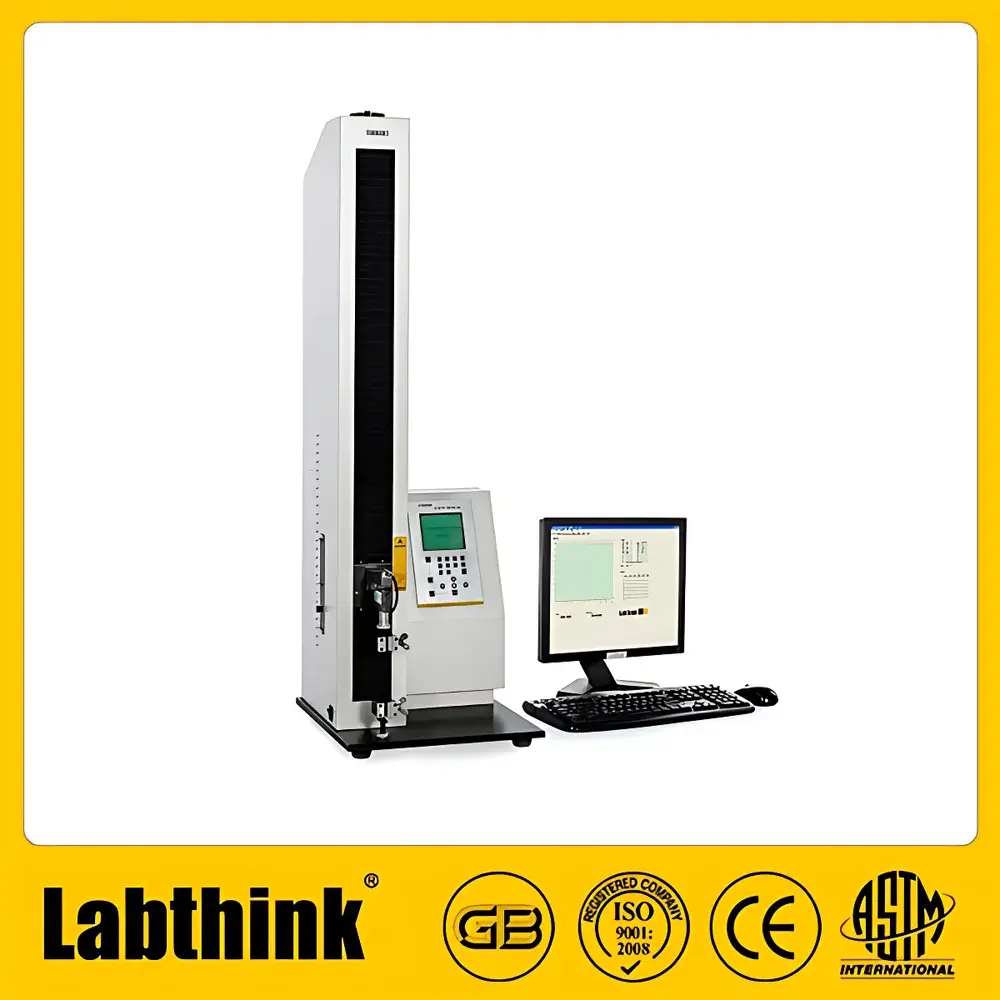
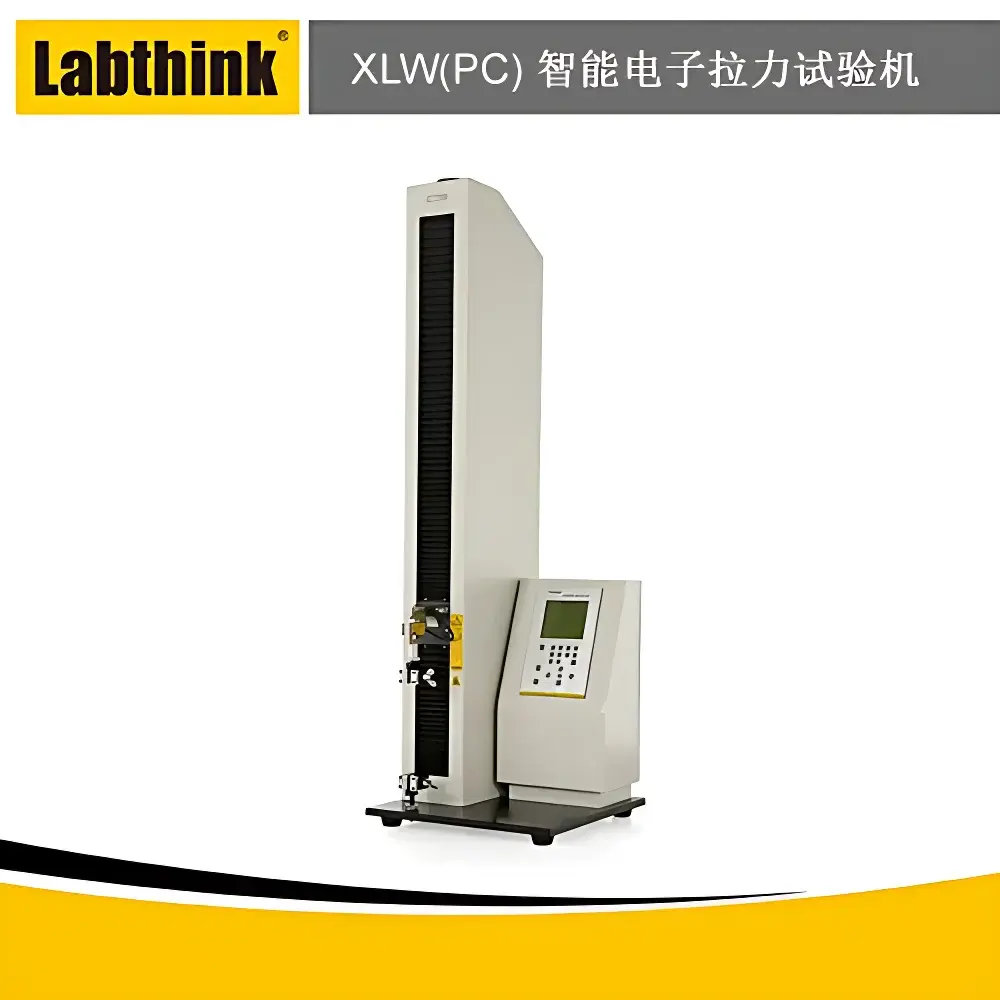
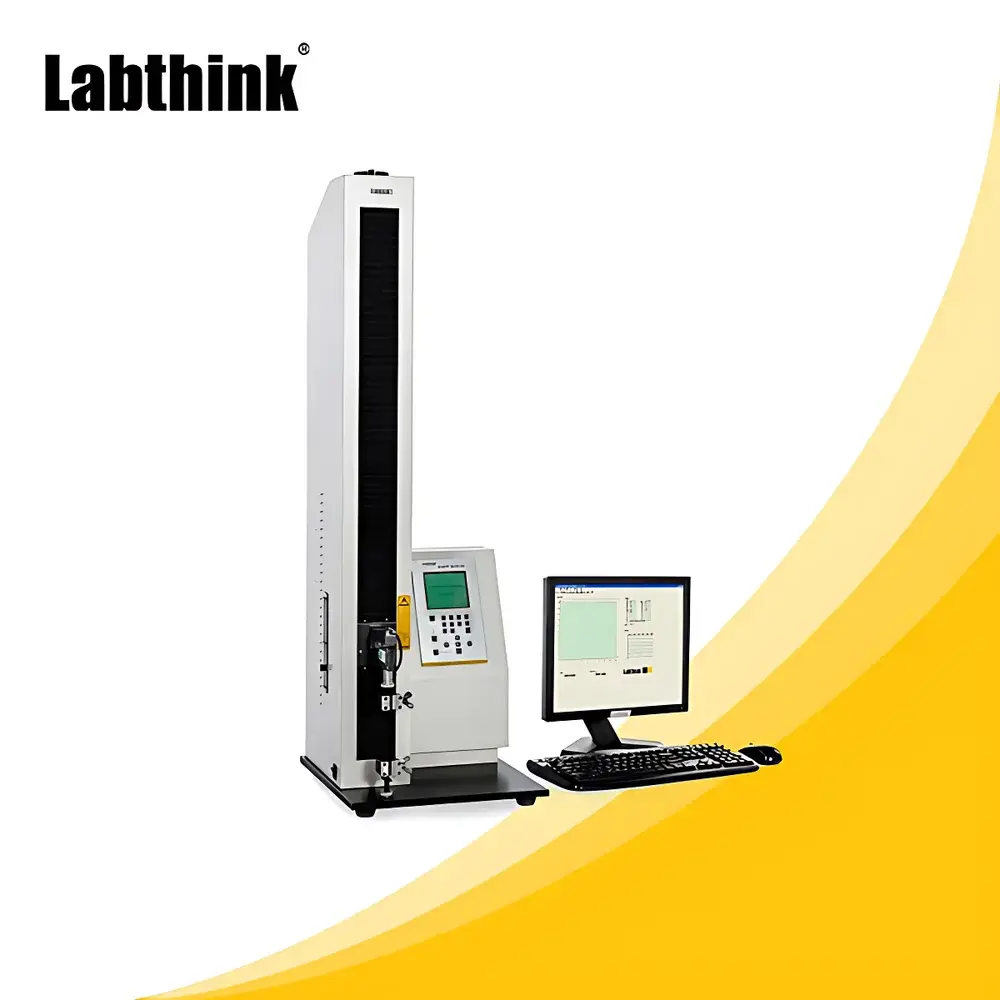
Labthink XLW(PC) Intelligent Electronic Tensile Testing Machine for Flexible Packaging Films
| Brand | Labthink |
|---|---|
| Origin | Jinan, Shandong, China |
| Manufacturer | Labthink Instruments Co., Ltd. |
| Instrument Type | Electromechanical Tensile Tester |
| Max Test Load | 1 kN |
| Force Measurement Range | 0–1000 N (standard 500 N sensor |
| Force Accuracy | Class 0.5 per ISO 7500-1 & ASTM E4 |
| Crosshead Travel | 1000 mm |
| Displacement Resolution | 1 mm |
| Test Speeds | 50, 100, 150, 200, 250, 300, 500 mm/min (7 fixed speeds) |
| Standard Specimen Width | 30 mm (50 mm optional) |
| Dimensions (L×W×H) | 450 × 450 × 1410 mm |
| Weight | 68 kg |
| Power Supply | 220 VAC 50 Hz / 120 VAC 60 Hz |
| Compliance | ISO 37, ISO 7500-1, ASTM D882, ASTM D1938, ASTM D3330, ASTM F88, ASTM F904, GB/T 1040.1–1040.5, GB/T 8808, GB/T 4850, GB/T 12914, GB/T 17200, GB/T 16578.1, GB/T 7122, GB/T 2790–2792, QB/T 2358, QB/T 1130, JIS P8113 |
Overview
The Labthink XLW(PC) Intelligent Electronic Tensile Testing Machine is a precision-engineered electromechanical system designed specifically for the mechanical characterization of thin, flexible polymeric materials used in packaging and medical applications. It operates on the principle of uniaxial tensile loading under controlled displacement rate, where a specimen is clamped between two grips and subjected to axial force until failure or defined deformation. Force is measured via high-stability load cells mounted on the moving crosshead, while displacement is tracked using an integrated linear encoder with 1 mm resolution. The system conforms to fundamental metrological standards including ISO 7500-1 (static calibration of force-measuring systems) and ASTM E4 (practices for force verification), ensuring traceable accuracy across its full measurement range. Its architecture supports both static and quasi-static mechanical testing modes—enabling quantification of tensile strength, elongation at break, Young’s modulus, peel adhesion, tear resistance, seal strength, puncture force, and shear bond performance—making it suitable for R&D laboratories, QC departments, and regulatory-compliant manufacturing environments.
Key Features
- Class 0.5 force accuracy certified per ISO 7500-1 and ASTM E4, guaranteeing high reproducibility in comparative and specification-driven testing.
- Seven preconfigured test programs—including tensile, peel, tear, heat seal strength, puncture, shear, and friction—each optimized for standardized protocols such as ASTM D882 (thin plastic film), ASTM F88 (seal strength), and ISO 37 (vulcanized rubber).
- Adjustable crosshead travel of up to 1000 mm, accommodating specimens with high elongation characteristics (e.g., elastomeric films, hydrogels, nonwovens) without mechanical interference.
- Modular load cell options (50 N, 100 N, 250 N, 500 N standard, 750 N, and 1000 N custom) allow precise dynamic range selection to match material stiffness and expected failure loads.
- Seven discrete test speeds (50–500 mm/min) provide compliance with method-specific requirements from ISO, ASTM, and GB standards, eliminating variable-speed interpolation artifacts.
- Microprocessor-based control interface with PVC membrane keypad and large LCD display enables standalone operation without external computing hardware.
- Integrated safety mechanisms include mechanical limit switches, overload cutoff, automatic return-to-start positioning, and power-loss memory retention for uninterrupted workflow continuity.
Sample Compatibility & Compliance
The XLW(PC) is validated for use with a broad spectrum of low-thickness, high-ductility substrates typical in flexible packaging and biomedical device manufacturing. Compatible sample types include biaxially oriented polypropylene (BOPP), polyethylene (PE), polyester (PET), metallized films, laminates, pressure-sensitive adhesives (PSAs), medical tapes, sterile barrier materials, spunbond/meltblown nonwovens, rubber sheets, and coated papers. All test configurations adhere strictly to internationally recognized physical testing standards—including ISO 37 (rubber tensile properties), ASTM D882 (tensile properties of thin plastic sheeting), ASTM D1938 (tear propagation), ASTM F904 (peel adhesion of flexible barrier materials), and GB/T 1040 series (plastics tensile testing). The instrument meets essential requirements for GLP-aligned laboratories, supporting audit-ready documentation when paired with Lystem™ Laboratory Data Sharing System.
Software & Data Management
The XLW(PC) is equipped with proprietary Windows-compatible software that provides full test configuration, real-time data acquisition, and post-processing analytics. The software supports multi-sample group analysis, statistical reporting (mean, SD, CV%), curve superposition for comparative evaluation, and historical data retrieval with time-stamped metadata. Raw force–displacement datasets are exportable in CSV and Excel formats for integration into enterprise quality management systems (QMS). When connected to the Lystem™ platform, the instrument enables centralized data governance, role-based access control, electronic signature capability, and 21 CFR Part 11–compliant audit trails—facilitating compliance with FDA-regulated environments and ISO 17025-accredited testing laboratories.
Applications
- Quantitative evaluation of tensile strength and elongation at break for food and pharmaceutical packaging films per GB/T 1040.3 and ASTM D882.
- Heat seal integrity assessment of pouches and blister lidding materials in accordance with ASTM F88 and ISO 11607-2.
- Peel adhesion testing of medical pressure-sensitive adhesives against stainless steel or skin simulants (ASTM D3330, ISO 29862).
- Tear resistance validation of protective wraps and sterilization packaging per ASTM D1938 and GB/T 16578.1.
- Mechanical screening of battery separator films, wound dressings, and transdermal patch backing layers under controlled environmental conditions.
- Quality conformance testing for incoming raw materials and in-process lot release in GMP-compliant production lines.
FAQ
What standards does the XLW(PC) comply with?
It complies with ISO 37, ISO 7500-1, ASTM D882, ASTM D1938, ASTM F88, ASTM F904, GB/T 1040.1–1040.5, GB/T 8808, and over 15 additional national and international standards for mechanical property testing.
Can the instrument be integrated into a networked laboratory information system?
Yes—it supports TCP/IP communication and native integration with the Lystem™ Laboratory Data Sharing System for centralized data archiving, user permission management, and 21 CFR Part 11–compliant electronic records.
Is calibration traceable to national metrology institutes?
Force calibration is performed using certified reference standards traceable to CNAS-accredited laboratories; users receive a calibration certificate with uncertainty values and compliance statements per ISO/IEC 17025.
What specimen widths are supported?
Standard grip width is 30 mm; 50 mm grips are available as optional accessories to accommodate wider samples or specific standard requirements (e.g., ASTM D882 allows 15–50 mm widths).
Does the system support automated test report generation?
Yes—the software generates customizable PDF reports containing test parameters, graphical curves, tabulated results, pass/fail flags based on user-defined limits, and digital signatures for QA sign-off.



