
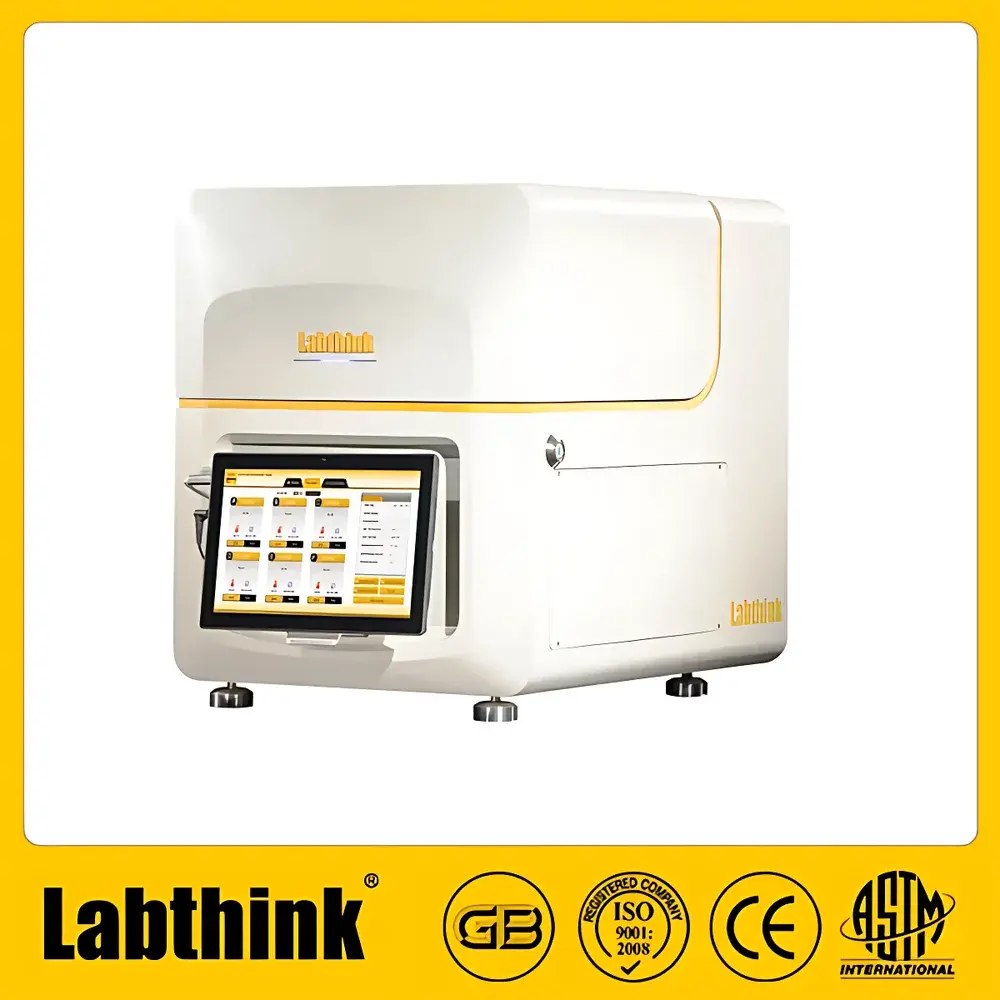
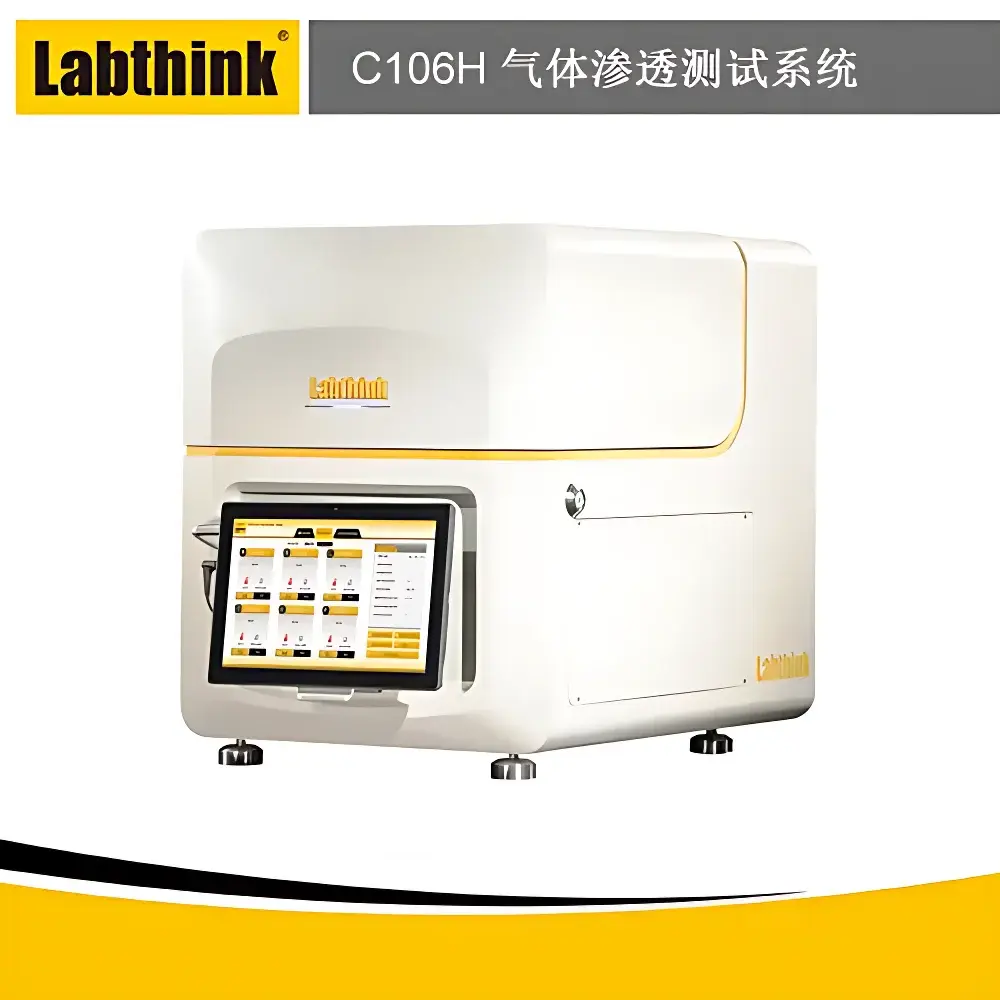
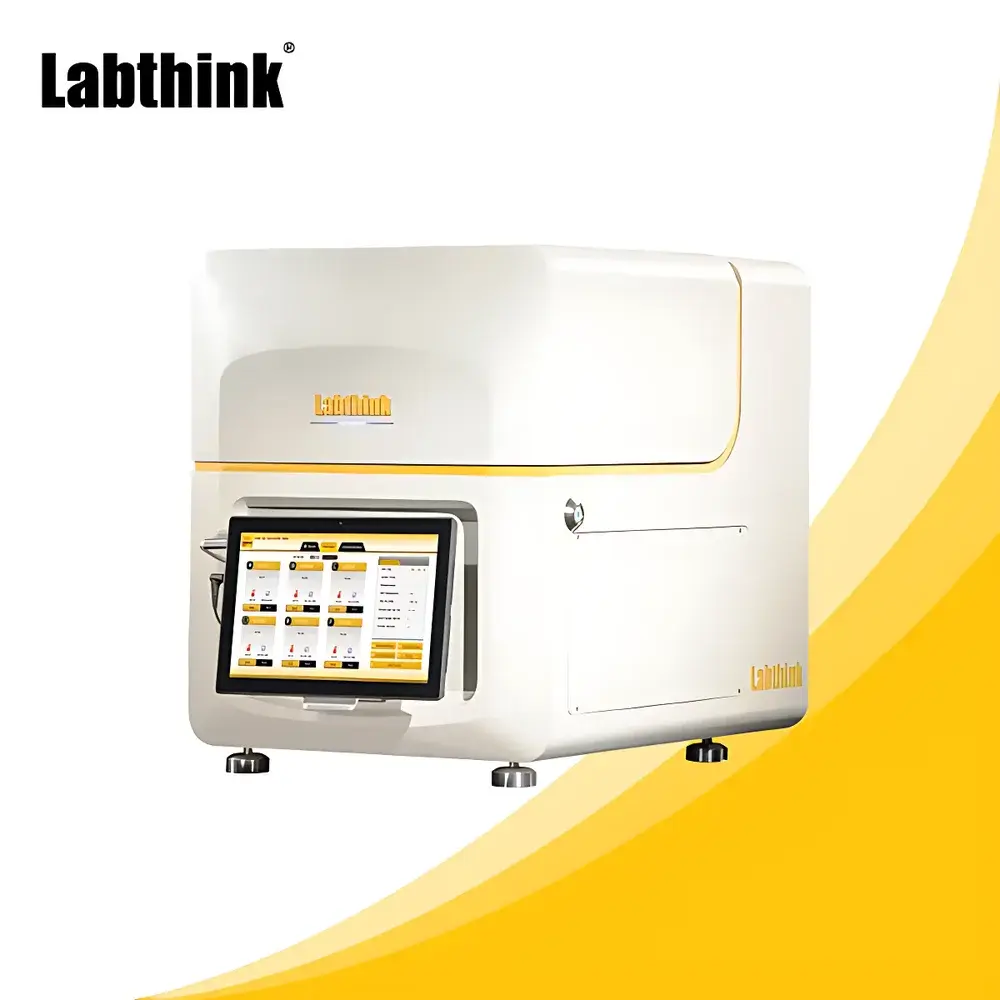
Labthink C106H High-Throughput Gas Permeability Tester for Films and Sheets
| Brand | Labthink |
|---|---|
| Model | C106H |
| Principle | Differential Pressure Method (ASTM D1434, ISO 15105-1, GB/T 1038-2000) |
| Test Range | 0.01–50,000 cm³/m²·24h·0.1MPa |
| Resolution | 0.001 cm³/m²·24h·0.1MPa |
| Temperature Range | 15–50 °C (5–60 °C optional) |
| Temp. Stability | ±0.15 °C |
| Vacuum Resolution | 0.01 Pa |
| Vacuum Accuracy | ±0.2% of reading (1–100% of sensor span) |
| Test Chamber Vacuum Level | ≤10 Pa |
| Chamber Count | 6 independent chambers |
| Standard Test Area | 38.48 cm² |
| Max. Sample Thickness | 3 mm |
| Pressure Control Range | 10–150 kPa |
| Pressure Stability | ±0.2 kPa |
| Gas Options | O₂, N₂, CO₂ (H₂, CH₄ available on custom configuration) |
| Power Supply | 120 VAC ±10%, 60 Hz or 220 VAC ±10%, 50 Hz |
| Net Weight | 100 kg |
| Dimensions | 600 × 490 × 660 mm |
Overview
The Labthink C106H High-Throughput Gas Permeability Tester is an engineered solution for precise, reproducible determination of gas transmission rates (GTR), permeability coefficients (P), diffusion coefficients (D), and solubility coefficients (S) in flexible barrier materials. It operates on the differential pressure (manometric) principle per ASTM D1434, ISO 15105-1, ISO 2556, GB/T 1038-2000, JIS K7126-1, and YBB 00082003. In this method, a conditioned specimen is sealed between two chambers — a high-pressure upper chamber charged with test gas (e.g., O₂, N₂, or CO₂), and a low-pressure lower chamber evacuated to high vacuum (≤10 Pa). A controlled, stable transmembrane pressure gradient drives gas permeation; real-time monitoring of pressure rise in the low-pressure chamber enables calculation of GTR and derived transport parameters using Fickian diffusion models. The system’s design emphasizes metrological integrity: its 0.01 Pa vacuum resolution, ±0.2 kPa pressure regulation fidelity, and ±0.15 °C thermal uniformity across six parallel test zones ensure compliance with GLP and regulatory-grade validation requirements.
Key Features
- Six independent, identically dimensioned test chambers (38.48 cm² standard area), enabling concurrent analysis of up to six specimens under identical environmental conditions — triple the throughput of conventional single- or dual-chamber instruments.
- Rainbow Bridge™ test cavity architecture with 360° circumferential air circulation and PID-controlled thermal management, delivering exceptional temperature homogeneity and stability across all chambers.
- Imported high-precision vacuum transducers (0.01 Pa resolution) and ultra-low-leakage pneumatic control valves, ensuring long-term sealing integrity and minimal drift during extended high-barrier measurements (e.g., <0.09 cm³/m²·24h·0.1MPa).
- Integrated UK-sourced vacuum pump with ultimate vacuum ≤0.2 Pa and automated duty-cycle control — eliminating manual valve actuation and reducing operator intervention while optimizing energy consumption.
- Proprietary auto-compensation pressurization technology maintains high-side pressure within ±0.2 kPa tolerance throughout testing, even during prolonged equilibration phases typical for ultra-high-barrier films.
- 12-inch industrial-grade Windows touch tablet interface with intuitive workflow navigation, supporting both fully automated mode (temperature input → start) and advanced manual control for method development and research applications.
- Motorized sample clamping mechanism ensures consistent compressive force and repeatable seal formation, minimizing edge leakage and inter-test variability.
Sample Compatibility & Compliance
The C106H accommodates a broad spectrum of planar barrier materials, including monolayer and multilayer plastic films (e.g., PET, PE, PP, EVOH, PVDC), metallized and aluminized laminates, paper-plastic composites, rubber sheets, silicon wafers, and metallic foils (Al, Cu). Specimens up to 3 mm thick and 11.2 cm × 11.2 cm in dimension are supported. The instrument meets essential regulatory and quality system expectations: data audit trails comply with FDA 21 CFR Part 11 when equipped with optional DataShield™ software; test reports include full metadata (timestamp, operator ID, calibration status, environmental logs); and hardware architecture supports IQ/OQ/PQ documentation for GMP environments. Optional configurations extend compatibility to flammable gases (H₂, CH₄) under IECEx/ATEX-aligned safety protocols.
Software & Data Management
Control and analysis are executed via Labthink’s proprietary PermeationSuite™ software, installed on the integrated Windows tablet. The platform delivers real-time visualization of pressure vs. time curves, automatic GTR calculation per ISO 15105-1 Annex A, and derivation of P, D, and S using standardized thickness-corrected algorithms. Users may export raw data in CSV or Excel format, generate PDF reports with embedded calibration certificates and uncertainty statements, and apply custom pass/fail thresholds against specification limits. For regulated laboratories, the CFR 21 Part 11 add-on provides electronic signatures, role-based access control, and immutable audit logs — all traceable to ALCOA+ principles (Attributable, Legible, Contemporaneous, Original, Accurate, Complete, Consistent, Enduring, Available).
Applications
This instrument serves critical quality assurance and R&D functions across packaging, medical device, electronics, and specialty film manufacturing. Typical use cases include: validating oxygen barrier performance of pharmaceutical blister lidding foils; quantifying CO₂ transmission in carbonated beverage pouches; benchmarking nitrogen permeation in vacuum-sealed meat trays; assessing moisture vapor resistance in flexible OLED encapsulation films; and characterizing hydrogen permeability in fuel cell membrane substrates. Its wide dynamic range (0.01–50,000 cm³/m²·24h·0.1MPa) and rapid cycle times (<4 h for medium-barrier, <8 h for ultra-high-barrier materials) make it suitable for both routine QC screening and fundamental transport kinetics studies.
FAQ
What standards does the C106H comply with?
It conforms to ASTM D1434, ISO 15105-1, ISO 2556, GB/T 1038-2000, JIS K7126-1, and YBB 00082003 for gas permeability measurement.
Can the system test hazardous gases such as hydrogen?
Yes — H₂ and CH₄ testing is available through factory-installed safety modifications, including explosion-proof solenoids, gas-tight manifolds, and dedicated venting pathways.
Is temperature and humidity control integrated?
Temperature is fully integrated (15–50 °C standard; 5–60 °C optional). Relative humidity control (5–90 %RH ±2 %) is available as a custom module but not included in base configuration.
How is data integrity ensured for regulated environments?
With the optional CFR 21 Part 11 package, the system provides electronic signatures, user authentication, change tracking, and tamper-evident audit logs aligned with FDA and EU Annex 11 requirements.
What maintenance is required for long-term accuracy?
Annual calibration of vacuum sensors and pressure transducers is recommended; routine inspection of O-rings, vacuum grease application, and verification of chamber seal integrity should be performed per Labthink’s Maintenance Protocol MP-C106H Rev. 3.



