
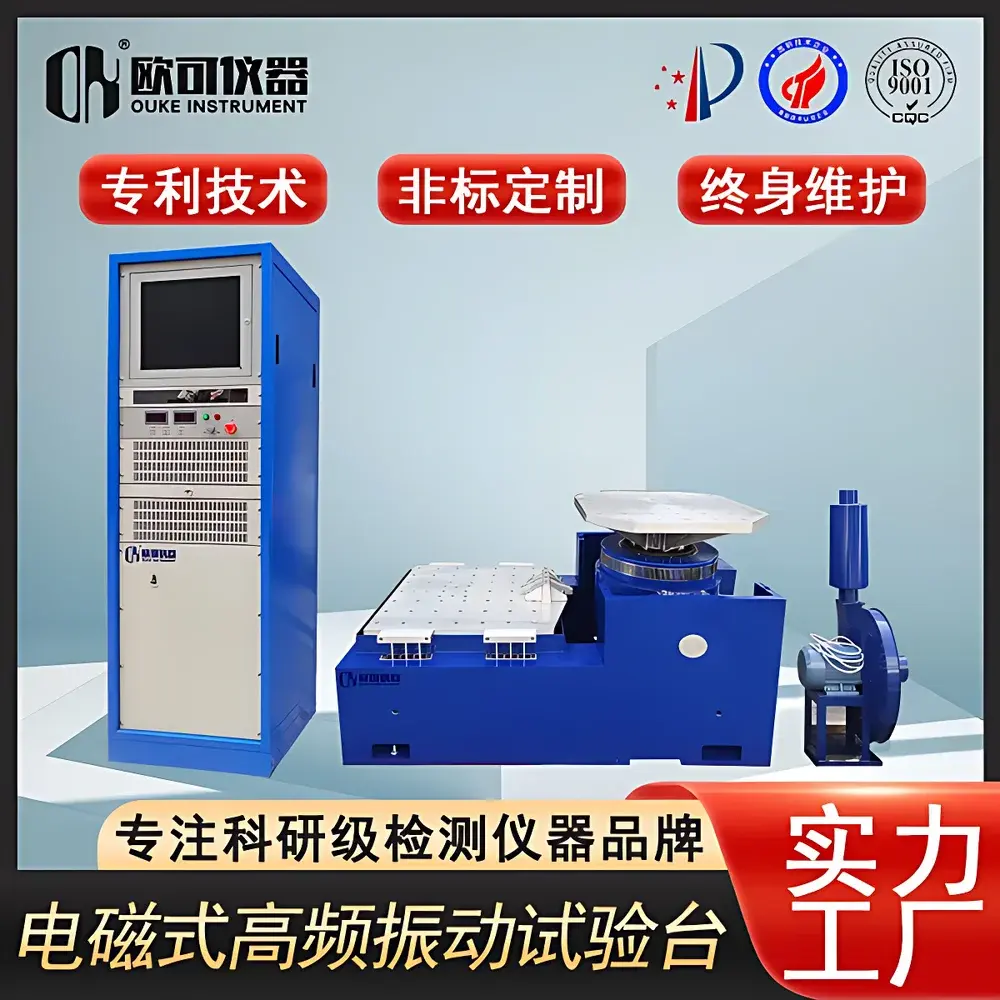
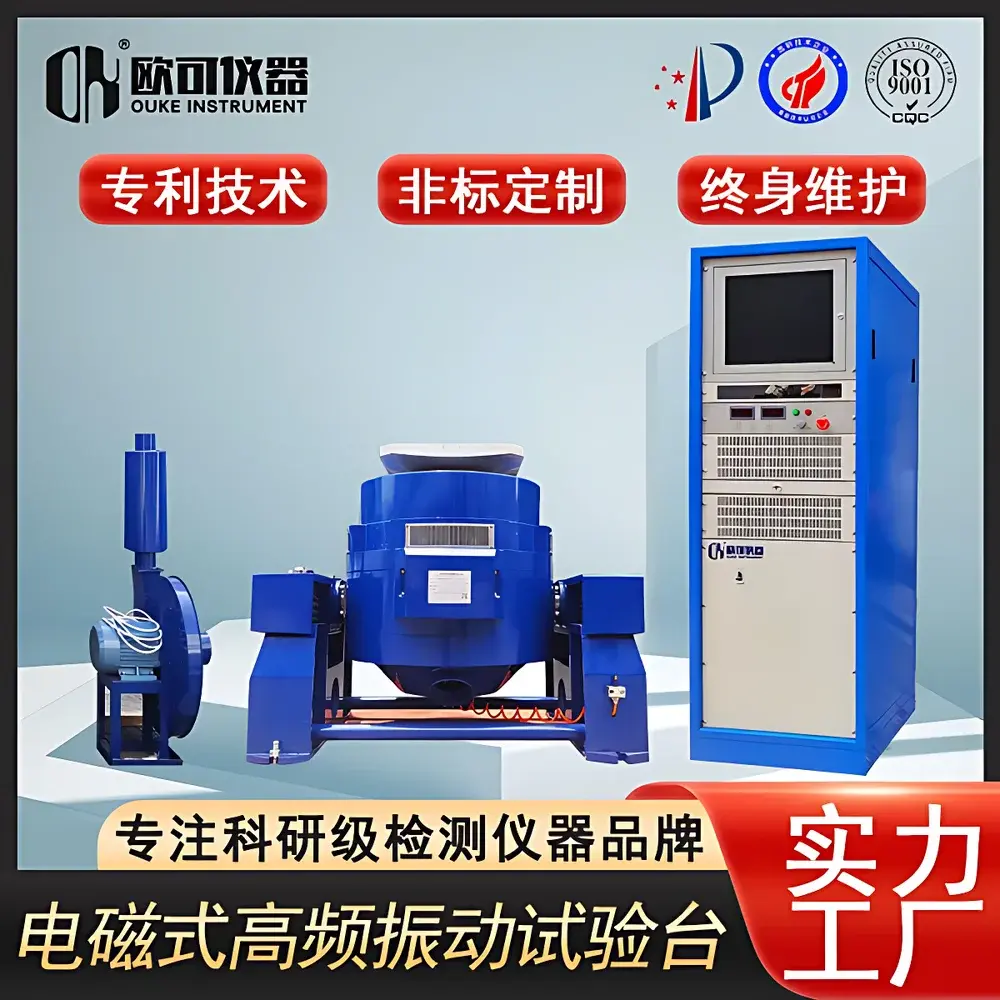
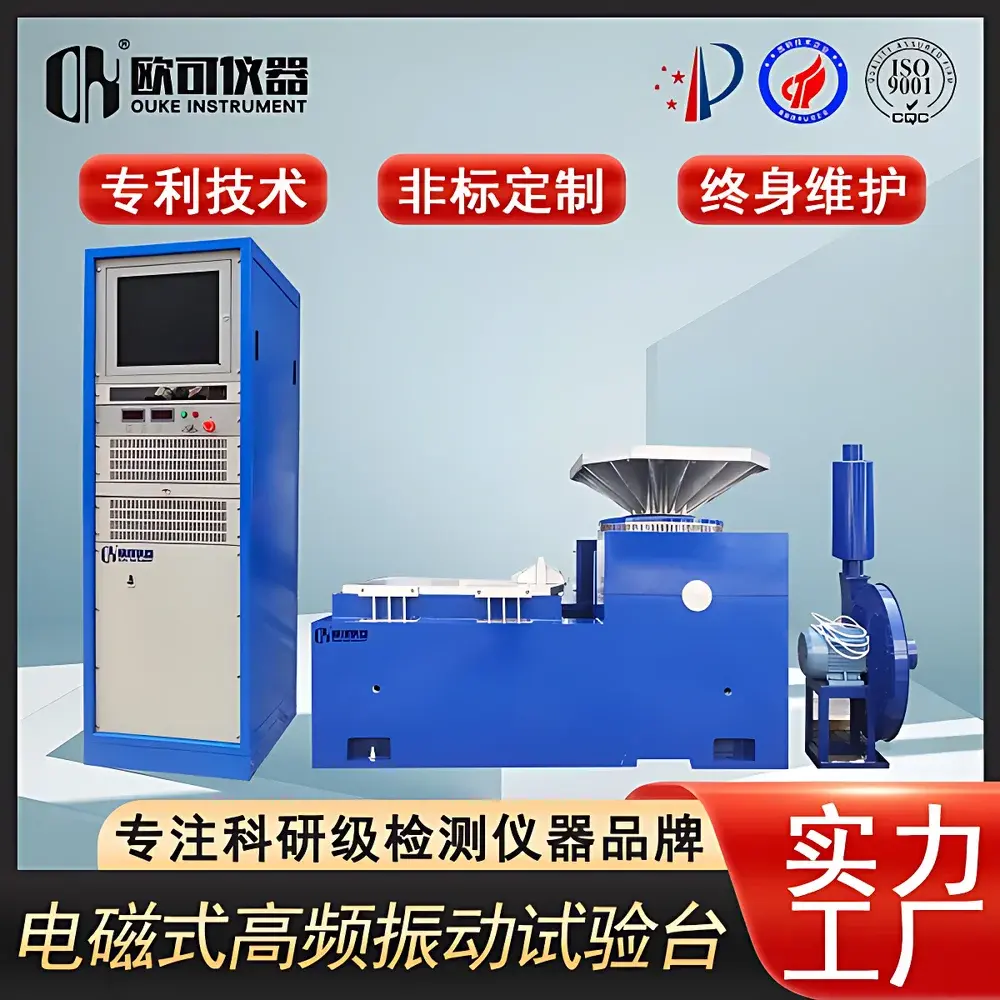
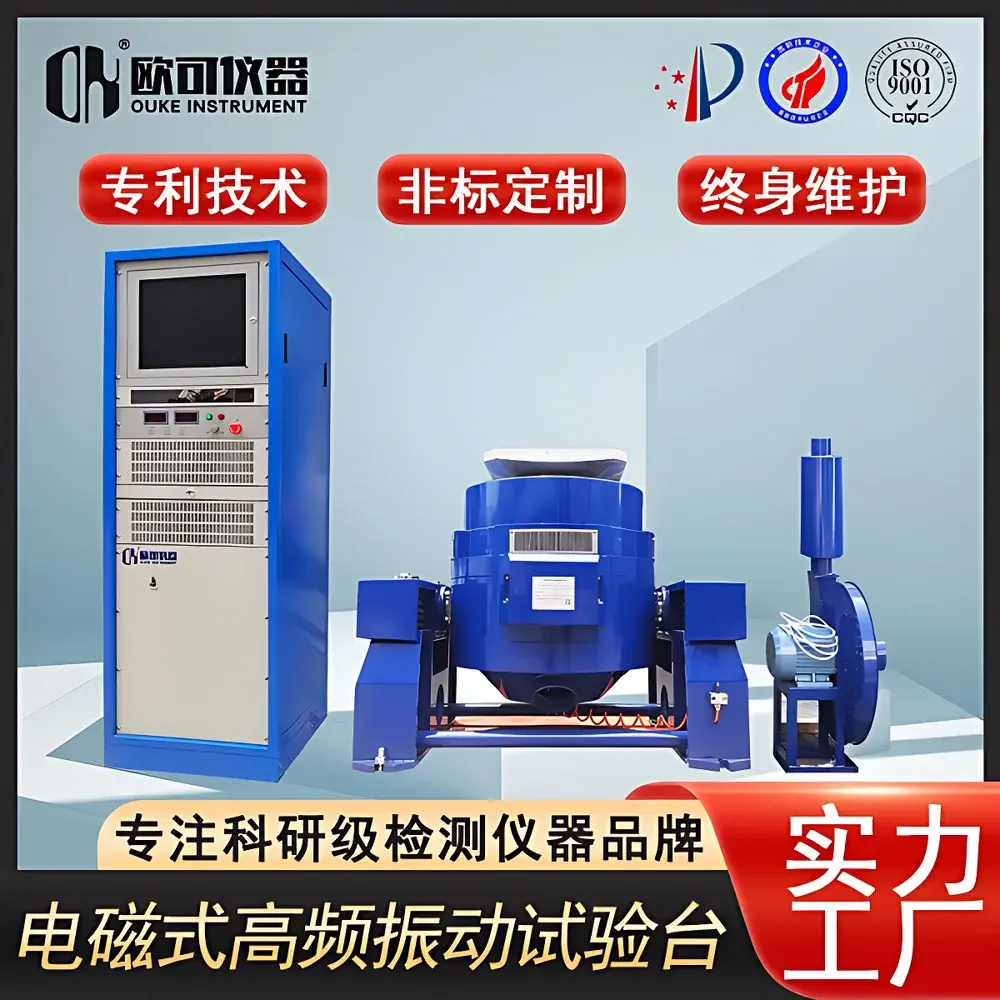
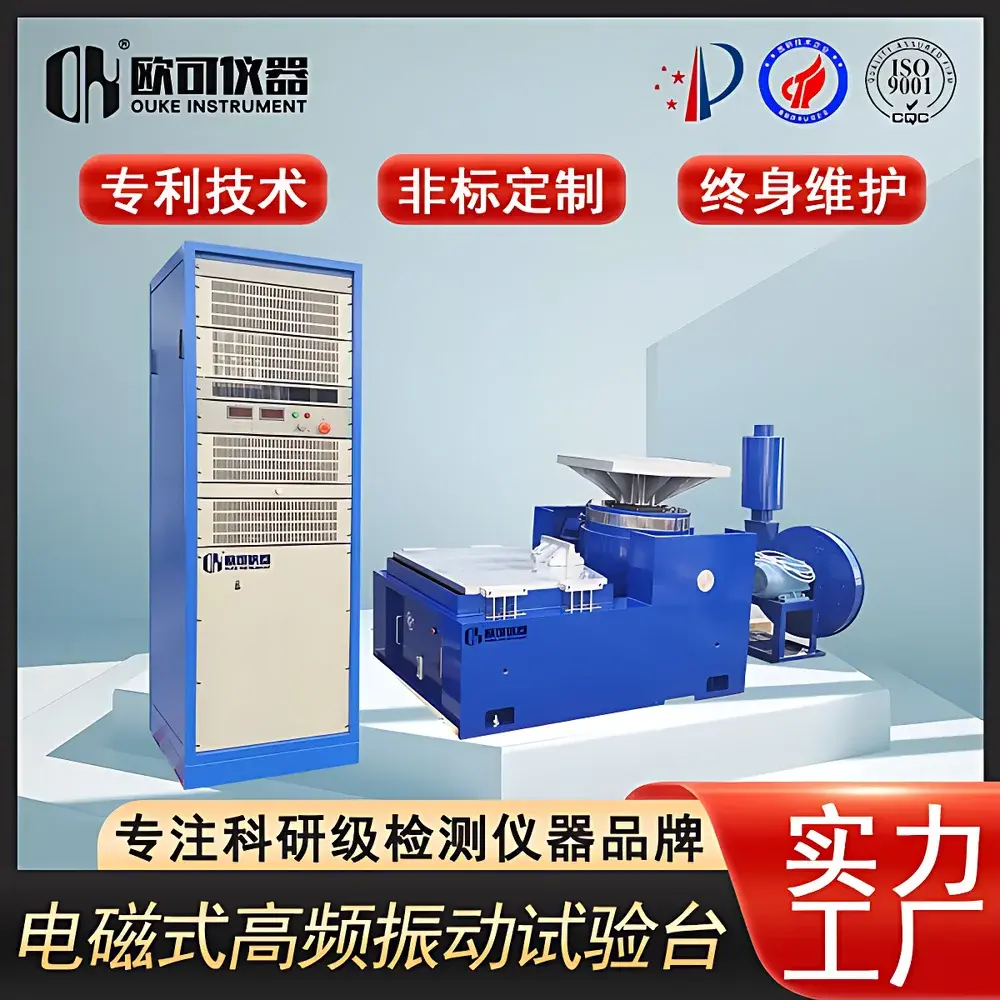
OK Instruments OK-ES-5.55 Electromagnetic Vibration Shaker System
| Brand | OK Instruments |
|---|---|
| Origin | Guangdong, China |
| Manufacturer Type | Direct Manufacturer |
| Equipment Type | Electromagnetic Vibration Shaker |
| Model | OK-ES-5.55 |
| Rated Thrust | 1.98 kN |
| Frequency Range | 5–5000 Hz |
| Maximum Test Load | 70 kg |
| Table Dimensions | 300 × 300 × 30 mm |
| Peak Acceleration Capacity | 10 g |
| Compliance Standards | ASTM D999, ISO 10326, IEC 60068-2-6, EN 60068-2-64, MIL-STD-810H (Vibration Sections), ISTA 3A/3E/3H |
Overview
The OK Instruments OK-ES-5.55 is a high-performance electromagnetic vibration shaker system engineered for precision mechanical stress evaluation under controlled dynamic excitation. Based on the principle of Lorentz force actuation—where alternating current in a voice-coil interacts with a static magnetic field to generate linear inertial motion—the system delivers reproducible sinusoidal, random, and transient vibration profiles across a broad frequency spectrum (5–5000 Hz). Its dual-magnetic-circuit architecture and self-supporting coil assembly minimize thermal drift and mechanical hysteresis, while air-suspension support combined with linear bearings and roller guidance ensures low lateral stiffness and high axial fidelity. Designed for laboratory-grade reliability and industrial durability, the OK-ES-5.55 meets the structural and metrological requirements of aerospace qualification, defense equipment validation, and electronics reliability testing.
Key Features
- Dual-magnetic-circuit design enabling enhanced flux density uniformity and improved force linearity over full stroke
- Self-generating skeleton-type moving coil for optimized thermal dissipation and extended operational duty cycle
- Air-suspension support system with integrated damping control to suppress parasitic resonances below 5 Hz
- High-precision linear bearing and roller-guided table mechanism ensuring ≤ ±0.02 mm lateral runout at 5000 Hz
- Ear-axis isolation mounting configuration minimizing base-structure coupling and improving test repeatability
- Modular interface for seamless integration with environmental chambers (e.g., temperature/humidity, thermal vacuum) to support combined environmental–mechanical testing per MIL-STD-810H Method 514.8 and ISO 16750-3
- Compliant with IEEE 1158-defined shaker controller interface protocols for interoperability with third-party real-time control systems
Sample Compatibility & Compliance
The OK-ES-5.55 accommodates test specimens up to 70 kg mass with dimensional constraints defined by its 300 × 300 mm active table surface (30 mm thickness). Fixturing is compatible with standard T-slots (M6 or 1/4″-20 UNC) and supports custom adapters for PCB assemblies, avionics enclosures, automotive ECUs, and munitions subsystems. The system is validated against internationally recognized vibration test standards including: ASTM D999 (shipping container vibration), ISO 10326-1 (road vehicle component testing), IEC 60068-2-6 (sinusoidal vibration), IEC 60068-2-64 (broadband random vibration), EN 60068-2-27 (shock), and MIL-STD-810H Method 514.8 (vibration tailoring). All calibration records adhere to ISO/IEC 17025 traceability requirements via NIST-traceable accelerometers and laser Doppler vibrometers.
Software & Data Management
The shaker is operated via OK-VibControl™ v4.2—a deterministic real-time control platform compliant with FDA 21 CFR Part 11 for audit trail, electronic signature, and data integrity assurance. It supports closed-loop acceleration control using IEPE-accelerometer feedback with ≤ 0.5 dB amplitude flatness and ≤ ±2° phase linearity from 10 Hz to 2000 Hz. Test profiles include swept-sine, fixed-frequency dwell, classical shock (half-sine, trapezoidal, terminal-peak sawtooth), and synthesized shock response spectra (SRS) per MIL-STD-810H Annex G. Raw time-history data (acceleration, velocity, displacement) are logged at user-selectable sampling rates up to 51.2 kHz and exported in ASAM MDF4, HDF5, or CSV formats. Full GLP/GMP audit logs—including operator ID, timestamp, parameter set, calibration status, and pass/fail flags—are embedded in each test report.
Applications
- Aerospace: Structural resonance screening of satellite payloads, antenna mounts, and flight computer chassis
- Defense: Qualification of guided munition fuzes, radar transceivers, and ruggedized handheld radios per MIL-STD-810H
- Automotive: NVH analysis of ADAS sensors, battery management systems, and infotainment modules
- Electronics: Reliability assessment of solder joint fatigue in high-density PCBs under broadband random excitation
- Telecom: Vibration endurance testing of 5G base station RF modules and optical transceivers
- Consumer Appliances: Durability validation of smart home controllers, robotic vacuum motors, and HVAC control boards
FAQ
What is the maximum achievable acceleration at 100 Hz?
At 100 Hz, the theoretical peak acceleration is limited to 10 g (98.1 m/s²) per system specification; actual delivered acceleration depends on payload mass, fixture dynamics, and control loop bandwidth.
Can the OK-ES-5.55 perform SRS synthesis from measured field data?
Yes—OK-VibControl™ includes built-in SRS synthesis algorithms conforming to MIL-STD-810H Figure G-10 and supports import of field-acquired time histories for reverse-engineered test profile generation.
Is the system compatible with third-party environmental chambers?
Yes—standard flange dimensions and electrical feedthrough specifications align with common climatic chamber vendors (Weiss, Binder, ESPEC); optional chilled-water cooling interface available for extended high-g, high-duty-cycle operation.
Does the shaker meet ISO 16750-3 for automotive component testing?
Yes—the OK-ES-5.55 satisfies the vibration severity levels and profile definitions specified in ISO 16750-3:2012, including the “road simulation” and “engine-induced vibration” test classes.
What documentation is provided for regulatory audits?
Each unit ships with a Factory Calibration Certificate (traceable to NIST), Installation Qualification (IQ), Operational Qualification (OQ), and Performance Qualification (PQ) templates aligned with ISO 9001 and IATF 16949 requirements.



