
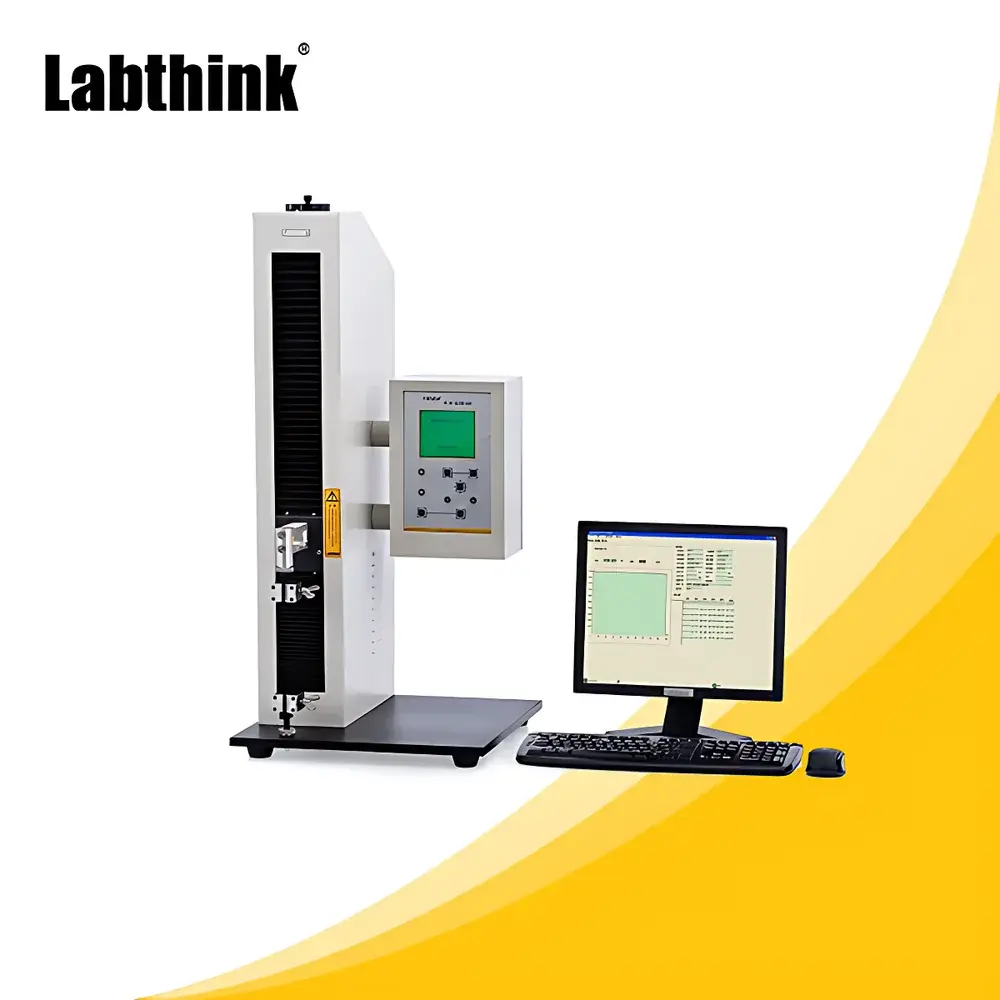
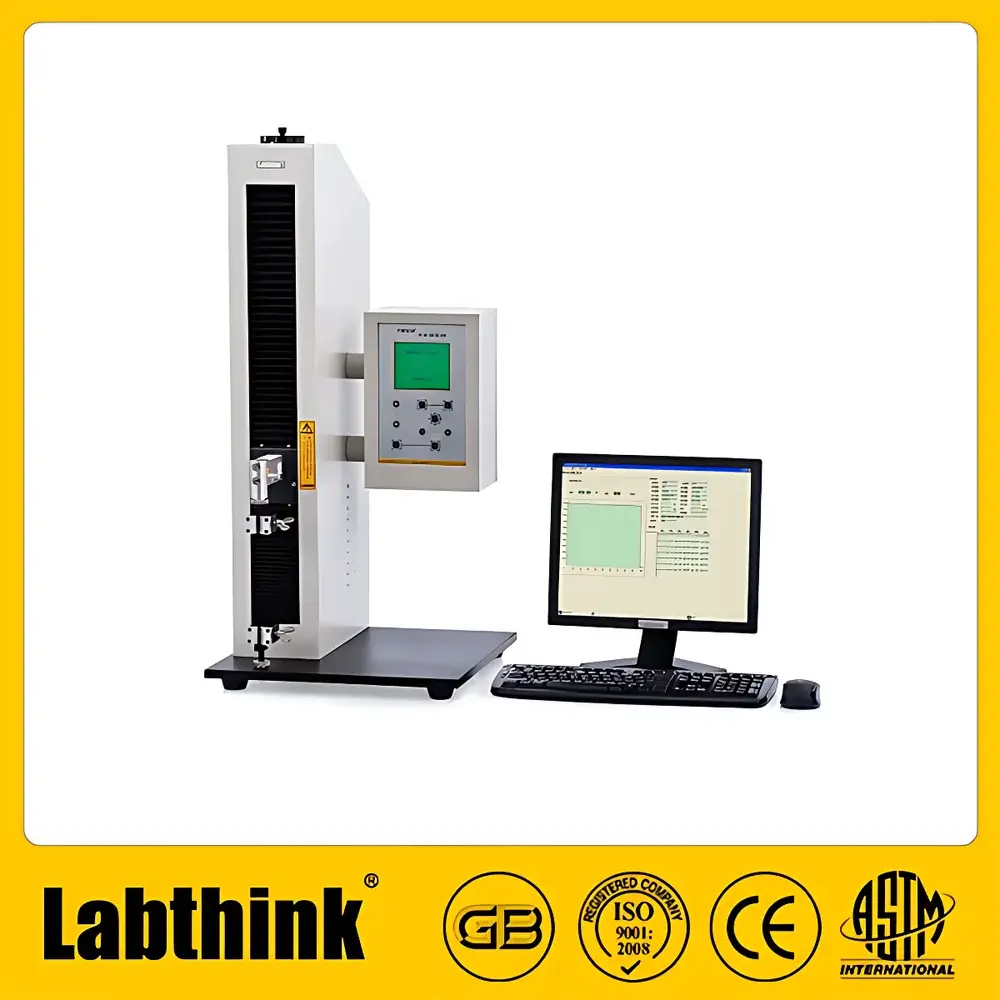
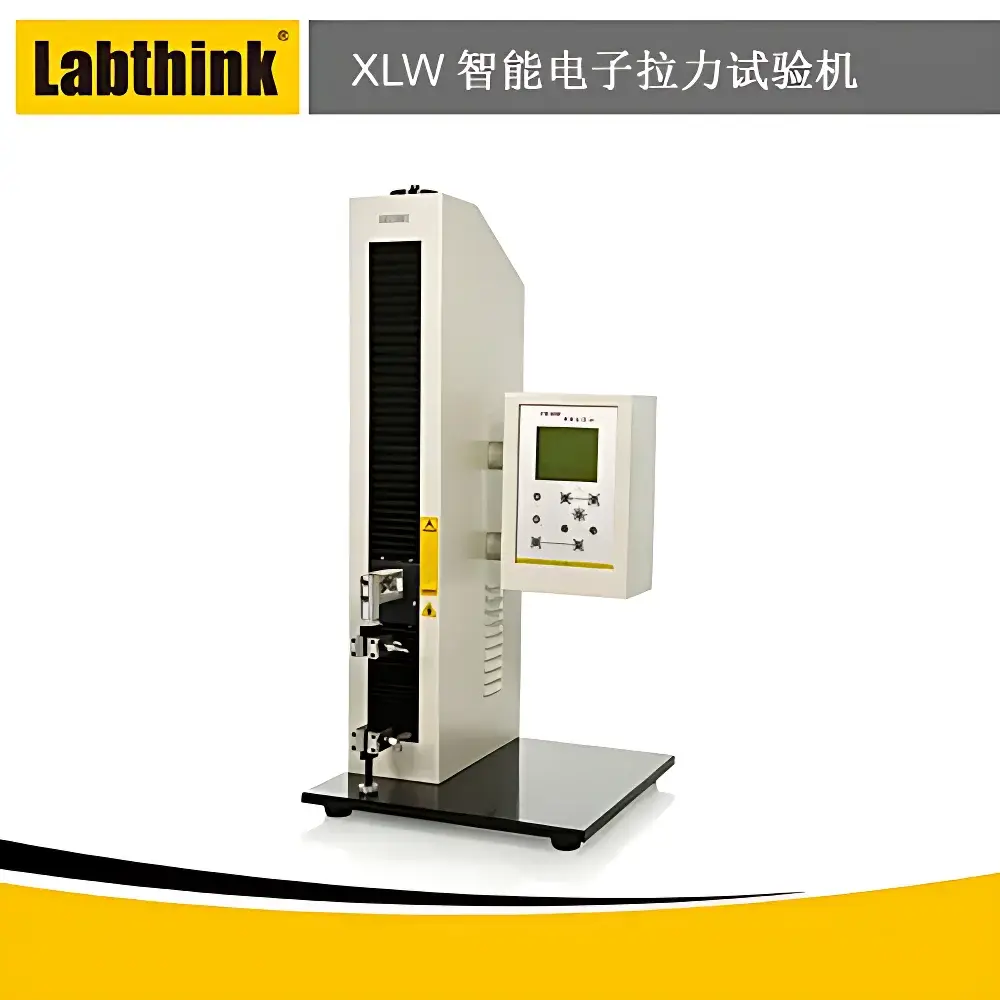
Labthink XLW Intelligent Electronic Tensile Testing Machine
| Brand | Labthink |
|---|---|
| Origin | Shandong, China |
| Manufacturer Type | Manufacturer |
| Product Category | Domestic |
| Model | XLW |
| Instrument Type | Electronic Tensile Testing Machine |
| Maximum Test Load | 1 kN |
| Force Accuracy Class | Class 1 |
| Test Stroke | 600 mm |
| Standard Load Cell | 500 N |
| Optional Load Cells | 30 N, 50 N, 100 N, 200 N, 750 N, 1000 N |
| Test Speeds | 50, 100, 150, 200, 250, 300, 500 mm/min |
| Specimen Width (Standard Clamp) | 30 mm |
| Optional Clamp Width | 50 mm |
| Power Supply | 220 VAC 50 Hz / 120 VAC 60 Hz |
| Net Weight | 65 kg |
| Dimensions (L×W×H) | 450 × 450 × 980 mm |
Overview
The Labthink XLW Intelligent Electronic Tensile Testing Machine is a precision-engineered universal testing system designed for the mechanical characterization of thin, flexible materials commonly used in packaging, medical device assembly, and functional film manufacturing. Operating on the fundamental principle of uniaxial tensile loading—where a specimen is clamped between two parallel grips and subjected to controlled, linear displacement—the XLW captures real-time force and displacement data via a high-stability load cell mounted on the moving crosshead and an integrated linear displacement transducer. This architecture enables accurate derivation of key mechanical parameters including tensile strength, elongation at break, Young’s modulus, tear resistance, peel adhesion, heat seal strength, puncture force, and low-speed unwind torque. The system complies with core international test methodologies governing soft material mechanics, making it suitable for routine quality control, R&D validation, and regulatory-compliant physical property documentation.
Key Features
- Class 1 force accuracy per ISO 7500-1 and ASTM E4, ensuring metrological traceability for critical QC applications
- Seven pre-programmed test modes: tensile, peel, tear, heat seal, shear, puncture, and unwind—each with dedicated algorithmic evaluation logic
- Modular load cell configuration: standard 500 N sensor with optional ranges from 30 N to 1000 N to accommodate ultra-thin films (e.g., <12 µm PET) or reinforced laminates
- Seven selectable crosshead speeds (50–500 mm/min), calibrated per ISO 527-1 and ASTM D882, supporting both quasi-static and dynamic-rate testing protocols
- Microprocessor-based control with PVC membrane keypad, large LCD display, and intuitive menu navigation—designed for operation in production lab environments without PC dependency
- Integrated safety architecture: mechanical limit switches, overload cutoff, automatic return-to-start, and power-loss memory retention for uninterrupted test continuity
Sample Compatibility & Compliance
The XLW accommodates a broad spectrum of planar, flexible substrates—including BOPP, PET, PE, CPP, AL foil laminates, medical-grade pressure-sensitive adhesives, nonwovens, release liners, and battery separator membranes. Its standardized 30 mm clamp width (with 50 mm option) aligns with specimen dimensions specified in ISO 37, ASTM D882, GB/T 1040.2, and ASTM F88. The instrument supports compliance workflows required under ISO/IEC 17025-accredited laboratories, with full audit trail capability when paired with Lystem™ Laboratory Data Management System. All test routines adhere to documented procedures referenced in FDA-regulated packaging validation (e.g., 21 CFR Part 11–compliant data handling via optional software modules), USP guidance on container closure integrity, and GMP-aligned physical testing SOPs.
Software & Data Management
The proprietary XLW control and analysis software provides comprehensive post-test functionality: group statistical reporting (mean, SD, CV%), overlay of multiple stress–strain curves for comparative analysis, elastic modulus calculation using initial linear slope regression, customizable report templates (PDF/CSV), and full parameter logging with timestamped metadata. Raw data export is supported via RS232 serial interface; optional USB-to-RS232 adapters enable legacy PC integration. When deployed with Lystem™, the system contributes to centralized test result repositories, enabling role-based access control, electronic signature enforcement, version-controlled method storage, and automated report generation compliant with GLP and internal QA documentation standards.
Applications
- Quantification of tensile strength and elongation of KOP (ketone-based oriented polypropylene) and other high-barrier packaging films during shelf-life stability studies
- Validation of heat seal integrity for flexible pouches used in sterile medical device packaging per ASTM F88 and ISO 11607-2
- Peel force assessment of protective films applied to optical displays or semiconductor wafers (ASTM D3330)
- Adhesive bond strength evaluation of transdermal patch backing layers and liner release forces (ASTM D1938, GB/T 2792)
- Mechanical screening of lithium-ion battery separator membranes under dry and humidified conditions (GB/T 17200, ASTM D882 modified)
- Quality conformance testing of food-grade cling films and vacuum packaging materials against GB/T 1040.3 and JIS P8113
FAQ
What standards does the XLW machine support for tensile testing of plastic films?
It fully supports ISO 37, ASTM D882, GB/T 1040.1–1040.5, GB/T 12914, and ISO 527 series for tensile property determination.
Can the XLW perform peel testing on pressure-sensitive adhesives?
Yes—its dedicated peel mode implements 90° and 180° configurations per ASTM D3330 and GB/T 2790, with configurable peel angle fixtures available as accessories.
Is the system compatible with 21 CFR Part 11 requirements?
When operated with validated Lystem™ software and configured user authentication, electronic signatures, and audit trail settings, it meets foundational Part 11 expectations for regulated environments.
What is the maximum specimen thickness the standard clamps can accommodate?
The manual wedge-action clamps accept specimens up to 2.5 mm thick; custom pneumatic or roller-type fixtures are available for thicker composites or textured surfaces.
Does the XLW require annual calibration certification?
Yes—Labthink recommends traceable calibration every 12 months using NIST-traceable reference load cells and displacement standards, consistent with ISO/IEC 17025 Clause 6.5.



