
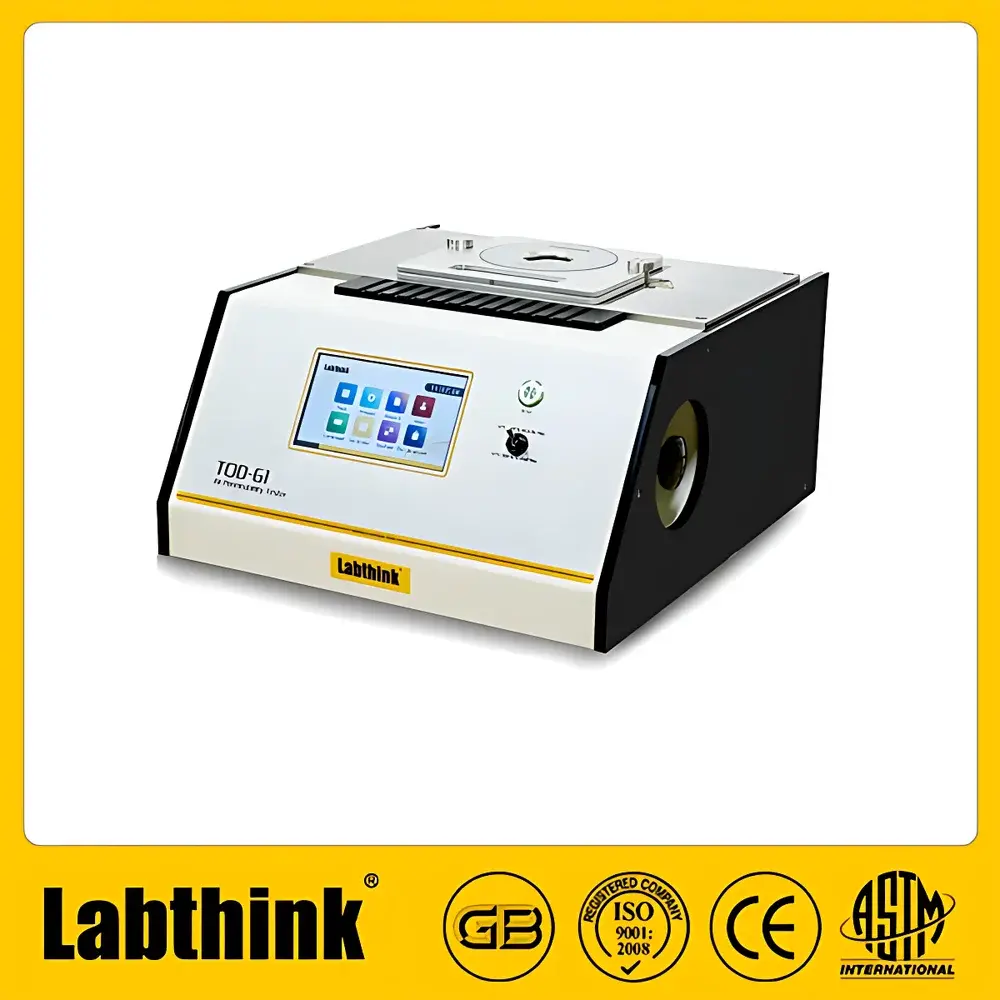
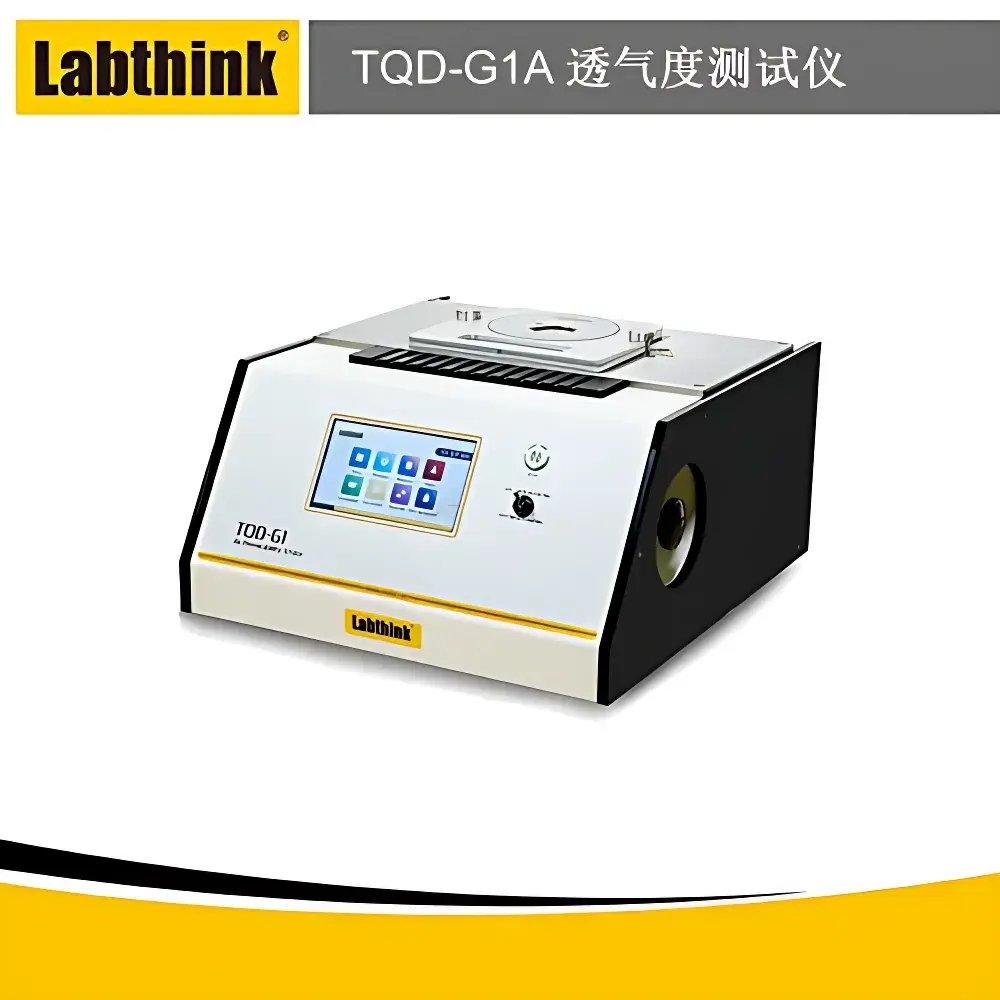
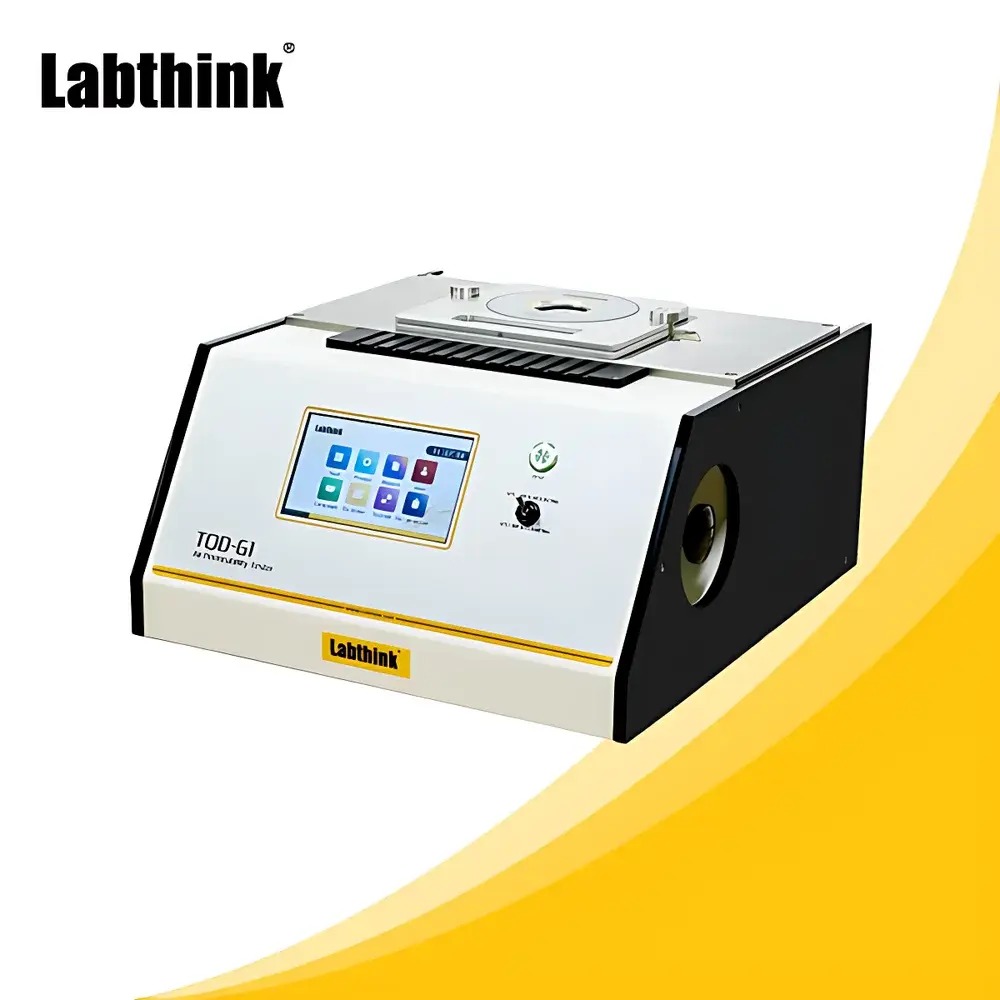
Labthink TQD-G1A Air Permeability Tester for Nonwovens and Fabrics
| Brand | Labthink |
|---|---|
| Origin | Shandong, China |
| Manufacturer Type | Direct Manufacturer |
| Country of Origin | China |
| Model | TQD-G1A |
| Price Range | USD 14,000 – 42,000 |
| Pressure Drop Range | 0–1000 Pa |
| Pressure Resolution | 0.1 Pa |
| Pressure Accuracy | ±0.25% FS |
| Air Flow Range | 0–30 L/min |
| Flow Resolution | 0.1 L/min |
| Flow Accuracy | ±2% FS |
| Test Area | 20 cm² (standard, customizable) |
| Sample Size | 5 cm × 5 cm |
| Max Sample Thickness | 1 mm |
| Gas Supply | Clean compressed air (user-supplied, ≥550 kPa, >120 L/min) |
| Power | 120 VAC ±10% 60 Hz / 220 VAC ±10% 50 Hz |
| Dimensions (W×D×H) | 300 × 460 × 520 mm |
| Net Weight | 25 kg |
| Interface | RS232 |
| Display | 7″ industrial color touchscreen |
| Compliance Standards | ISO 9237, ISO 4638, ISO 5636, GB/T 5453, GB/T 10655, ASTM D737, TAPPI T460, JIS P8117 |
Overview
The Labthink TQD-G1A Air Permeability Tester is a precision-engineered instrument designed for quantitative evaluation of air permeability and airflow resistance in planar porous materials. It operates on two standardized measurement principles—constant-flow (Method A) and constant-pressure (Method B)—as defined in ISO 9237 and ASTM D737. In Method A, a regulated volumetric airflow is forced vertically through a fixed test area; the resulting pressure differential across the specimen is measured to calculate airflow resistance (Pa·s/m). In Method B, a preset pressure differential is applied, and the volumetric airflow rate through the same test area is quantified to derive permeability (µm² or L/m²·s·Pa), enabling direct comparison across material classes. The system employs high-stability, traceable electronic pressure and flow sensors calibrated to NIST-traceable references, ensuring metrological integrity for quality control, R&D, and regulatory documentation.
Key Features
- Dual-mode operation: Select between constant-flow (Method A) and constant-pressure (Method B) testing per ISO 9237 and ASTM D737 protocols.
- High-fidelity sensing: Integrated piezoresistive pressure transducers (0–1000 Pa, 0.1 Pa resolution, ±0.25% FS accuracy) and thermal mass flow sensors (0–30 L/min, 0.1 L/min resolution, ±2% FS accuracy).
- Stable pneumatic architecture: Built-in oil-free vacuum pump and pressure-regulated air supply path ensure laminar, pulse-free airflow during extended test cycles.
- Repeatable sample handling: Pneumatically actuated clamping system applies uniform compressive force (±2% variation) across the 20 cm² test area, minimizing edge leakage and operator-induced variability.
- Industrial HMI: 7″ capacitive touchscreen with embedded real-time OS supports multilingual UI (English, Chinese, Spanish, French), calendar-based test logging, and three-tier user permission management (Operator, Supervisor, Administrator).
- Expandable connectivity: Standard RS232 interface enables bidirectional communication with external PCs; optional Labthink PermeaSoft™ software provides automated report generation, statistical process control (SPC) charts, and audit-trail-compliant data archiving per FDA 21 CFR Part 11 requirements.
Sample Compatibility & Compliance
The TQD-G1A accommodates rigid and flexible sheet materials up to 1 mm thickness and 5 cm × 5 cm nominal dimensions. Validated applications include nonwovens (spunbond, meltblown, needlepunched), woven and knitted textiles, automotive interior substrates (PU foam, PVC, synthetic leather), filtration media, medical barrier fabrics, disposable face masks (per ISO 13485 and EN 14683 breathability assessment), paperboard, and technical felts. All test procedures align with internationally recognized standards—including ISO 9237 (textiles), ISO 4638 (paper), ISO 5636 (paper and board), ASTM D737 (fabrics), TAPPI T460 (paper), and JIS P8117 (Japanese industrial standard)—ensuring cross-laboratory reproducibility and regulatory acceptability in GLP- and GMP-aligned environments.
Software & Data Management
When paired with optional PermeaSoft™ v3.x, the TQD-G1A supports full digital workflow integration. Software features include method templates preconfigured for ISO/ASTM test modes, auto-calibration verification logs, configurable pass/fail thresholds, export to CSV/PDF/XLSX, and electronic signature-enabled report finalization. Audit trails record all user actions—including parameter changes, test starts/stops, and data exports—with timestamps and operator IDs. Data encryption and role-based access controls meet requirements for ISO/IEC 17025 accreditation and pharmaceutical quality systems operating under Annex 11 and 21 CFR Part 11.
Applications
Primary use cases span quality assurance in automotive interiors (e.g., seat fabric breathability, headliner airflow resistance), medical device manufacturing (surgical gowns, mask filtration layers), hygiene product development (diaper coverstock, feminine care topsheets), and packaging substrate validation (breathable lidding films). Secondary applications include R&D screening of novel porous polymers, validation of coating uniformity on nonwovens, and comparative benchmarking of membrane hydrophobicity/hydrophilicity via normalized airflow metrics.
FAQ
What compressed air specifications are required for reliable operation?
Clean, oil-free compressed air at ≥550 kPa (79.7 PSI) supply pressure and ≥120 L/min free-air delivery is mandatory. A dedicated refrigerated dryer and 0.01 µm particulate filter are recommended upstream.
Can test area be modified beyond the standard 20 cm²?
Yes. Custom test heads with 5 cm², 10 cm², or 50 cm² apertures are available as factory-configured options, with recalibrated sensor ranges and updated firmware mapping.
Is the instrument suitable for testing layered composites?
Yes—provided total thickness remains ≤1 mm and interlayer delamination does not occur under clamping pressure. Layered specimens must be tested as a single unit without adhesive interference.
Does the system support automated batch testing?
With PermeaSoft™ and optional barcode scanner integration, up to 99 samples can be queued, identified, and tested sequentially with automatic result annotation and folder-based archiving.
How is calibration traceability maintained?
Labthink provides NIST-traceable calibration certificates for pressure and flow sensors upon installation, with annual recalibration services available through accredited third-party labs. Internal verification routines run at startup and every 24 hours.




