
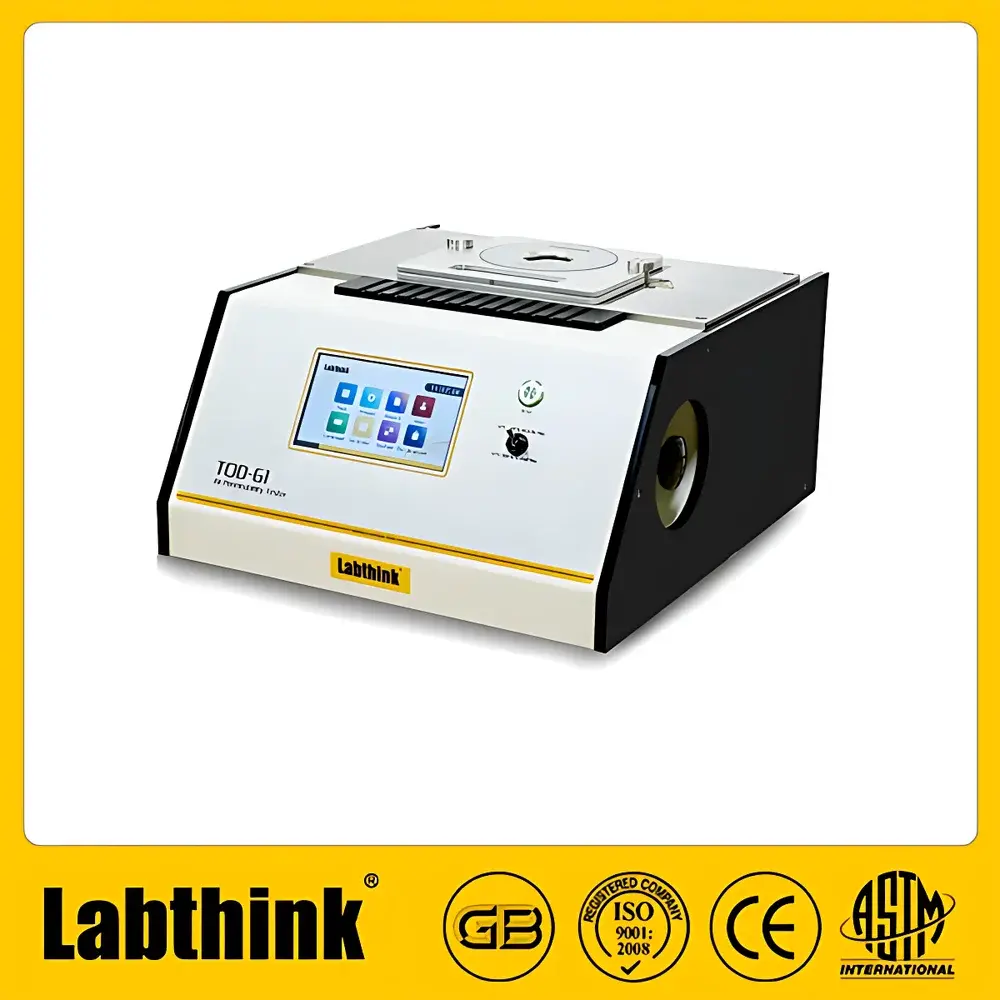
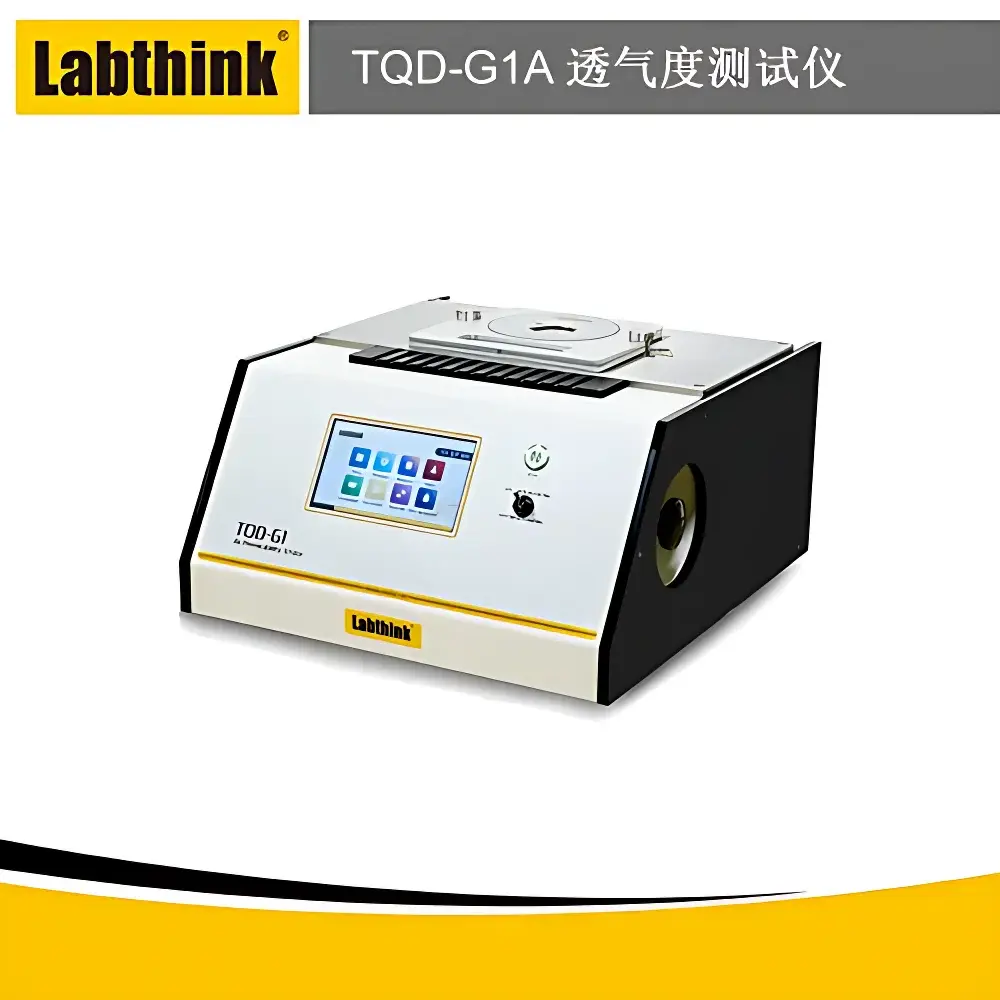
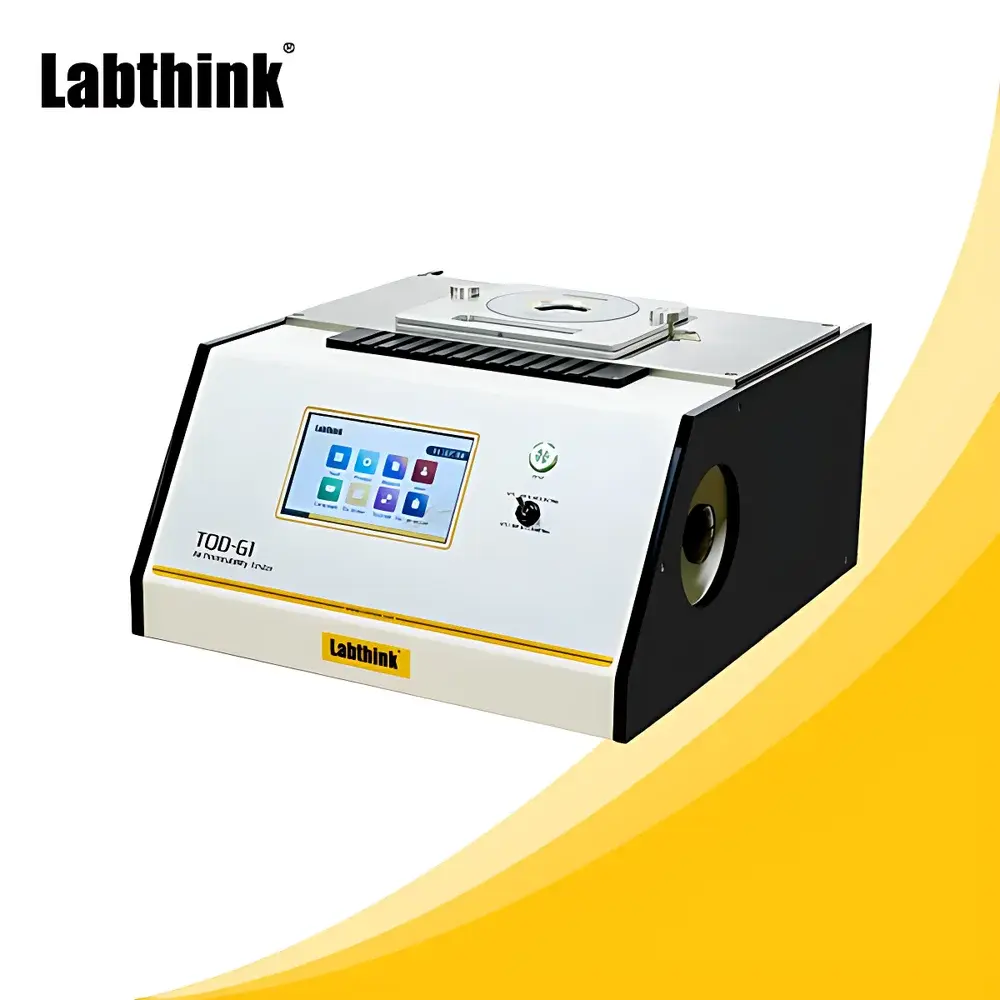
Labthink TQD-G1A Air Permeability Tester for Nonwovens and Textiles
| Brand | Labthink |
|---|---|
| Origin | Shandong, China |
| Manufacturer Type | Direct Manufacturer |
| Model | TQD-G1A |
| Pressure Differential Range | 0–1000 Pa |
| Pressure Resolution | 0.1 Pa |
| Pressure Accuracy | ±0.25% FS |
| Flow Rate Range | 0–30 L/min |
| Flow Resolution | 0.1 L/min |
| Flow Accuracy | ±2% FS |
| Test Area | 20 cm² (standard, customizable) |
| Sample Size | 5 cm × 5 cm |
| Max Sample Thickness | 1 mm |
| Gas Supply | Clean compressed air (user-supplied, ≥550 kPa, >120 L/min) |
| Power Supply | 120 VAC ±10%, 60 Hz / 220 VAC ±10%, 50 Hz (selectable) |
| Dimensions (W×D×H) | 300 × 460 × 520 mm |
| Net Weight | 25 kg |
Overview
The Labthink TQD-G1A Air Permeability Tester is an engineered precision instrument designed to quantify the resistance of planar porous materials to airflow under controlled differential pressure or constant flow conditions. It operates in strict accordance with established international test methodologies—including ISO 9237 (determining air permeability of textile fabrics), ISO 4638 (air permeability of paper and board), ASTM D737 (air permeability of textile fabrics), and GB/T 5453 (Chinese national standard for textile air permeability)—making it suitable for R&D, quality control, and regulatory compliance laboratories across automotive, medical, packaging, and textile sectors. The instrument implements two standardized measurement modes: Method A (constant flow, variable pressure drop) for calculating air resistance (Pa·s/m) and Method B (constant pressure differential, variable flow rate) for determining air permeability (mm/s or L/m²·s). Its dual-mode architecture ensures traceable, repeatable data generation essential for material specification validation and process optimization.
Key Features
- Dual-test methodology support: Selectable constant-flow (Method A) or constant-pressure (Method B) operation via intuitive touchscreen interface
- High-fidelity sensing system: Integrated high-stability differential pressure transducers (0–1000 Pa, 0.1 Pa resolution, ±0.25% FS accuracy) and mass flow sensors (0–30 L/min, 0.1 L/min resolution, ±2% FS accuracy)
- Automated pneumatic clamping: Uniform, repeatable sample fixation without manual torque variation—critical for minimizing operator-induced variability in thin or compressible substrates
- Self-contained vacuum-assisted air management: Imported maintenance-free vacuum pump ensures stable, pulse-free airflow during transient and steady-state measurements
- Industrial-grade 7-inch color touchscreen HMI: Desktop OS with built-in calendar, multi-language UI (English, Chinese, Spanish, French), and role-based access control (administrator, technician, operator)
- Modular connectivity: Standard RS-232 port for external PC communication; optional Labthink proprietary software enables automated report generation, audit trail logging, and 21 CFR Part 11-compliant electronic signatures
Sample Compatibility & Compliance
The TQD-G1A accommodates a broad spectrum of flexible, semi-rigid, and low-density porous media, including nonwoven fabrics, automotive interior trim (PVC, PU foam, synthetic leather), technical textiles, filtration membranes, paper products (tissue, kraft, filter paper), medical face masks (for differential pressure and breathability assessment per ISO 13485 and ASTM F2100), carpets, and elastomeric foams. All testing adheres to defined specimen geometry: standard test area of 20 cm² (5 cm × 5 cm), maximum thickness 1 mm, and flat, non-curling surface requirements per ISO 9237 Annex A. The instrument’s mechanical design conforms to IEC 61000-6-2 (immunity) and IEC 61000-6-3 (emission) standards. Calibration procedures follow ISO/IEC 17025 guidelines, and measurement uncertainty budgets are documented for GLP/GMP-aligned validation protocols.
Software & Data Management
When paired with optional Labthink PermeaSoft™ v3.x, the TQD-G1A supports full lifecycle data governance. The software provides real-time graphical display of pressure vs. time and flow vs. time curves, automatic calculation of derived parameters (e.g., air resistance, permeability coefficient, K value per Darcy’s law), and export to CSV, PDF, or XML formats. Audit trails record user actions, method changes, calibration events, and result modifications with timestamps and operator IDs—meeting FDA 21 CFR Part 11 requirements for electronic records and signatures. Data archiving supports long-term retention with configurable backup intervals and encrypted local storage. Integration with LIMS environments is achievable via ASCII-based RS-232 command protocol.
Applications
- Automotive interiors: Quantifying airflow resistance of headliner substrates, door panel laminates, and seat cushioning materials to ensure cabin ventilation performance and acoustic damping targets
- Medical PPE: Evaluating pressure drop across surgical mask layers and respirator filter media at specified flow rates (e.g., 8 L/min for surgical masks, 30 L/min for N95-equivalents)
- Hygiene product development: Optimizing breathability of diaper backsheets, feminine care topsheets, and adult incontinence barriers
- Paper & packaging: Measuring porosity of cigarette paper, tea bag filter media, and barrier-coated food packaging substrates
- Technical textiles: Validating air permeability specifications for geotextiles, roofing membranes, and protective workwear fabrics per ISO 11058 and EN 13758
FAQ
What standards does the TQD-G1A directly support?
It natively implements test logic and reporting templates for ISO 9237, ASTM D737, GB/T 5453, ISO 4638, TAPPI T460, JIS P8117, and ISO 13485-related breathability assessments.
Is compressed air supply included with the instrument?
No—the unit requires externally supplied clean, oil-free compressed air at ≥550 kPa and >120 L/min flow capacity. A dedicated lab-grade air compressor is recommended as an optional accessory.
Can test area be modified beyond the standard 20 cm²?
Yes—custom test heads with alternative orifices (e.g., 5 cm², 100 cm²) are available upon request to accommodate specialized material geometries or industry-specific protocols.
Does the system support GLP-compliant calibration documentation?
Yes—calibration certificates traceable to NIST or CNAS-accredited laboratories are provided with each instrument, and calibration intervals are configurable within the software audit log.
What safety features prevent operator exposure during testing?
The pneumatic clamping mechanism eliminates manual screw tightening; the sealed test chamber and interlocked lid switch prevent accidental exposure to pressurized airflow during operation.






