
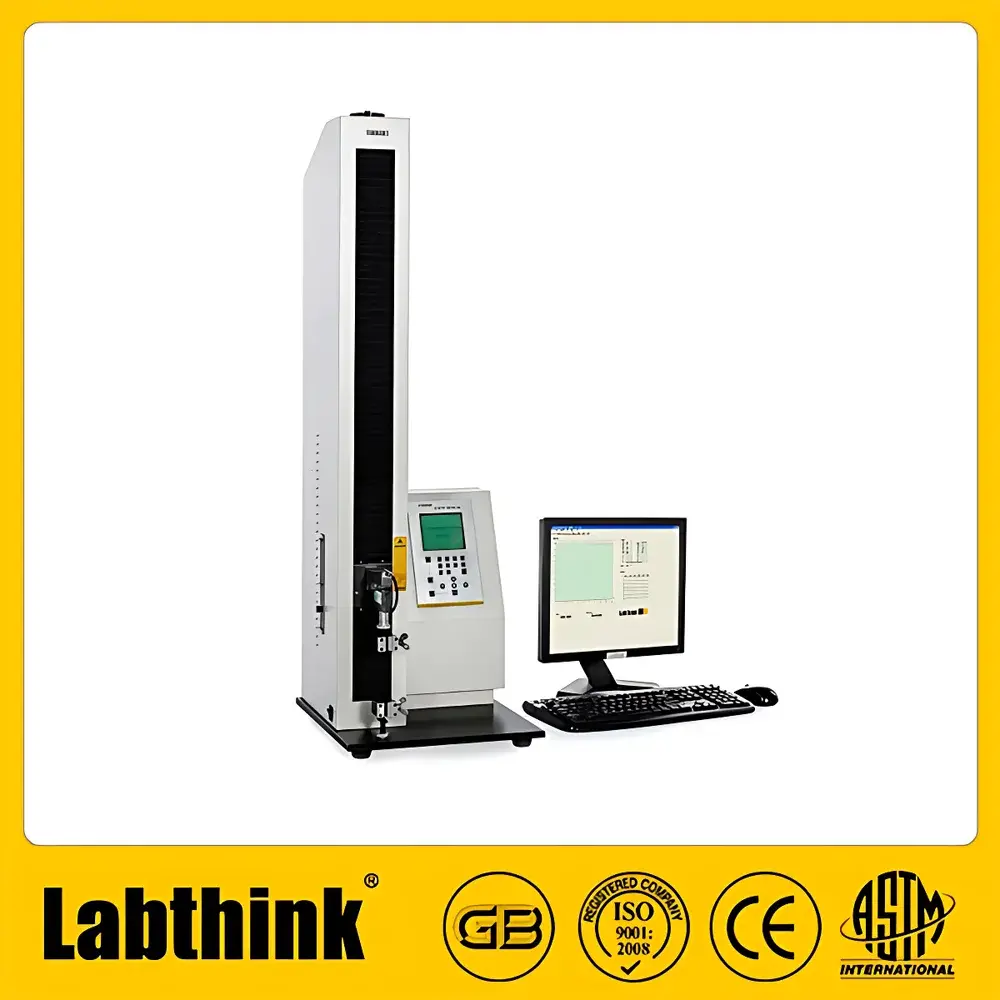
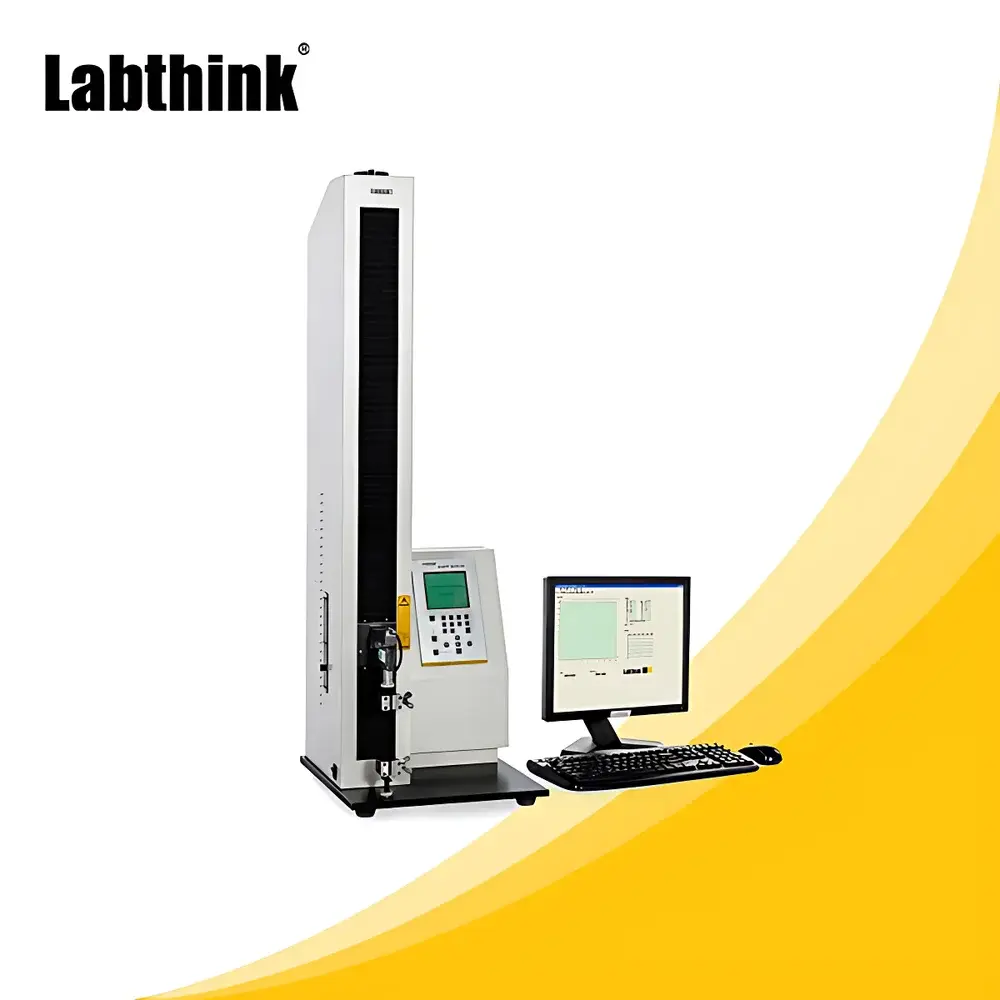
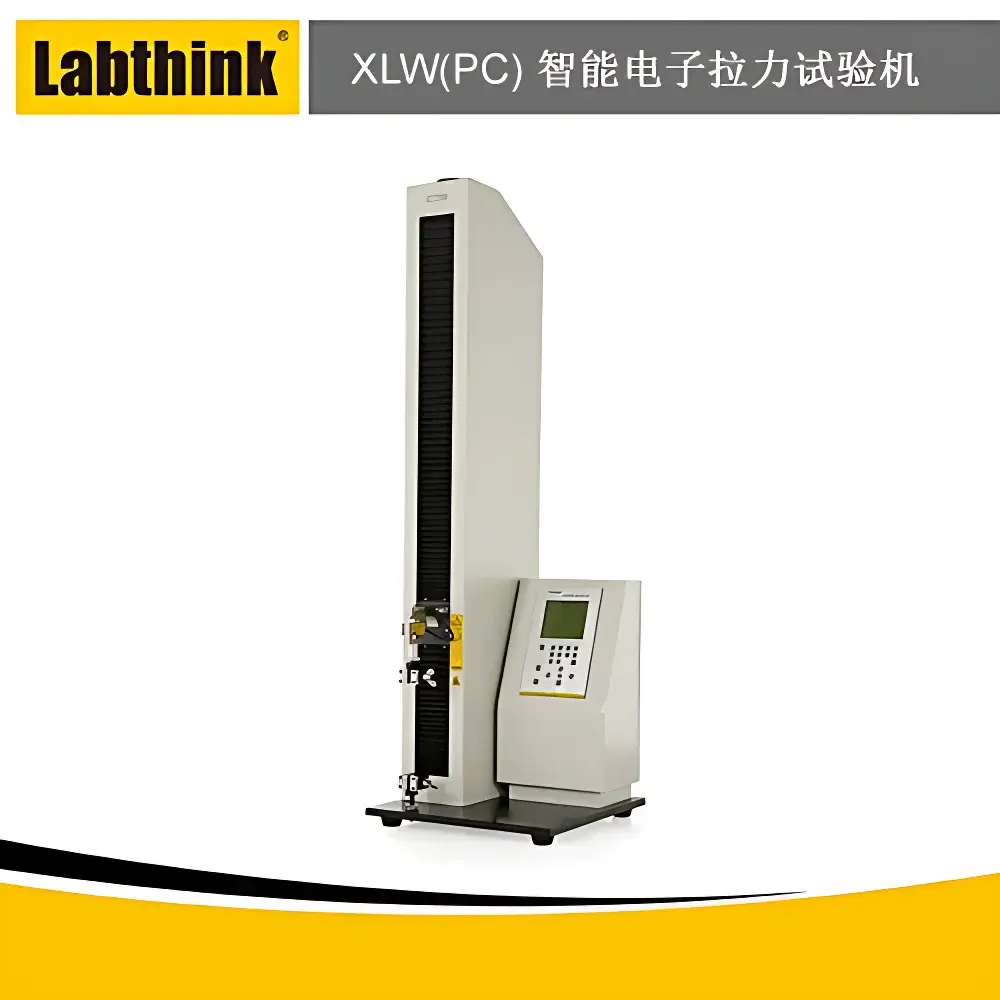
Labthink XLW(PC) Intelligent Electronic Tensile Testing Machine
| Brand | Labthink |
|---|---|
| Model | XLW(PC) |
| Type | Electronic Tensile Testing Machine |
| Origin | Shandong, China |
| Manufacturer | Labthink Instruments Co., Ltd. |
| Test Stroke | 1000 mm |
| Accuracy Class | 0.5 |
| Force Sensor Options | 50 N, 100 N, 250 N (standard: 500 N), 750 N, 1000 N (customizable) |
| Test Speeds | 50, 100, 150, 200, 250, 300, 500 mm/min |
| Sample Width | 30 mm (standard fixture), 50 mm (optional) |
| Dimensions | 450 × 450 × 1410 mm (L×W×H) |
| Weight | 68 kg |
| Power Supply | 220 VAC 50 Hz / 120 VAC 60 Hz |
Overview
The Labthink XLW(PC) Intelligent Electronic Tensile Testing Machine is a precision-engineered universal testing system designed specifically for mechanical property evaluation of flexible packaging materials and thin-film substrates. It operates on the fundamental principle of uniaxial tensile loading in accordance with standardized force-displacement transduction: a specimen is clamped between two grips, one stationary and one motor-driven; during controlled separation, high-resolution load cells (mounted on the moving crosshead) and integrated displacement encoders continuously record force (N) and extension (mm) data at millisecond intervals. These raw signals are processed in real time to compute critical mechanical parameters—including tensile strength (MPa), elongation at break (%), Young’s modulus (MPa), peel adhesion (N/15 mm), tear resistance (N), puncture force (N), heat seal strength (N), and opening force (N)—all traceable to SI units and internationally recognized calibration protocols.
Key Features
- 0.5-class accuracy per ISO 7500-1 and ASTM E4, ensuring metrological reliability across all force ranges (50–1000 N).
- Seven pre-programmed test modes—tensile, peel, tear, puncture, heat seal, burst, and low-speed unwind—each compliant with dedicated material-specific standards.
- 1000 mm maximum travel stroke, enabling full characterization of highly extensible polymers, elastomeric films, and laminated structures without premature crosshead limitation.
- Seven discrete test speeds (50–500 mm/min), independently selectable per method, supporting both quasi-static and dynamic compliance requirements per ASTM D882 and ISO 37.
- Modular force sensor architecture: standard 500 N transducer with optional upgrades (50 N for micro-thin barrier films; 1000 N for reinforced composites), all factory-calibrated and NIST-traceable.
- Microprocessor-based control unit with PVC membrane keypad, backlit LCD display (128×64 pixels), and intuitive menu navigation—no external PC required for basic operation.
- Comprehensive safety architecture: dual-limit switch protection, overload cutoff (>110% FS), automatic return-to-start post-test, and power-loss position memory.
Sample Compatibility & Compliance
The XLW(PC) accommodates a broad spectrum of soft-material specimens used in food, pharmaceutical, medical device, and electronics packaging industries. Validated substrates include biaxially oriented polypropylene (BOPP), polyethylene terephthalate (PET), aluminum foil laminates, ethylene-vinyl acetate (EVA) coextrusions, silicone-coated release liners, hydrocolloid wound dressings, and metallized polyester films. All test routines adhere strictly to regulatory and consensus standards: ISO 37 (rubber vulcanizates), ISO 1184 (plastic films), ASTM D882 (thin plastic sheeting), ASTM F88 (heat seal strength), ASTM D1938 (tear propagation), GB/T 1040 series (plastics tensile testing), GB/T 2792 (peel adhesion), and QB/T 2358 (plastic film heat seal). The system supports GLP-compliant audit trails when paired with Lystem™ Laboratory Data Management System (LDMS), fulfilling documentation requirements under FDA 21 CFR Part 11 for electronic records and signatures.
Software & Data Management
The embedded firmware enables standalone test execution, while the optional Windows-based Lystem™ software extends analytical capability significantly. It provides real-time curve overlay (up to 12 traces), group statistical reporting (mean, SD, CV%, min/max), pass/fail threshold validation, customizable report templates (PDF/Excel), and automated compliance flagging against user-defined limits. Raw data export is supported in CSV and XML formats for third-party statistical analysis (e.g., JMP, Minitab). Lystem™ integrates seamlessly into enterprise laboratory networks via TCP/IP, enabling centralized data archiving, role-based access control, and synchronized firmware updates—all aligned with ISO/IEC 17025:2017 clause 7.5.2 on data integrity and traceability.
Applications
This instrument serves as a primary quality assurance tool in R&D labs, production QC environments, and contract testing facilities. Typical use cases include: evaluating seal integrity of retort pouches under thermal stress; quantifying delamination resistance in multilayer snack packaging; verifying mechanical stability of child-resistant blister lidding; assessing tensile durability of transdermal patch backing films; validating tear initiation energy for stand-up pouch gussets; measuring peel force consistency of pressure-sensitive labels on HDPE containers; and characterizing puncture resistance of protective medical packaging under simulated transport conditions. Its adaptability to non-standard fixtures (e.g., floating roller grips, dart impact adapters) further extends utility into niche applications such as battery separator tensile mapping and e-textile yarn elongation profiling.
FAQ
What standards does the XLW(PC) support for tensile testing of plastic films?
ASTM D882, ISO 1184, GB/T 1040.3–2006, and ISO 527–3 are fully implemented through dedicated test programs with auto-calculated modulus and strain rate compensation.
Can the system perform simultaneous multi-specimen testing?
No—it is a single-station tester optimized for high repeatability per ISO 1798 and ASTM D3776; however, batch processing is enabled via sequential automated runs with programmable pause intervals.
Is the force sensor calibrated in-house or by an accredited third party?
All transducers ship with a factory calibration certificate traceable to CNAS-accredited reference standards; optional UKAS/NIST-certified recalibration services are available annually.
Does the software meet FDA 21 CFR Part 11 requirements?
Yes—when deployed with Lystem™ LDMS, it delivers full electronic signature enforcement, audit trail logging, and secure user authentication per Part 11 Subpart B.
What maintenance is required to sustain 0.5-class accuracy over time?
Annual verification using certified deadweight standards (Class M1) and linear encoder alignment check; no routine lubrication or mechanical adjustment is needed due to brushless DC drive architecture.



