
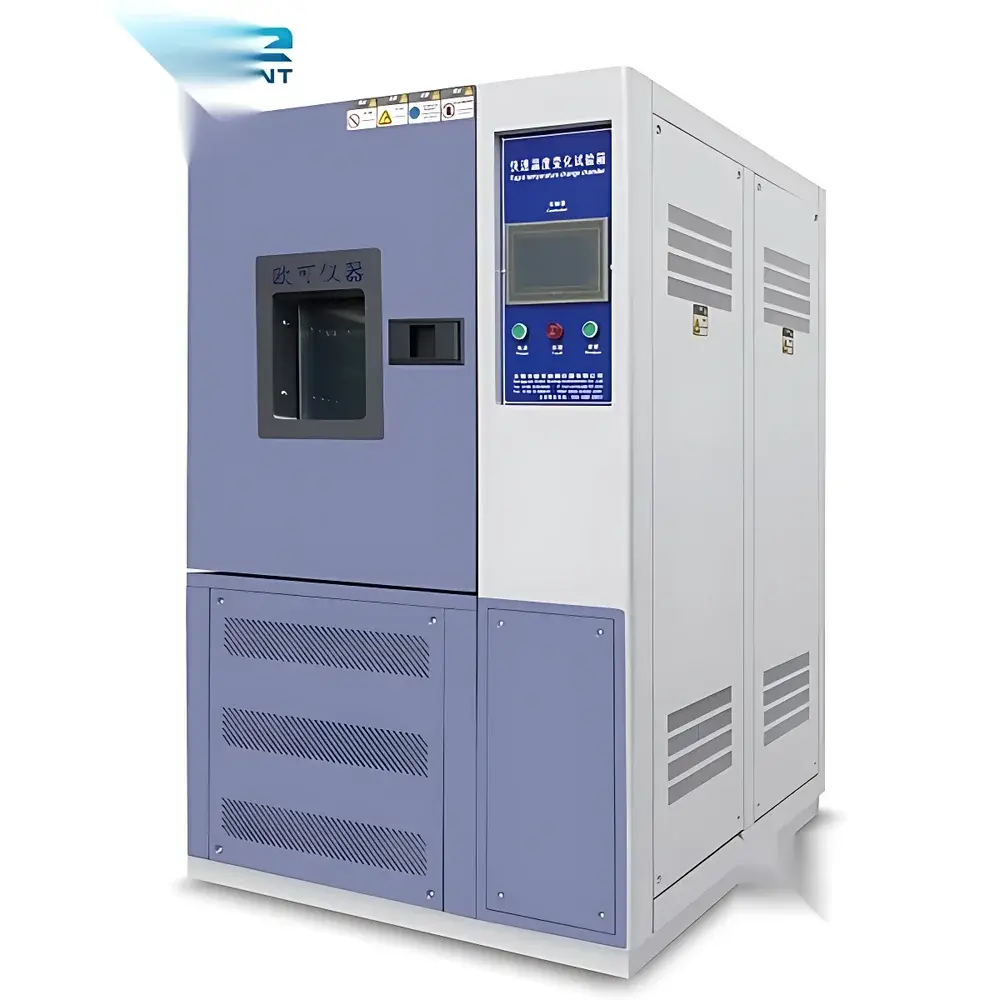
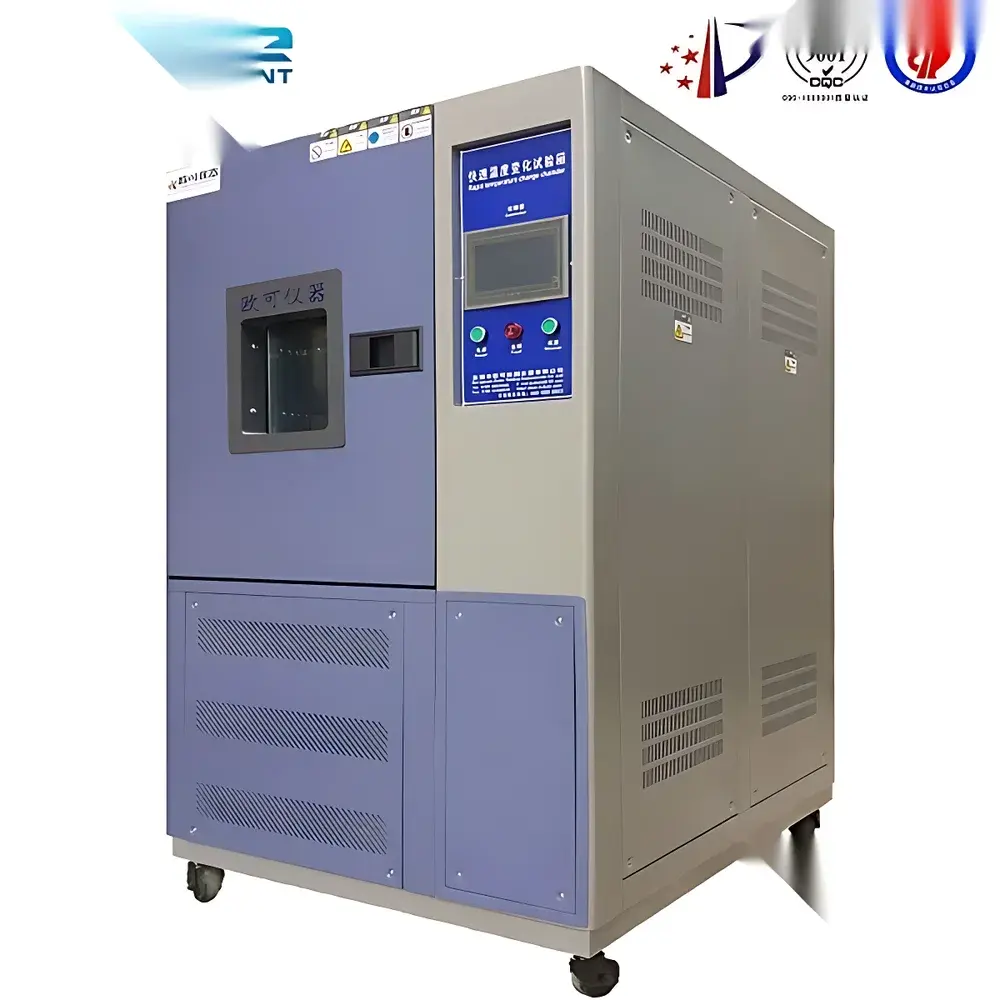
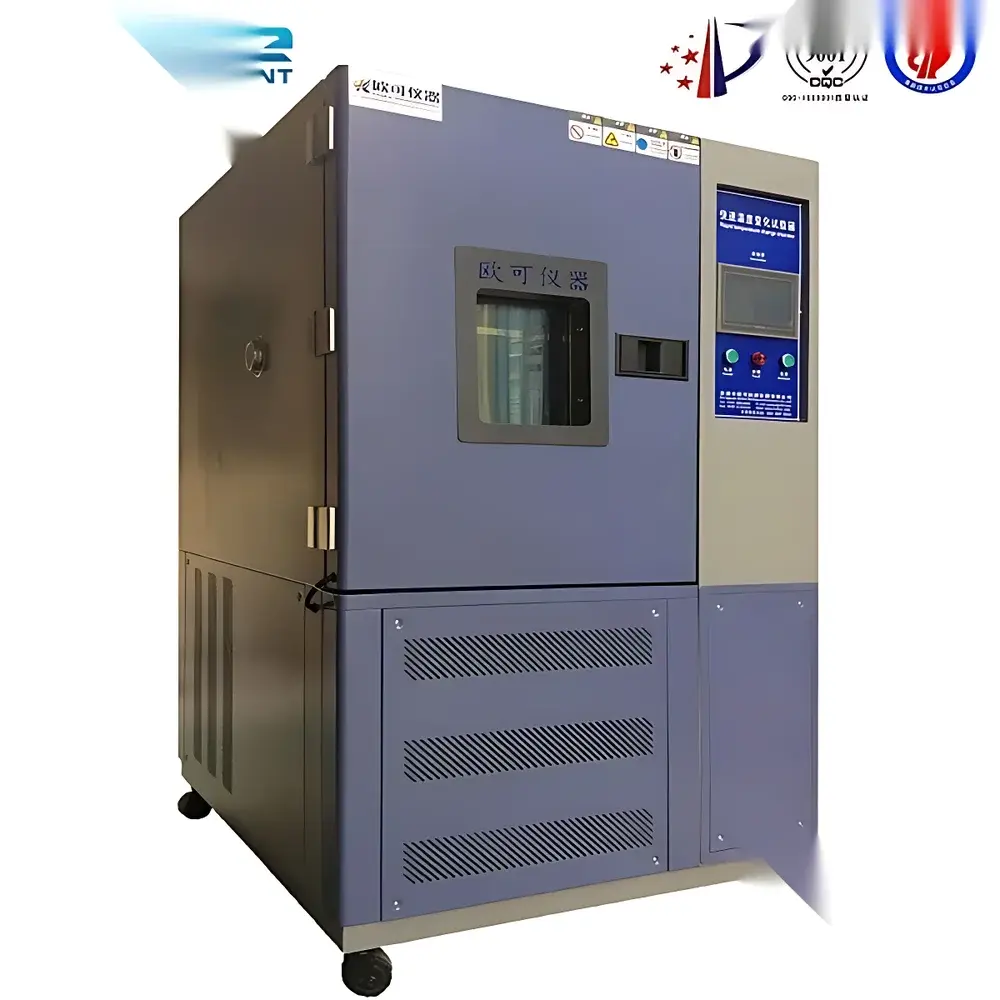
High-Performance Rapid Thermal Cycling Chamber
| Brand | Other Brands |
|---|---|
| Origin | Imported |
| Manufacturer Type | Authorized Distributor |
| Price | USD 2,650 (FOB) |
| Internal Dimensions (W×H×D) | 500×600×500 mm to 1000×1000×1000 mm |
| External Dimensions (W×H×D) | 1750×2250×2350 mm to 2350×2800×3000 mm |
| Temperature Range | −70 °C to +150 °C |
| Humidity Range (optional) | 20–98% RH |
| Rapid Thermal Cycling Range | −45 °C to +85 °C |
| Rapid Thermal Cycling Accuracy | ±3.0 °C |
| Ramp Rates | 5–30 °C/min (linear or non-linear, selectable) |
| Temperature Resolution | 0.1 °C |
| Humidity Resolution | 0.1% RH |
| Temperature Uniformity | ±2.0 °C |
| Humidity Uniformity | ±3.0% RH |
| Temperature Control Accuracy | ±0.5 °C |
| Humidity Control Accuracy | ±2.5% RH |
| Construction | Interior – SUS304 stainless steel |
| Insulation | High-density polyurethane foam (CFC-free, high-temperature resistant) |
| Cooling System | Water-cooled |
| Compressor | Tecumseh (France) or Bitzer (Germany) |
| Power Supply | AC 380 V, 3-phase 5-wire, 50/60 Hz |
| Weight | 950–2300 kg |
Overview
The High-Performance Rapid Thermal Cycling Chamber is an engineered environmental simulation system designed for accelerated reliability testing of electronic components, automotive modules, aerospace subsystems, and advanced materials under dynamically controlled thermal stress. Based on the principle of programmable temperature ramping—where chamber air temperature is precisely elevated or reduced at defined linear or non-linear rates—the system replicates real-world thermal transients encountered during operational startup, power cycling, altitude changes, or extreme ambient exposure. Unlike conventional thermal chambers, this unit delivers rapid transitions between extreme setpoints (e.g., −45 °C ↔ +85 °C) with ramp rates up to 30 °C/min, enabling accelerated life testing (ALT), HALT (Highly Accelerated Life Testing), and qualification per JEDEC JESD22-A104, MIL-STD-810H Method 503.4, and IEC 60068-2-14. Its architecture supports both dry thermal cycling and optional humidity-controlled thermal cycling (20–98% RH), facilitating evaluation of hygrothermal degradation mechanisms in PCB laminates, conformal coatings, solder joints, and polymer encapsulants.
Key Features
- Programmable ramp rate control from 5 to 30 °C/min, with selectable linear or non-linear profiles to emulate realistic thermal gradients
- Dual-zone independent control logic for precise synchronization of temperature and optional humidity during dynamic transitions
- SUS304 stainless steel interior chamber with seamless welds and electro-polished finish—resistant to corrosion, outgassing, and condensation buildup
- Water-cooled refrigeration circuit featuring dual-stage compressors (Tecumseh or Bitzer) and optimized heat exchanger design for stable sub-zero operation down to −70 °C
- High-efficiency polyurethane insulation (≥120 mm thickness) with low thermal conductivity (<0.022 W/m·K) to minimize energy consumption and improve thermal inertia control
- Integrated safety architecture including high/low pressure cutouts, over-temperature/over-humidity interlocks, phase failure detection, and real-time fault logging
- Modular footprint scalability across five standard internal volumes (150 L to 1000 L), each validated for uniformity per IEC 60068-3-5
Sample Compatibility & Compliance
The chamber accommodates test specimens ranging from bare semiconductor die and BGA packages to full automotive ECUs and avionics enclosures. Its open-chamber geometry and optional observation window (tempered glass with anti-fog heater) permit in-situ monitoring of physical deformation, delamination, or solder joint fracture during cycling. All models comply with electromagnetic compatibility (EMC) per EN 61326-1 and electrical safety per IEC 61010-1. For regulated industries, the system supports audit-ready operation when paired with optional data loggers compliant with FDA 21 CFR Part 11 (electronic signatures, audit trail, user access control). Test protocols align with ASTM D5229/D5229M (low-temperature embrittlement), IPC-9701A (interconnect reliability), and ISO 16750-4 (road vehicles—electrical loads). Humidity-enabled variants meet ISO 8502-6 for corrosion assessment under cyclic wet/dry conditions.
Software & Data Management
Equipped with a 10.4-inch color touchscreen HMI running embedded Linux, the controller provides intuitive profile programming—including multi-step ramps, dwells, and conditional branching based on real-time sensor feedback. Optional PC-based software (Windows-compatible) enables remote supervision, automated report generation (PDF/CSV), and integration with MES or PLM systems via Modbus TCP or Ethernet/IP. All temperature and humidity readings are timestamped with millisecond resolution and stored locally on industrial-grade SD card (16 GB, redundant backup). Calibration traceability is maintained to NIST-traceable standards, with annual verification points documented per ISO/IEC 17025 requirements. Audit trails record operator ID, parameter changes, alarm events, and calibration interventions—fully exportable for GLP/GMP compliance reviews.
Applications
- Qualification of IC packaging integrity under thermal shock-induced intermetallic growth and CTE mismatch stress
- Validation of adhesive bond strength in battery module housings subjected to repeated expansion/contraction cycles
- Evaluation of optical lens mount stability in infrared sensors exposed to desert-to-alpine ambient swings
- Accelerated aging of OLED display substrates to quantify moisture ingress and dark spot formation kinetics
- Reliability screening of 5G RF front-end modules operating under burst-mode thermal loading
- Material science research on shape-memory alloys and phase-change composites undergoing reversible martensitic transformation
FAQ
What is the difference between thermal cycling and thermal shock testing?
Thermal cycling applies controlled, gradual temperature transitions (ramp rates ≤30 °C/min) with dwell periods, simulating operational duty cycles. Thermal shock uses near-instantaneous transfers between extreme chambers (typically >60 °C/min), inducing higher mechanical stress. This chamber supports only thermal cycling per IEC 60068-2-14.
Can humidity be added to rapid temperature ramps?
Yes—humidity is available as an optional feature. However, due to thermodynamic constraints, RH control is suspended during active ramping phases and resumes only during dwells to ensure measurement fidelity and prevent condensation-related artifacts.
Is the chamber suitable for testing lithium-ion battery cells?
It meets UN 38.3 Section 4.4 (thermal cycling) requirements when operated within −40 °C to +60 °C range at 15 °C/min max ramp rate. Battery-specific safety interlocks (e.g., voltage monitoring input) must be integrated externally.
How is temperature uniformity verified across the working volume?
Uniformity is validated using 9-point sensor mapping (per IEC 60068-3-5) at three load conditions: empty, 50% load, and full load—with all results documented in the factory acceptance test (FAT) report.
Does the system support custom protocol scripting for complex multi-segment tests?
Yes—the optional PC software includes a script editor supporting conditional logic, variable assignment, and external trigger inputs (TTL/relay), enabling implementation of JEDEC JEP122G or AEC-Q200-compliant test sequences.



