
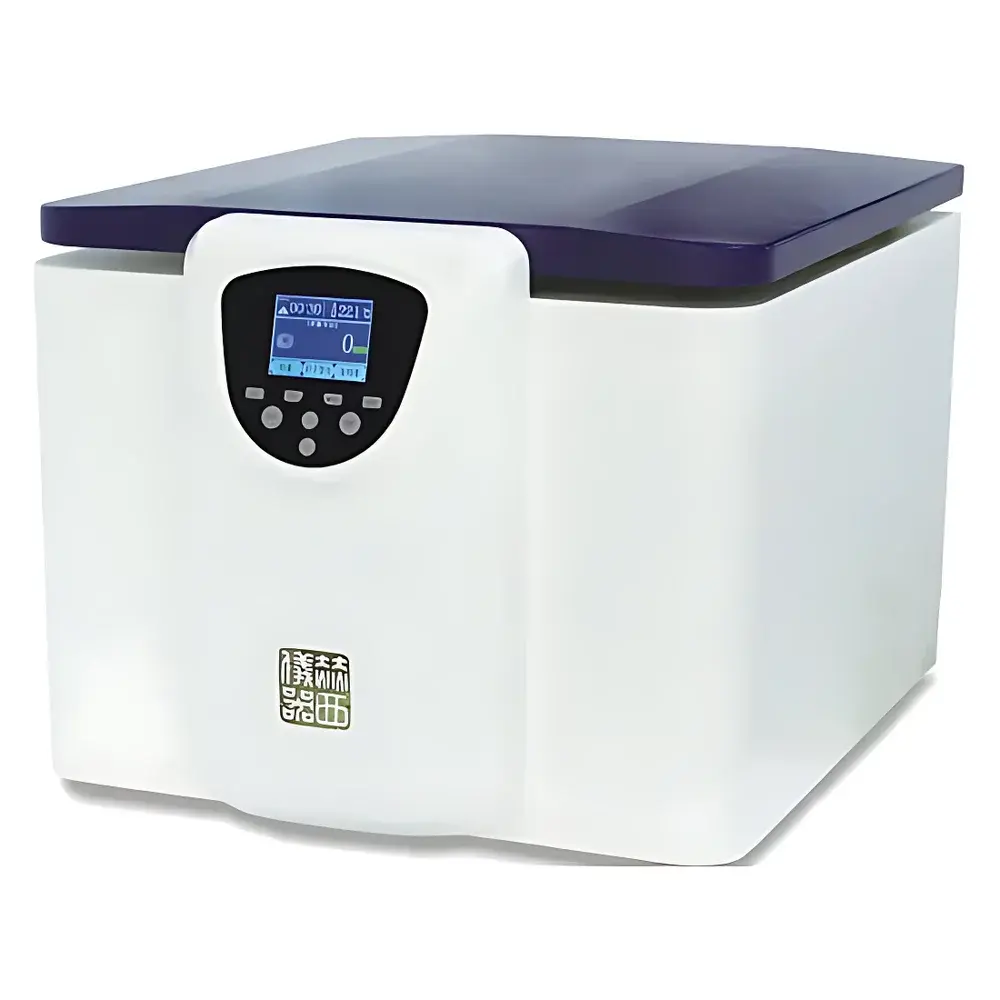
Herxi MBB-DD5 4×2×96-Well Quadrant Microplate Centrifuge
| Brand | Herxi |
|---|---|
| Origin | Hunan, China |
| Model | MBB-DD5 |
| Instrument Type | Benchtop Low-Speed Centrifuge |
| Max Speed | 5000 rpm |
| Max RCF | 4800 ×g |
| Max Capacity | 4 × 500 mL |
| Temperature Range | −20 °C to +40 °C |
| Refrigerant | R404a |
| Dimensions (L×W×H) | 630 × 500 × 420 mm |
| Noise Level | ≤60 dB(A) |
| Power Supply | AC 220 V, 50 Hz |
| Weight | 65 kg |
| Certifications | CFDA Registered, ISO 9001:2015 & ISO 13485:2016 Compliant |
| Rotor Type | Horizontal Microplate Rotor (Quadrant Configuration) |
Overview
The Herxi MBB-DD5 is a purpose-engineered benchtop low-speed centrifuge designed specifically for high-throughput microplate processing in life science and clinical laboratories. It employs horizontal rotor architecture with a unique 4×2×96-well quadrant configuration—capable of simultaneously accommodating four standard 96-well microplates arranged in two stacked layers per position—to enable efficient, uniform sedimentation of cells, beads, or precipitated analytes without cross-well disturbance. Unlike general-purpose centrifuges, the MBB-DD5 integrates precision temperature control (−20 °C to +40 °C), real-time RCF monitoring, and biocompatible sealing to meet the operational rigor required for ELISA, cell-based assays, immunoassays, and nucleic acid purification workflows. Its core mechanical design utilizes a brushless AC motor coupled with a reinforced 304 stainless steel centrifuge chamber and triple-stage damping system, ensuring mechanical stability during extended runs at up to 5000 rpm and 4800 ×g—conditions critical for reproducible pellet formation in sensitive biological samples.
Key Features
- Quadrant-compatible horizontal rotor supporting simultaneous centrifugation of four 96-well plates (2×96 per position), optimized for enzyme-linked immunosorbent assay (ELISA), PCR plate handling, and high-density cell culture applications.
- Intelligent temperature management: R404a refrigerant-based cooling system with pre-cool, hold-at-temperature standby, and auto-defrost functions; programmable setpoint adjustment during active spin cycles.
- Advanced safety architecture: RoHS-compliant silicone gasket-sealed rotor chamber; three-tier mechanical damping; automatic door lock with aviation-grade latching mechanism; real-time detection of imbalance, overspeed, overtemperature, under/over-voltage, and rotor failure.
- TFT-LCD color touchscreen with dual-input mode (touch + physical keys); dedicated RCF display key; live parameter overlay showing both setpoints and actual values; on-the-fly parameter modification without rotor stoppage.
- Multi-language UI support (English, Chinese, Russian, Portuguese); 20 programmable method storage slots; last-run program recall on power-up; 10-step acceleration/deceleration ramp control for shear-sensitive samples.
- CE-marked structural integrity: 304 stainless steel rotor chamber; powder-coated steel housing; triple-layer protective front panel; compliant with IEC 61010-2-020 for laboratory centrifuge safety.
Sample Compatibility & Compliance
The MBB-DD5 accommodates standard ANSI/SLAS-format microplates (including flat-bottom, U-bottom, and V-bottom 96-well plates), as well as compatible deep-well and PCR plates via optional polyamide adapters. Its sealed horizontal rotor design prevents aerosol escape during centrifugation—critical for biosafety Level 2 (BSL-2) environments handling human serum, viral lysates, or antibody-conjugated reagents. The unit carries CFDA registration and manufacturing license for Class II medical devices in China, and conforms to ISO 9001:2015 (quality management) and ISO 13485:2016 (medical device QMS). While not FDA-cleared, its design principles align with CLIA and CAP requirements for centrifugal separation in diagnostic testing, and supports audit-ready documentation through timestamped run logs and parameter traceability.
Software & Data Management
The embedded control firmware records full run metadata—including start/stop timestamps, rotor ID, speed, RCF, temperature, duration, and fault events—in non-volatile memory. All data are exportable via USB interface in CSV format for integration into LIMS or electronic lab notebooks (ELN). Though no cloud connectivity or remote monitoring is provided, the system supports GLP-aligned operation through user-accessible audit trails, password-protected parameter editing, and immutable session logs—features essential for regulated QC/QA environments operating under ISO/IEC 17025 or pharmaceutical GMP guidelines (e.g., USP Analytical Instrument Qualification).
Applications
- ELISA plate washing and post-incubation pelleting of coated beads or antigen-antibody complexes.
- Cell harvesting from suspension cultures in 96-well formats prior to lysis or staining.
- Centrifugal clarification of serum, plasma, or CSF samples in high-throughput screening pipelines.
- Uniform sedimentation of magnetic beads in automated nucleic acid extraction protocols.
- Removal of residual ethanol or isopropanol following precipitation steps in microplate-based DNA/RNA isolation kits.
- Stabilization of enzymatic reaction mixtures prior to optical density (OD) measurement in kinetic assays.
FAQ
What microplate formats does the 4×2×96-well rotor accept?
It accepts standard ANSI/SLAS-compliant 96-well plates (flat, U-, or V-bottom), including commercially available ELISA, cell culture, and PCR plates. Deep-well and 384-well plates require separate adapter kits.
Can the temperature be adjusted while the rotor is spinning?
Yes—the system allows dynamic temperature setpoint modification during active centrifugation without interrupting the run.
Is this centrifuge suitable for BSL-2 applications involving infectious agents?
Yes, when used with the certified airtight rotor seal and proper PPE, it meets containment requirements for low-risk aerosol-generating procedures in BSL-2 labs.
Does the MBB-DD5 support 21 CFR Part 11 compliance?
No—it lacks electronic signature capability and role-based access control; however, its audit trail functionality satisfies basic ALCOA+ data integrity expectations for non-GxP research use.
What maintenance intervals are recommended for long-term reliability?
Rotor inspection every 6 months; refrigerant pressure check annually; calibration verification of speed and temperature sensors every 12 months per ISO/IEC 17025 recommendations.



