
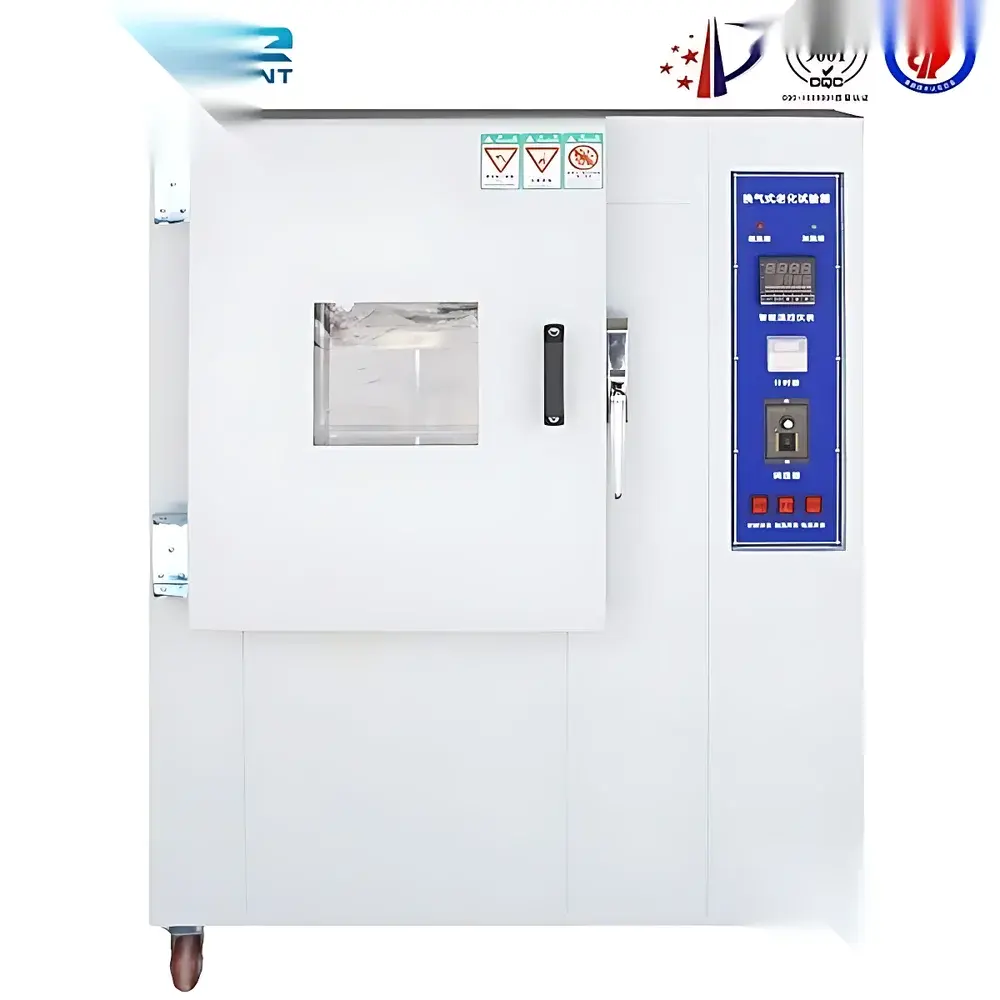
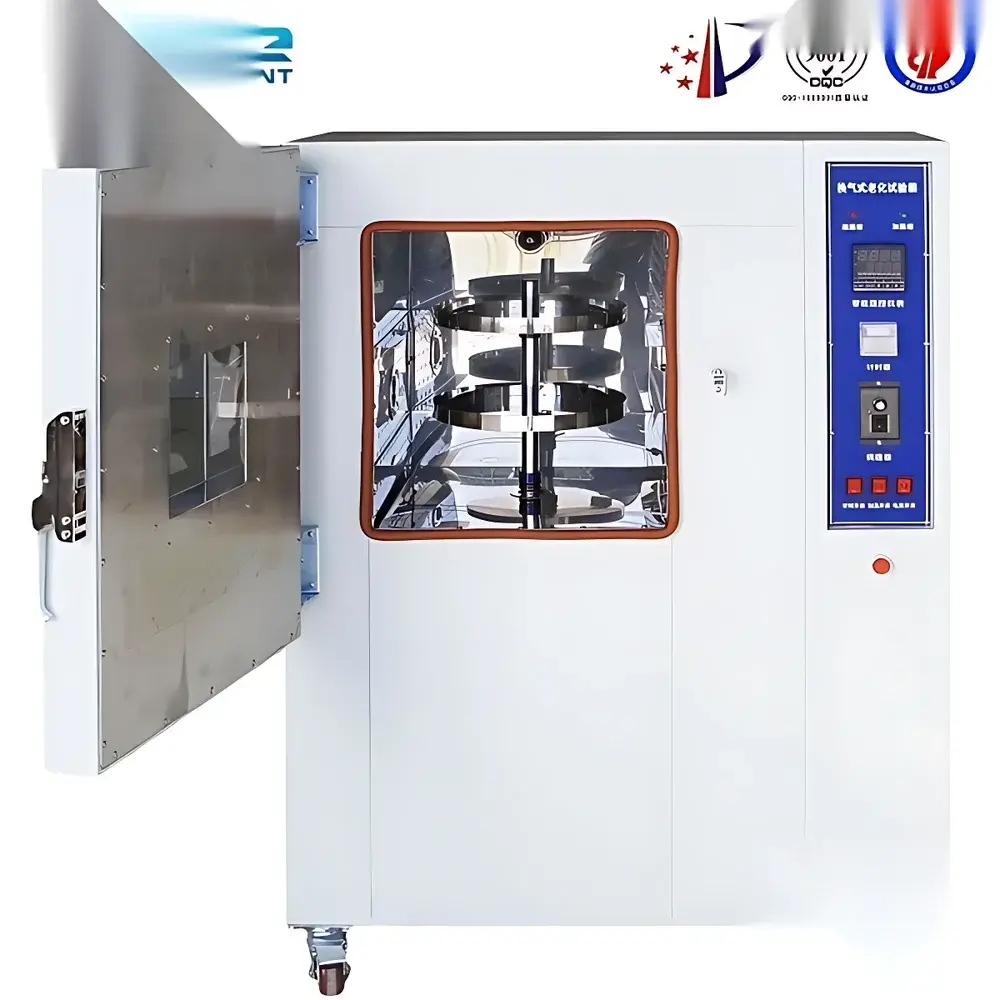
OK-HQ Series Forced-Air Thermal Aging Test Chamber
| Brand | OK Instruments |
|---|---|
| Origin | Imported |
| Manufacturer Type | Authorized Distributor |
| Temperature Range | RT+10°C to 200°C / 300°C |
| Temperature Uniformity | ±2°C |
| Temperature Stability | ±0.5°C |
| Air Exchange Rate | 2–100 cycles/hour |
| Adjustable Air Exchange Time | 1 min – 99 h |
| Internal Dimensions (L×W×H, mm) | 450×450×500 to 800×1000×1000 |
| Power Rating | 4.0–9.0 kW |
| Controller | PID + SSR Microcomputer-Based Digital Controller |
| Temperature Resolution | 0.1°C (setpoint & display) |
| Timer Range | 1–9999 minutes |
| Rotating Turntable Diameter | Φ250–Φ700 mm |
| Compliance | ASTM D5423-09 (Type II), ASTM D5374-93 (2005), UL 1581, GB/T 2423.2, IEC 60068-2-2, JIS C 0068, VDE 0470 |
Overview
The OK-HQ Series Forced-Air Thermal Aging Test Chamber is an engineered environmental test system designed for accelerated thermal aging evaluation of polymeric and elastomeric materials under controlled, ventilated high-temperature conditions. Based on the principle of forced convection with regulated air exchange, it replicates long-term thermal degradation mechanisms—such as oxidative chain scission, crosslinking, and volatilization—by maintaining precise temperature profiles while continuously replenishing chamber atmosphere at user-defined rates. This methodology aligns with standardized aging protocols where oxygen availability critically influences material failure modes. The chamber is widely deployed in R&D laboratories, quality assurance departments, and third-party testing facilities for pre-compliance screening of insulated wires, cables, rubber compounds, textile laminates, and plastic housings prior to certification against international electrical safety and durability standards.
Key Features
- Precision-engineered forced-air circulation system with dual-side airflow baffles and horizontal centrifugal blower—ensures uniform temperature distribution (±2°C) across the entire working volume.
- Digital programmable controller with PID + SSR regulation, offering 0.1°C setpoint and display resolution, ±0.5°C steady-state fluctuation control, and timer functionality up to 9999 minutes.
- Modular air exchange mechanism featuring calibrated orifice plates and adjustable flow dampers, enabling reproducible air replacement rates from 2 to 100 cycles per hour—critical for simulating real-world ventilation-dependent aging environments.
- Stainless steel (SUS304) interior chamber with argon-arc welded seams and A3 steel exterior with electrostatic powder coating—resistant to thermal oxidation and chemical exposure during extended high-temperature operation.
- Integrated rotating turntable (Φ250–Φ700 mm, depending on model) for uniform thermal exposure of asymmetrical or vertically oriented specimens such as cable bundles or molded components.
- Large observation window with tempered glass and built-in LED lighting facilitates real-time visual monitoring without compromising thermal integrity.
- Energy-efficient insulation using high-density ultra-fine glass fiber cotton minimizes thermal leakage and supports stable chamber performance at 300°C continuous operation.
- Standard 50 mm diameter test port on left sidewall enables external power/signal interfacing for in-situ resistance measurement, tensile property tracking, or voltage biasing during aging.
Sample Compatibility & Compliance
The OK-HQ chamber accommodates a broad range of specimen geometries—including flat sheets, extruded wires, molded plaques, and textile swatches—without requiring custom fixtures. Its design satisfies mandatory preconditioning and aging requirements defined in ASTM D5423-09 (Type II forced-ventilation ovens), ASTM D5374-93 (2005), UL 1581 Section 1000, IEC 60811-201, GB/T 2951.12, JIS C 0068, and VDE 0470-1. All models support GLP-compliant documentation workflows when paired with optional data logging modules; configuration settings, runtime logs, and alarm records are timestamped and exportable for audit readiness under FDA 21 CFR Part 11 and ISO/IEC 17025 frameworks.
Software & Data Management
While the base unit operates via standalone LED-PID controller, optional RS485/Modbus RTU interface enables integration with LabVIEW, MATLAB, or enterprise LIMS platforms. Data acquisition includes real-time chamber temperature, elapsed cycle time, air exchange count, and over-temperature event timestamps. Optional PC-based software provides trend visualization, comparative aging curve plotting (e.g., elongation vs. time), and automated report generation compliant with ISO 17025 clause 7.8.2. Audit trails record all parameter modifications, operator IDs, and calibration events—supporting traceability in GMP-regulated environments.
Applications
- Evaluation of insulation integrity in automotive wiring harnesses after 1000–5000 h thermal exposure at 125°C–150°C per SAE J1127.
- Oxidative stability assessment of EPDM and silicone rubber seals used in HVAC and industrial gasketing applications.
- Pre-screening of halogen-free flame-retardant (HFFR) compounds for cable jacketing according to IEC 60332-1-2 and EN 50305.
- Accelerated life testing of polymer-based battery pack enclosures under elevated ambient conditions (e.g., 85°C/85% RH preconditioning followed by thermal cycling).
- Validation of colorfastness and surface cracking resistance in coated textiles per AATCC TM186 and ISO 105-B02.
FAQ
What standards does the OK-HQ chamber specifically meet for wire and cable testing?
It complies with ASTM D5423-09 (Type II oven classification), UL 1581 Section 1000, and IEC 60811-201 for thermal aging of insulating materials—covering test durations, temperature tolerances, and air exchange specifications required for pass/fail certification.
Can the air exchange rate be validated and documented for audit purposes?
Yes. The chamber includes calibrated airflow adjustment hardware and supports manual verification using anemometry or tracer gas methods. Optional digital airflow sensor integration enables automatic logging of actual exchange rates per cycle.
Is the turntable speed adjustable?
No—the turntable rotates at fixed low speed (≤6 rpm) to ensure mechanical stability and thermal equilibrium; speed variation is not supported, as uniform rotation is prioritized over dynamic control.
Does the chamber support ramp-and-soak temperature profiles?
The standard controller supports single-setpoint timed operation only. Multi-step profiling requires optional upgrade to a programmable logic controller (PLC) module with ≥8 segment capability.
What maintenance intervals are recommended for long-term reliability?
Biannual inspection of heating elements, airflow sensors, and door gaskets is advised. Annual recalibration of temperature sensors against NIST-traceable references ensures continued compliance with ASTM and ISO accuracy requirements.



