
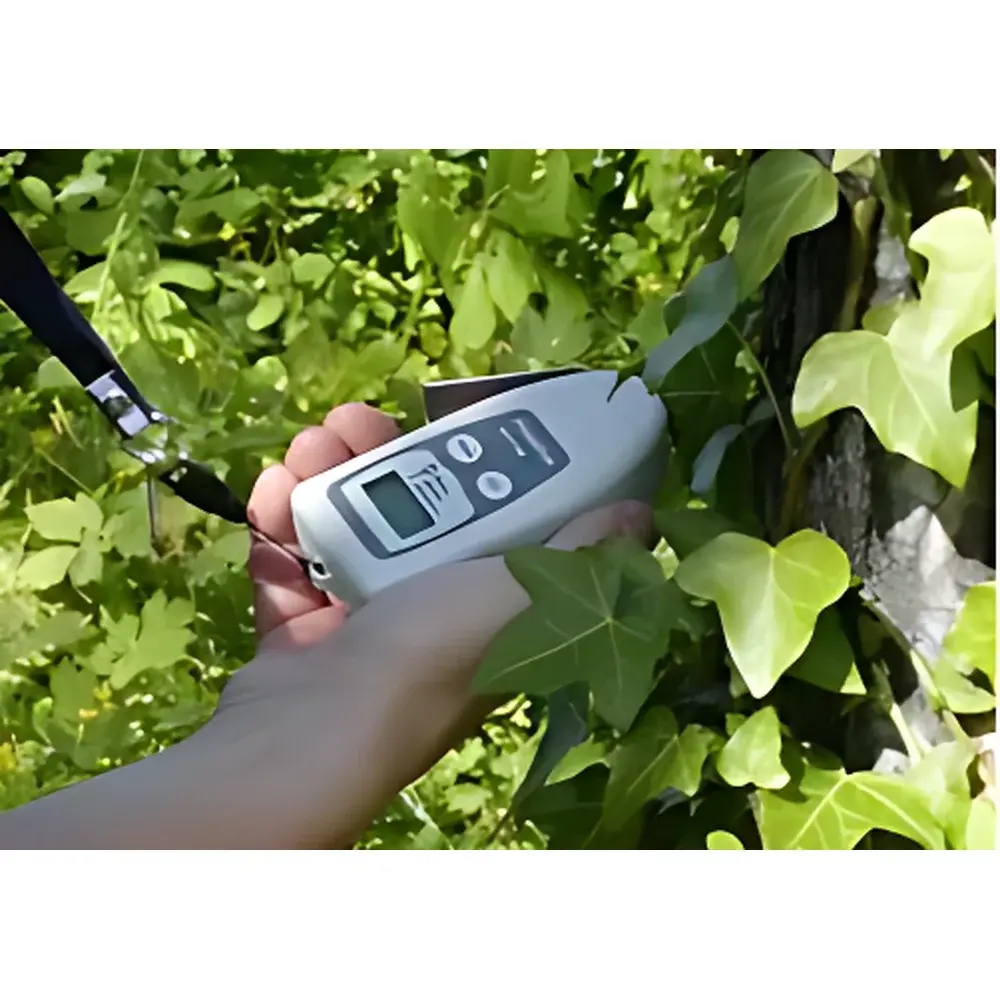
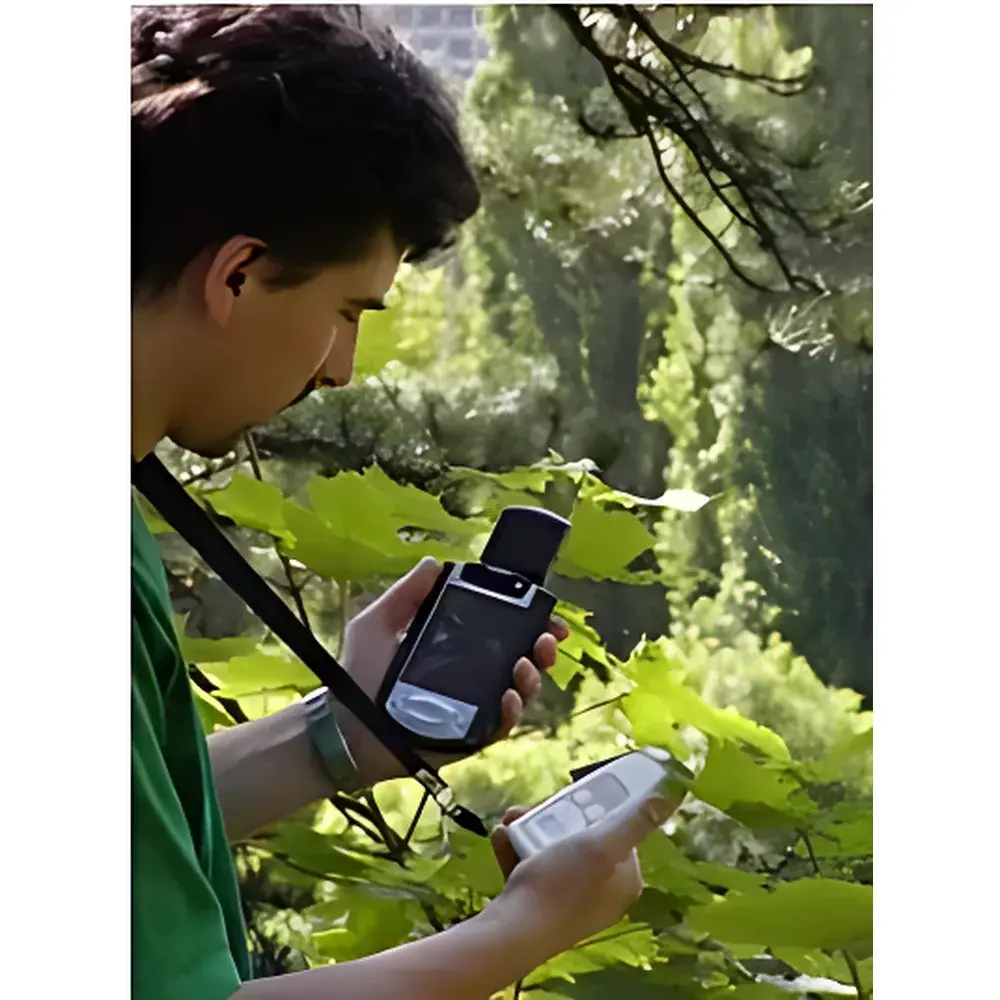
Phenometrics PlantPen Portable NDVI Clip-on Sensor
| Origin | Czech Republic |
|---|---|
| Manufacturer Type | Authorized Distributor |
| Product Origin | Imported |
| Model | PlantPen Portable NDVI Clip-on Sensor |
| Pricing | Available Upon Request |
| Measurement Principle | Dual-wavelength reflectance-based normalized difference vegetation index (NDVI) calculation using built-in 660 nm (red) and 740 nm (NIR) LEDs |
| Spectral Detection Range | 620–750 nm |
| Communication | Bluetooth 1.1, USB 2.0 |
| Onboard Memory | 4 MB flash storage (up to 100,000 measurements) |
| Display | 2×8-character monochrome LCD |
| Keypad | Sealed, waterproof two-button interface |
| Power Supply | 4 × AA rechargeable or alkaline batteries (70 h continuous operation) |
| Auto-power-off | After 5 min inactivity |
| Dimensions | 120 × 57 × 30 mm (4.7″ × 2.2″ × 1.2″) |
| Weight | 180 g |
| Operating Environment | 0–55 °C, 0–95% RH (non-condensing) |
| Storage Conditions | −10–60 °C, 0–95% RH (non-condensing) |
| Software Compatibility | Windows-based PC application with real-time control, GPS metadata tagging, Excel export, and remote acquisition support |
Overview
The Phenometrics PlantPen Portable NDVI Clip-on Sensor is a field-deployable, hand-held optical instrument engineered for rapid, non-destructive assessment of plant physiological status through spectral reflectance analysis. It operates on the well-established principle of normalized difference vegetation index (NDVI) computation—derived from the ratio of near-infrared (NIR) and visible (red) reflectance—using integrated, calibrated light-emitting diodes at 660 nm (VIS) and 740 nm (NIR). Unlike passive optical sensors relying on ambient sunlight, the PlantPen incorporates active illumination, ensuring measurement consistency under variable lighting conditions—including overcast skies, canopy shade, or indoor growth chambers. Its clip-on design enables direct leaf placement without sample excision, preserving tissue integrity and enabling repeated longitudinal monitoring of individual plants across experimental time series. The device is designed for rigorous field use in agronomy, forest ecology, crop physiology, and environmental stress research, where reproducible, operator-independent spectral indices are essential for quantitative phenotyping.
Key Features
- Active dual-wavelength illumination (660 nm red + 740 nm NIR) eliminates dependency on ambient light intensity and spectral quality
- Integrated clip mechanism ensures consistent leaf positioning and pressure-independent optical coupling
- Onboard storage capacity of up to 100,000 NDVI measurements with timestamping and optional GPS geotagging
- Sealed, IP65-rated keypad and ruggedized housing suitable for outdoor deployment in high-humidity or dusty environments
- Low-power architecture supporting >70 hours of continuous operation on standard AA batteries
- Real-time bidirectional communication via Bluetooth 1.1 or USB 2.0 for live data streaming and remote instrument control
- Configurable firmware platform enabling future expansion to PRI (Photochemical Reflectance Index), RVI (Ratio Vegetation Index), or user-defined spectral ratios
Sample Compatibility & Compliance
The PlantPen is optimized for intact, mature dicot and monocot leaves with typical thicknesses between 0.1–0.5 mm and surface areas ≥2 cm². It accommodates broadleaf species (e.g., Arabidopsis thaliana, maize, soybean, wheat) as well as conifer needles when positioned perpendicular to the sensor aperture. Measurements conform to widely accepted optical vegetation index conventions defined in ISO 11120:2021 (optical methods for plant status assessment) and align with USDA-ARS standard protocols for field-based NDVI validation. While not certified for regulatory submission per se, its traceable optical calibration and deterministic algorithm output support GLP-compliant experimental documentation when paired with validated metadata logging (time, location, operator ID, battery level).
Software & Data Management
The companion Windows desktop application provides full instrument configuration, real-time visualization, and batch data export in native Excel (.xlsx) format with column headers compliant with FAIR (Findable, Accessible, Interoperable, Reusable) data principles. Each record includes NDVI value, acquisition timestamp, battery voltage, internal temperature, and—when enabled—WGS84 coordinates from connected external GPS modules. Audit trails are maintained for all parameter changes and firmware updates. Exported datasets integrate seamlessly with statistical platforms including R (via readxl), Python (Pandas), and MATLAB, facilitating downstream analysis such as time-series trend modeling, spatial interpolation, or machine learning–based stress classification. No cloud dependency; all processing occurs locally to ensure data sovereignty and compliance with institutional IT policies.
Applications
- High-throughput phenotyping trials evaluating drought, heat, or nutrient stress responses across breeding populations
- Longitudinal monitoring of photosynthetic efficiency during controlled-environment experiments (growth chambers, greenhouses)
- Forestry inventory assessments of canopy vigor and seasonal phenology in mixed-species stands
- Ecological field studies correlating NDVI dynamics with soil moisture, microclimate, or herbivory pressure
- Undergraduate and graduate teaching laboratories demonstrating spectral plant physiology concepts and instrumentation fundamentals
- Validation of satellite- or UAV-derived NDVI products at ground-truth plot scale
FAQ
Does the PlantPen require factory recalibration? Why or why not?
No routine recalibration is required. The optical path is factory-aligned and sealed against drift; LED output stability is verified per IEC 62471 photobiological safety standards. Users may perform optional verification checks using certified neutral-density reference tiles (sold separately).
Can the device measure chlorophyll concentration directly?
No—it measures NDVI, an indirect proxy correlated with chlorophyll content and canopy structure. For absolute chlorophyll quantification, laboratory-based spectrophotometric assays (e.g., Arnon method) remain the reference standard.
Is the firmware upgradeable in the field?
Yes. Firmware updates are delivered as signed binary packages via the desktop software and installed over USB or Bluetooth, preserving all stored measurement history.
What is the minimum leaf thickness the sensor can reliably measure?
The optical design assumes leaf transmission <5% at 740 nm; reliable NDVI acquisition begins at ~0.1 mm thickness. Very thin or translucent tissues (e.g., young seedling cotyledons) may yield elevated noise; averaging ≥3 readings per leaf is recommended.
How does the PlantPen handle specular reflection from waxy or hairy leaf surfaces?
The 60° illumination–detection geometry and diffuse LED emission profile minimize specular artifacts. For highly reflective species (e.g., Eucalyptus), orienting the clip to avoid midrib alignment improves signal consistency.
Related Products




