
AZ-800M-C Closed-Box Plant Chlorophyll Fluorescence Imaging System
| Origin | Imported |
|---|---|
| Manufacturer Type | Authorized Distributor |
| Model | AZ-800M-C |
| Pricing | Upon Request |
Overview
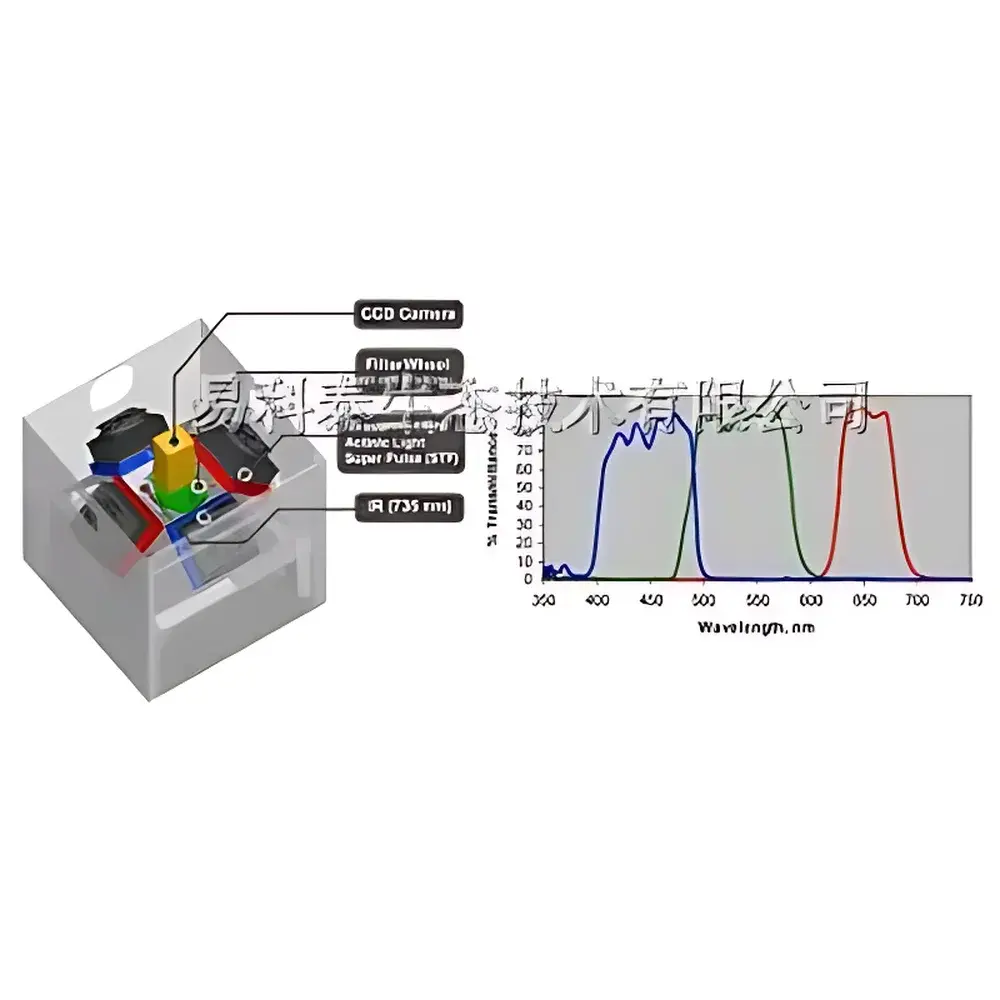
The AZ-800M-C Closed-Box Plant Chlorophyll Fluorescence Imaging System is a high-resolution, quantitative fluorescence imaging platform engineered for non-invasive, spatially resolved analysis of photosynthetic performance in intact plant tissues. It operates on the principle of pulse-amplitude modulated (PAM) chlorophyll fluorescence detection, enabling precise measurement of photochemical yield, energy dissipation pathways, and electron transport dynamics across defined sample areas. The system integrates a thermoelectrically stabilized 12-bit CCD camera (512 × 512 pixels), dual LED excitation panels (λmax = 620 nm, 345 diodes per panel), and a shutter-controlled 250 W halogen lamp for programmable saturating pulses (duration adjustable up to 2 s; maximum irradiance 2000 µmol photons·m−2·s−1). All optical components are housed within a light-tight enclosure to eliminate ambient interference—critical for reproducible dark-adapted measurements and low-noise kinetic profiling. Designed for laboratory-based plant physiology research, it supports standardized protocols including Kautsky induction kinetics, OJIP transient analysis, and rapid fluorescence decay (RFd) quantification under controlled environmental conditions.
Key Features
- Closed-box architecture with integrated light shielding ensures consistent dark adaptation and eliminates stray-light artifacts during F0, FM, and transient fluorescence acquisition.
- Dual synchronized LED panels deliver uniform actinic illumination (10–33 ms flash duration) over an 8 cm diameter circular imaging area, optimized for homogeneous excitation of chlorophyll a fluorescence.
- High-speed CCD camera (f/1.2, 2.8–6 mm focal range) captures up to 50 frames per second at 12-bit depth, enabling millisecond-scale resolution of fluorescence induction and relaxation kinetics.
- Programmable halogen saturating pulse source allows precise control of pulse intensity, duration, and timing—essential for accurate determination of FV/FM, ΦPSII, NPQ, qP, qN, and other biophysically validated parameters.
- USB 2.0 interface enables real-time data streaming and synchronization with external devices such as gas exchange systems or environmental controllers.
- Modular hardware design supports optional upgrades—including GFP/RFP excitation filters and spectral calibration modules—for multi-fluorophore imaging applications.
Sample Compatibility & Compliance
The AZ-800M-C accommodates a broad range of plant samples, from detached leaves and seedlings to small rosettes and excised tissue sections, within its 8 cm circular field of view. Its closed configuration minimizes convective heat transfer and humidity fluctuations, supporting short-term physiological assays under stable thermal conditions. While not certified for GLP or GMP environments, the system’s hardware and software architecture align with principles outlined in ISO 17025 for method validation in plant phenotyping laboratories. Data acquisition protocols conform to widely adopted conventions described in the *Photosynthesis Research* literature (e.g., Nedbal & Whitmarsh, 2002; Lazár, 2015) and support compliance with ASTM E2912-13 (Standard Guide for Chlorophyll Fluorescence Measurements in Plants). All fluorescence parameter calculations follow established biophysical definitions per the JIP-test and QA reoxidation modeling frameworks.
Software & Data Management
The proprietary acquisition and analysis suite provides full experimental control via intuitive graphical interface: users define illumination sequences (measuring light intensity/duration, saturating pulse timing, dark intervals), set ROI masks, and configure time-series capture schedules. Image segmentation algorithms automatically isolate regions of interest based on user-defined thresholds or morphological criteria. Raw fluorescence traces (Ft, F0, FM, F0′, FM′) are synchronized with corresponding image frames and exported as calibrated TIFF stacks. Computed parameter maps—including FV/FM, ΦPSII, NPQ, RFd, and qP—are generated pixel-wise and exportable in CSV or HDF5 format for downstream statistical analysis. Advanced users may extend functionality using embedded Python scripting support for custom protocol development, batch processing, and integration with third-party platforms (e.g., R, MATLAB, or FAIR-aligned metadata repositories).
Applications
- Phenotypic screening of stress responses (drought, heat, salinity, heavy metals) through spatial heterogeneity mapping of PSII efficiency and non-photochemical quenching.
- Functional characterization of photosynthetic mutants and transgenic lines—particularly those affecting electron transport chain components or photoprotective mechanisms.
- Time-resolved analysis of photoinhibition recovery kinetics and QA− reoxidation dynamics following high-light exposure.
- Validation of remote sensing indices by correlating ground-truth fluorescence images with canopy-level reflectance data.
- Co-imaging studies integrating chlorophyll fluorescence with GFP-tagged reporters to dissect gene expression–photosynthesis coupling in developmental contexts.
- Method development for standardized chlorophyll fluorescence protocols aligned with international plant phenotyping networks (e.g., EMPHASIS, PHENOME).
FAQ
What is the maximum frame rate and bit depth supported during kinetic acquisition?
The system acquires images at up to 50 frames per second with 12-bit dynamic range (4096 intensity levels); optional firmware upgrade enables 14-bit mode for enhanced signal-to-noise ratio in low-fluorescence conditions.
Can the system be integrated with a commercial photosynthesis system (e.g., LI-6400XT or Walz GFS-3000)?
Yes—via TTL synchronization triggers and analog voltage output interfaces, enabling simultaneous recording of gas exchange parameters and fluorescence kinetics in coordinated experiments.
Is spectral calibration provided for quantitative cross-laboratory comparisons?
A factory-installed NIST-traceable spectral response profile is included; users may perform routine verification using certified fluorescent reference standards (e.g., Rhodamine B solution or quantum dot arrays).
Does the software support automated ROI selection based on leaf morphology?
Yes—the segmentation module includes edge-detection algorithms trained on angiosperm leaf shapes and supports manual refinement for non-standard specimens such as moss gametophytes or algal biofilms.
What environmental controls are built into the closed-box design?
The enclosure maintains passive thermal stability (±1.5°C over 30 min at 25°C ambient); optional integration with external climate chambers or Peltier-based temperature stages is supported via RS-232 and digital I/O ports.




