
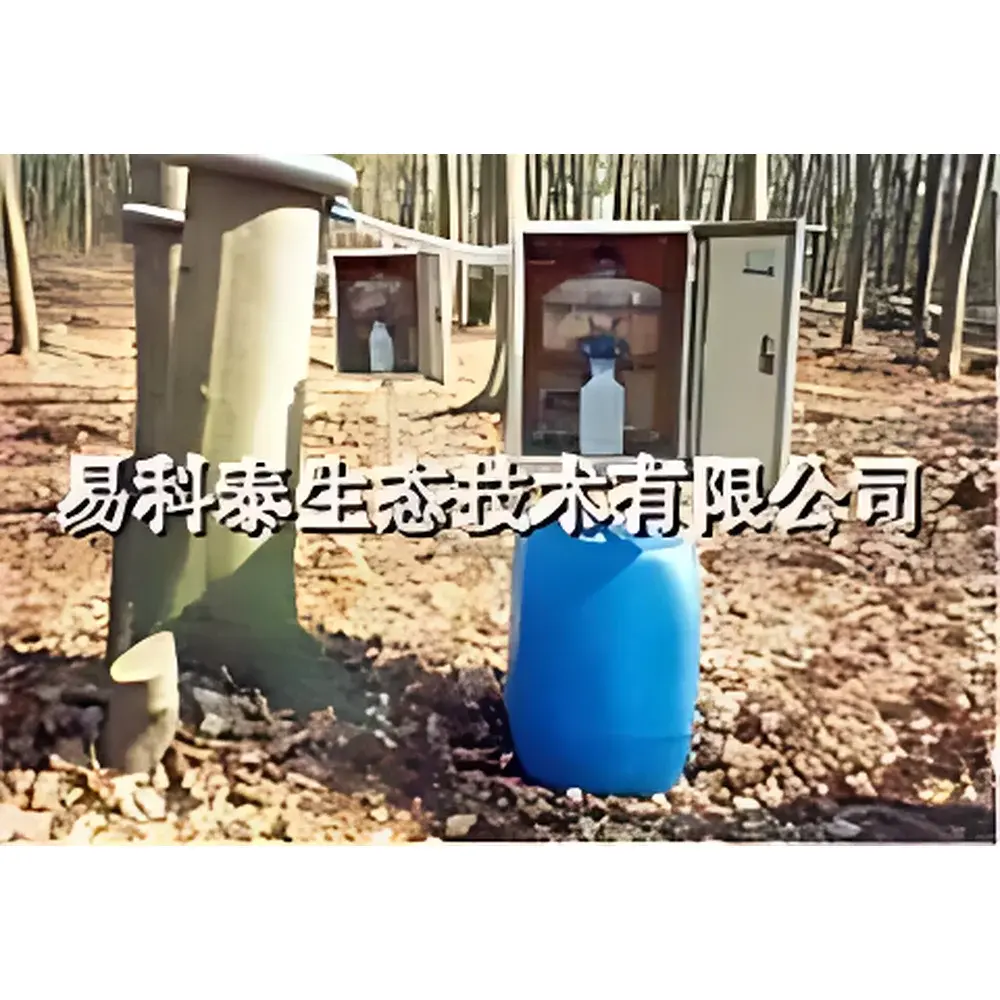
Stemflow Measurement System Model 173100
| Origin | Germany |
|---|---|
| Manufacturer Type | Authorized Distributor |
| Origin Category | Imported |
| Model | 173100 Stemflow Measurement System |
| Pricing | Available Upon Request |
Overview
The Stemflow Measurement System Model 173100 is a field-deployable, precision-engineered instrument designed for the quantitative, long-term monitoring of stemflow—the portion of incident precipitation that drains down the trunk surface of trees following canopy interception. Operating on the principle of gravimetric collection and volumetric counting, this system captures stemflow runoff via a calibrated rubber collar mounted circumferentially around the tree bole, channels it through a rigid conduit into a 20 L polyethylene collector, and delivers it to a high-reliability tipping-bucket sensor housed in an IP65-rated protective enclosure. The system is optimized for ecological hydrology studies, forest water balance modeling, nutrient leaching assessments, and canopy interception partitioning (rainfall → throughfall + stemflow + interception loss). Its modular architecture enables deployment across diverse species and trunk diameters (typically 10–80 cm DBH), with minimal disturbance to natural stemflow pathways.
Key Features
- Calibrated elastomeric stem collar: Custom-molded synthetic rubber ring with integrated drainage groove and flexible tension band ensures secure, non-invasive attachment to irregular bark surfaces while maintaining hydraulic continuity.
- Tipping-bucket sensor assembly: Precision-machined 100 mL polycarbonate tipping bucket housed in a UV-stabilized, weatherproof enclosure; equipped with Reed switch transduction and internal battery-backed counter module for uninterrupted operation during power outages.
- Robust data acquisition infrastructure: Electronic counting module features real-time pulse logging, onboard memory (≥12 months at 1-min resolution), and optional RS-485 or SD card output for integration with external dataloggers (e.g., Campbell Scientific CR1000X, Onset HOBO UX120).
- Field-hardened mechanical design: IP65-rated outer housing with transparent polycarbonate lid permits visual verification of bucket operation without compromising environmental sealing; all wetted components are UV-resistant and chemically inert (polyethylene collector, polycarbonate bucket, stainless-steel hinge pins).
- Modular scalability: Compatible with auxiliary sensors—including temperature-compensated pressure transducers for dynamic flow rate estimation—and supports synchronized deployment with throughfall gauges and meteorological stations for full canopy water budget analysis.
Sample Compatibility & Compliance
The Model 173100 is validated for use with broadleaf and coniferous species exhibiting smooth to moderately fissured bark textures. It complies with standard field methodology protocols outlined in ISO 17925:2016 (Hydrological measurements — Determination of stemflow volume) and aligns with best practices recommended by the International Association of Hydrological Sciences (IAHS) Working Group on Forest Hydrology. All materials meet EU RoHS Directive 2011/65/EU requirements for hazardous substance restrictions. The system supports GLP-compliant data traceability when paired with timestamped, audit-logged dataloggers meeting FDA 21 CFR Part 11 electronic record criteria.
Software & Data Management
Raw tipping events are recorded as time-stamped digital pulses. Data export is supported via CSV or Excel-compatible formats using manufacturer-provided configuration utilities or third-party platforms (e.g., LoggerNet, HOBOware Pro). Firmware allows user-defined calibration offsets to correct for minor bucket inertia or evaporation bias under low-flow conditions. Optional cloud-based dashboards (via MQTT or HTTP POST) enable remote health monitoring, threshold alerts (e.g., >5 mm/hr stemflow intensity), and automated QA/QC flagging based on diurnal consistency checks. All firmware updates undergo version-controlled release cycles with documented change logs for regulatory documentation.
Applications
- Quantifying species-specific stemflow ratios (stemflow / gross rainfall) across phenological stages (leaf-on vs. leaf-off) in temperate, tropical, and boreal forests.
- Assessing dissolved organic carbon (DOC), cation leaching (Ca²⁺, K⁺, Mg²⁺), and particulate transport dynamics associated with stemflow-mediated nutrient fluxes.
- Parameterizing ecohydrological models such as RHESSys, SWAT, or BROOK90 to improve predictions of watershed-scale runoff generation and groundwater recharge.
- Evaluating impacts of climate variability (e.g., drought frequency, extreme rainfall events) on canopy interception efficiency and below-canopy water availability.
- Supporting urban forestry research—measuring stemflow from street trees to inform stormwater management and green infrastructure planning.
FAQ
What is the minimum detectable stemflow volume per tip?
Each tip corresponds to 100 mL ± 1.5% volumetric accuracy under ISO-standardized calibration conditions (20 °C, distilled water, laminar inflow).
Can the system operate continuously during extended rainy periods?
Yes—the 20 L collector provides ≥200 tips of buffer capacity, and the battery-backed counter maintains integrity for up to 18 months on two AA lithium cells (typical field use).
Is bark damage or cambial disruption observed after prolonged collar installation?
No adverse physiological effects have been reported in peer-reviewed deployments exceeding 36 months; collar tension is adjustable and remains below bark tensile yield thresholds for common hardwood and softwood species.
How is evaporation loss from the collector mitigated?
The sealed polycarbonate housing minimizes wind-driven evaporation; empirical correction factors (<2% error at <30 °C, <60% RH) are provided in the technical manual for high-precision applications.
Does the system support co-location with throughfall and rainfall gauges for water balance closure?
Yes—standardized mounting brackets and time-synchronization protocols (NTP or GPS pulse-per-second input) ensure spatially and temporally aligned multi-sensor deployments.





