
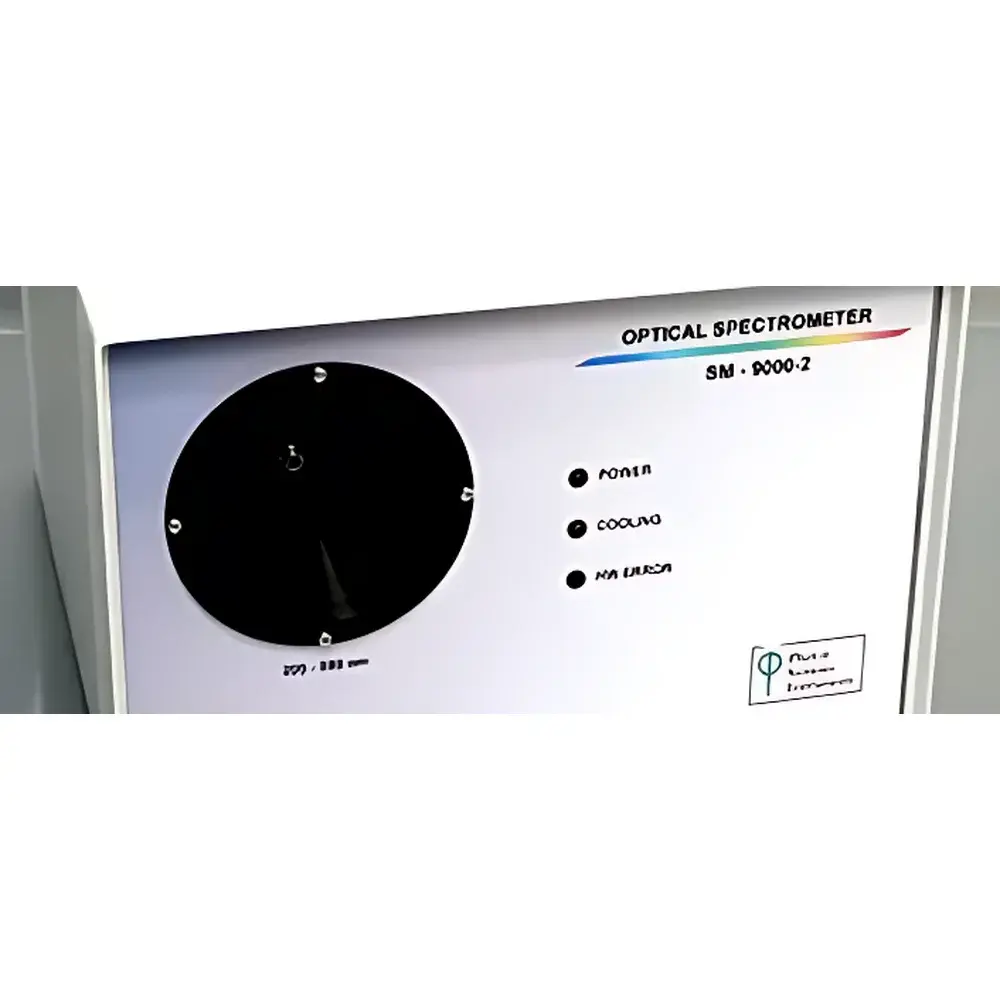
SM9000 Fiber Optic Spectrometer
| Origin | Europe |
|---|---|
| Detector Type | Back-Illuminated CCD Array (1044 × 64 pixels, 24 µm × 24 µm) |
| Spectral Range | 200–980 nm |
| Optical Resolution (FWHM) | 3–4 nm |
| Wavelength Accuracy | < 0.5 nm |
| Repeatability | < 0.1 nm |
| Thermal Drift | < 0.01 nm/K |
| Stray Light | 0.1% @ 340 nm (Xe lamp) |
| Integration Time | 1 ms to several minutes |
| Acquisition Rate | Up to 100 spectra/s (16-bit digitization) |
| Input Interface | Removable SMA-905 connector (Ø0.5 mm, NA = 0.22) |
| Slit Dimensions | 70 µm × 1400 µm |
| Grating | Flat-field corrected holographic grating |
| Pixel Dispersion | ~0.8 nm/pixel |
| Flash Detection Capability | 10 µs – 10 ms transient events |
Overview
The SM9000 Fiber Optic Spectrometer is a high-performance, modular optical spectrometer engineered for precision spectral acquisition across the ultraviolet, visible, and near-infrared (UV-VIS-NIR) range (200–980 nm). Based on a back-illuminated CCD array architecture with 1044 × 64 active pixels (24 µm × 24 µm), it delivers exceptional quantum efficiency in the UV region and stable responsivity up to 980 nm. Its optical design incorporates a flat-field corrected holographic grating and a fixed 70 µm × 1400 µm entrance slit, enabling consistent spectral dispersion (~0.8 nm/pixel) and a nominal FWHM resolution of 3–4 nm. The instrument operates on a robust thermo-mechanical platform with low thermal drift (< 0.01 nm/K) and minimal self-heating—critical for long-duration kinetic experiments requiring wavelength stability. Unlike scanning monochromators, the SM9000 captures full spectra simultaneously via array detection, supporting time-resolved fluorescence, transient absorption, and dynamic chlorophyll fluorescence spectroscopy with microsecond-scale temporal resolution.
Key Features
- Simultaneous full-spectrum acquisition at up to 100 Hz with 16-bit analog-to-digital conversion
- Configurable integration time from 1 millisecond to several minutes—enabling both rapid transient capture and high-S/N steady-state measurements
- Optimized for ultra-low-light applications: capable of resolving single-cell fluorescence spectra when coupled with high-throughput microscopy platforms
- Modular mechanical design with SMA-905 input port (Ø0.5 mm, NA = 0.22), facilitating seamless integration into custom optical benches or OEM systems
- Thermally stabilized housing ensures <0.1 nm spectral repeatability over extended measurement sessions
- Stray light performance validated at 0.1% (measured at 340 nm using a calibrated xenon lamp), meeting requirements for quantitative fluorescence ratio analysis
Sample Compatibility & Compliance
The SM9000 is routinely deployed in plant physiology, photobiology, and environmental microbiology laboratories for non-invasive, label-free spectral characterization of biological samples—including intact leaves, algal suspensions, cyanobacterial cultures, and single eukaryotic cells. Its compatibility with standardized optical interfaces enables direct coupling to commercial fluorescence imaging systems such as the FKM Multispectral Fluorescence Dynamic Imaging System and FL3500 Dual-Modulation Chlorophyll Fluorometer. All spectral data comply with FAIR principles (Findable, Accessible, Interoperable, Reusable) and can be exported in vendor-neutral formats (e.g., CSV, HDF5) for downstream processing in MATLAB, Python (NumPy/SciPy), or Igor Pro. While not certified for regulated GMP environments, the instrument’s deterministic timing, audit-ready metadata tagging (timestamp, integration time, gain setting), and traceable wavelength calibration support GLP-aligned experimental workflows per ISO/IEC 17025 guidelines.
Software & Data Management
The SM9000 is operated via a cross-platform SDK (Windows/Linux/macOS) supporting C/C++, Python, LabVIEW, and MATLAB APIs. Real-time spectral visualization, batch acquisition scripting, and automated dark/reference correction are implemented through the included SpectraView Suite. Each acquired spectrum embeds calibrated metadata—including absolute wavelength scale (traceable to NIST-traceable Hg/Ne emission lines), integration time, detector temperature, and system gain—ensuring reproducibility across instruments and laboratories. Raw 16-bit frames are stored without loss; post-acquisition binning, smoothing, and baseline correction are applied non-destructively. For time-series studies (e.g., OJIP kinetics), the software supports synchronized triggering with external TTL signals (±10 ns jitter), enabling precise alignment with actinic light pulses or modulated excitation sources.
Applications
- Time-resolved chlorophyll a fluorescence spectroscopy in higher plants and algae (e.g., Elsholtzia splendens, Guillardia theta)
- Multi-parameter photosynthetic phenotyping under variable CO2, nutrient, or metal stress conditions
- Characterization of light-harvesting complex composition and energy transfer dynamics in cryptophytes and chromerids
- In vivo detection of red-shifted chlorophyll variants (e.g., Chl f, Chl d) in oxygenic phototrophs
- Quantitative stray-light-corrected spectral deconvolution of overlapping fluorophore emissions
- Integration into closed-loop optogenetic or photobioreactor control systems requiring real-time spectral feedback
FAQ
What spectral calibration standards are supported?
The SM9000 includes factory calibration using Hg/Ne spectral lamps; users may perform field recalibration using optional NIST-traceable line sources.
Is the detector cooled?
No active thermoelectric cooling is integrated; however, the low-power design and thermally isolated housing maintain detector temperature within ±0.5°C over 2-hour acquisitions at ambient 25°C.
Can I synchronize acquisition with external hardware?
Yes—the spectrometer accepts TTL trigger inputs with programmable delay (0–10 s, 1 µs resolution) and provides sync output for coordinating with light sources or cameras.
Does the system support dark current subtraction?
Yes—real-time dark frame acquisition is fully automated and applied prior to spectral intensity calculation.
What is the maximum sustainable acquisition rate at full 16-bit depth?
100 spectra per second is guaranteed with onboard buffering; sustained streaming to disk requires SSD storage and ≥1 Gbps interface bandwidth.
Related Products






