
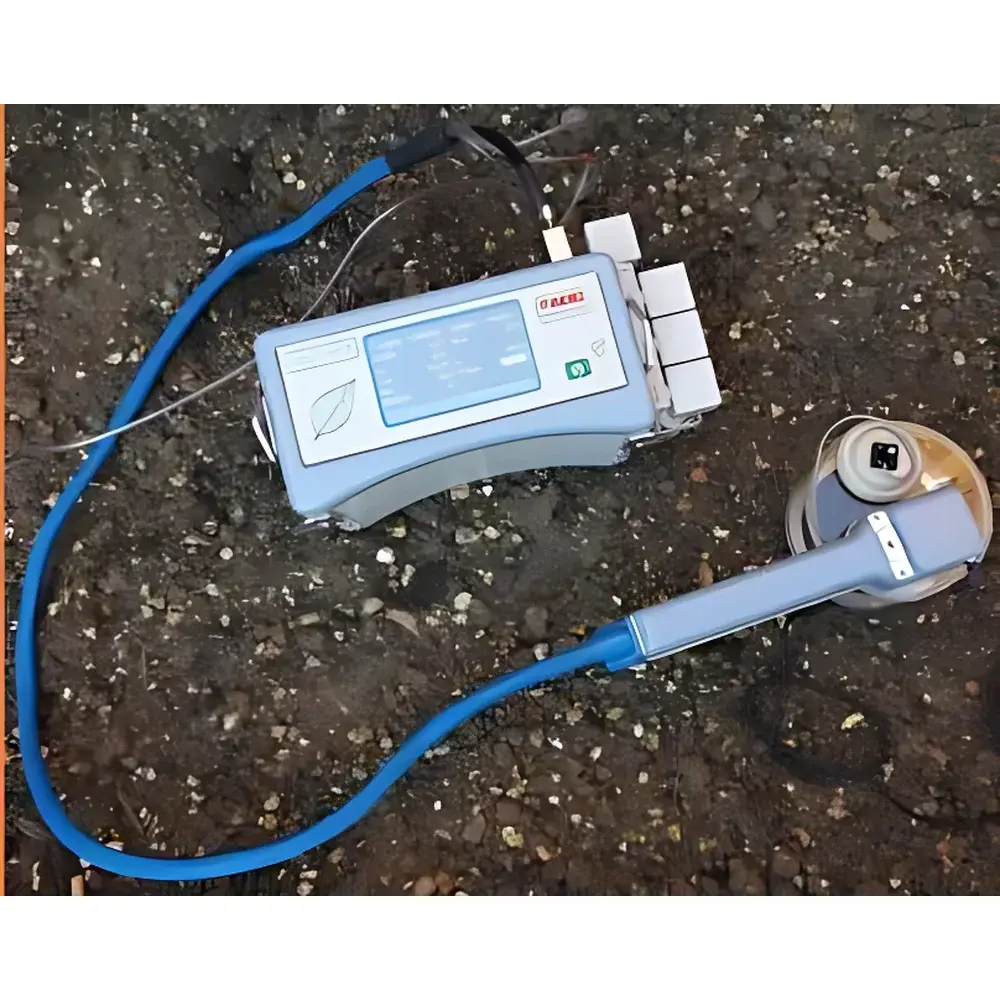
ADC Bio SRS-2000 T Portable Soil Respiration System
| Brand | ADC Bio |
|---|---|
| Origin | United Kingdom |
| Model | SRS-2000 T |
| CO₂ Range | 0–3000 ppm |
| CO₂ Resolution | 1 ppm |
| H₂O Range | 0–75 mbar |
| H₂O Resolution | 0.1 mbar |
| PAR Sensor Range | 0–3000 µmol·m⁻²·s⁻¹ |
| Soil Temperature Probe Range | 5–50 °C |
| Chamber Volume | 1 L |
| Chamber Diameter | 130 mm |
| Chamber Height (Stainless Steel Ring + Acrylic Hood) | 145 mm |
| Flow Rate | 68–340 µmol·m⁻²·s⁻¹ |
| Preheat Time | 5 min @ 20 °C |
| Display | 480 × 272-pixel WQVGA color touchscreen (95 × 53.9 mm) |
| Battery | 7.5 Ah / 12 V Li-ion (16 h continuous operation) |
| Data Storage | SD card (up to 32 GB) |
| Operating Temperature | 5–45 °C |
| Control Unit Dimensions & Weight | 230 × 110 × 170 mm / 4.1 kg |
| Handle Weight | 0.8 kg |
| Chamber Weight | 645 g (325 g ring + 320 g hood) |
Overview
The ADC Bio SRS-2000 T Portable Soil Respiration System is a field-deployable, open-path gas exchange instrument engineered for high-fidelity quantification of soil carbon flux under natural conditions. It operates on the principle of dynamic closed-chamber CO₂ accumulation measurement, integrated with real-time infrared gas analysis (IRGA) and environmental parameter control. Unlike static chamber systems, the SRS-2000 T maintains continuous air circulation between ambient atmosphere and the 1-L acrylic respiration chamber via a precision-matched flow path—minimizing pressure artifacts, eliminating chamber-induced microclimate distortion, and preserving in situ soil biophysical integrity. The system’s core analytical module—a miniaturized, gold-coated, time-domain differential IRGA—is embedded directly within the ergonomic handle to reduce sample transport lag and thermal drift, ensuring sub-second CO₂ response times and long-term baseline stability without dual-IRGA balance recalibration. Coupled with dual high-stability laser-trimmed humidity sensors and automatic temperature/pressure compensation, the SRS-2000 T delivers trace-level CO₂ (0–3000 ppm, 1 ppm resolution) and water vapor (0–75 mbar, 0.1 mbar resolution) measurements compliant with ISO 16634-2 and ASTM D6348-15 methodological frameworks for soil gas efflux assessment.
Key Features
- True Field Portability: Integrated touchscreen console, lightweight handle (0.8 kg), and modular chamber assembly enable rapid deployment across heterogeneous terrain—ideal for large-scale spatial surveys, transect studies, or remote polar ecosystems (e.g., Antarctic soil–algae carbon exchange).
- Environmental Parameter Control: On-the-fly regulation of intra-chamber CO₂ (0–2000 ppm) and H₂O (± relative humidity setpoints) gradients supports mechanistic studies of substrate limitation, moisture thresholds, and microbial metabolic sensitivity.
- Minimized Soil Disturbance: Stainless steel ring knife (75 mm depth, 325 g) ensures consistent insertion depth and mechanical stability across variable soil textures; optional PVC adapters allow cost-effective multi-point installation without repeated ring knife deployment.
- Ruggedized Field Architecture: IP54-rated electronics, conformal-coated circuitry, and sealed optical pathways ensure reliable operation in high-humidity, dusty, or low-temperature environments (5–45 °C operating range).
- Integrated Geospatial Logging: Built-in GPS synchronizes CO₂ flux, H₂O, PAR (0–3000 µmol·m⁻²·s⁻¹), and temperature metadata (chamber: ±0.2 °C; soil probe: 5–50 °C) at user-defined temporal intervals (1 min to 24 h), enabling spatiotemporal carbon flux mapping.
- Multi-Application Modularity: Interchangeable chambers—including narrow/wide leaf cuvettes, fruit/respiration chambers, transparent community chambers, and canopy chambers—extend functionality to plant physiological ecology, ecosystem carbon partitioning, and eddy-covariance validation.
Sample Compatibility & Compliance
The SRS-2000 T accommodates diverse soil types (sand, loam, clay, organic peat), disturbed or undisturbed cores, and surface-embedded biological matrices (e.g., cryptobiotic crusts, moss layers, rhizosphere zones). Its open-loop airflow design meets GLP-aligned requirements for unaltered gas diffusion kinetics, while its CO₂/H₂O measurement uncertainty (<±2% of reading, NIST-traceable calibration) satisfies reporting criteria for IPCC Tier 2 soil carbon inventories and UNFCCC national greenhouse gas inventories. All firmware and data logging routines comply with FDA 21 CFR Part 11 audit trail requirements when configured with timestamped, password-protected SD card storage and USB export logs. The system adheres to ISO 14064-2 (GHG project quantification) and supports verification against US EPA Method TO-11A for soil CO₂ efflux characterization.
Software & Data Management
Data acquisition, visualization, and post-processing are managed via the embedded Linux-based firmware interface and optional PC software (ADC Bio LCpro Suite v4.2+). Real-time graphs display CO₂ slope (µmol·m⁻²·s⁻¹), H₂O mixing ratio, chamber temperature, and PAR on the 480 × 272-pixel WQVGA touchscreen. Raw time-series data (ASCII CSV format) are stored on removable SD cards (up to 32 GB) with configurable sampling intervals, metadata tagging, and cyclic overwrite protection. USB Mini-B and RS232 (9-pin D-sub) interfaces support direct download, remote diagnostics, and integration into larger environmental monitoring networks. Exported datasets include calibrated CO₂ flux rates, temperature-corrected Q₁₀ values, and moisture-response curves—structured for direct import into R, Python (Pandas), MATLAB, or ArcGIS for statistical modeling and geospatial interpolation.
Applications
- Quantifying soil respiration responses to hydrocarbon contamination (e.g., diesel-amended forest soils, per Edyta Hewelke et al., Water Air Soil Pollut 2018)
- Evaluating land-use change impacts on carbon sequestration potential (afforestation vs. cropland conversion)
- Assessing ecological restoration efficacy through seasonal CO₂ efflux trajectories
- Parameterizing biogeochemical models (e.g., RothC, CENTURY) with field-validated temperature/moisture sensitivity functions
- Validating satellite-derived gross primary production (GPP) and ecosystem respiration (Reco) estimates
- Supporting IPCC AR6 WGII vulnerability assessments for permafrost and arid-zone soils
FAQ
What distinguishes the SRS-2000 T from conventional static chamber systems?
It employs an open-loop, actively circulated gas pathway with real-time IRGA—eliminating headspace equilibration artifacts and enabling true dynamic flux estimation under ambient wind and pressure conditions.
Can the system operate autonomously for unattended long-term deployments?
Yes—programmable sampling schedules, internal battery (16 h), SD card logging, and GPS-tagged metadata support multi-day field campaigns without manual intervention.
Is the CO₂ analyzer factory-calibrated and field-serviceable?
The IRGA is pre-calibrated using NIST-certified gas standards; zero-point auto-correction occurs during each startup, and span calibration is supported via external CO₂ reference gas (optional accessory kit).
How does the system handle condensation in high-humidity soils?
Dual laser-trimmed humidity sensors maintain accuracy across 0–100% RH; chamber airflow and thermal management prevent dew formation on optical surfaces during extended low-temperature measurements.
Are software updates and technical documentation available to end users?
Firmware updates, user manuals (EN/DE/FR/ES), application notes, and SOP templates for ISO/IEC 17025-compliant labs are provided via ADC Bio’s secure customer portal with registered device authentication.
Related Products







