
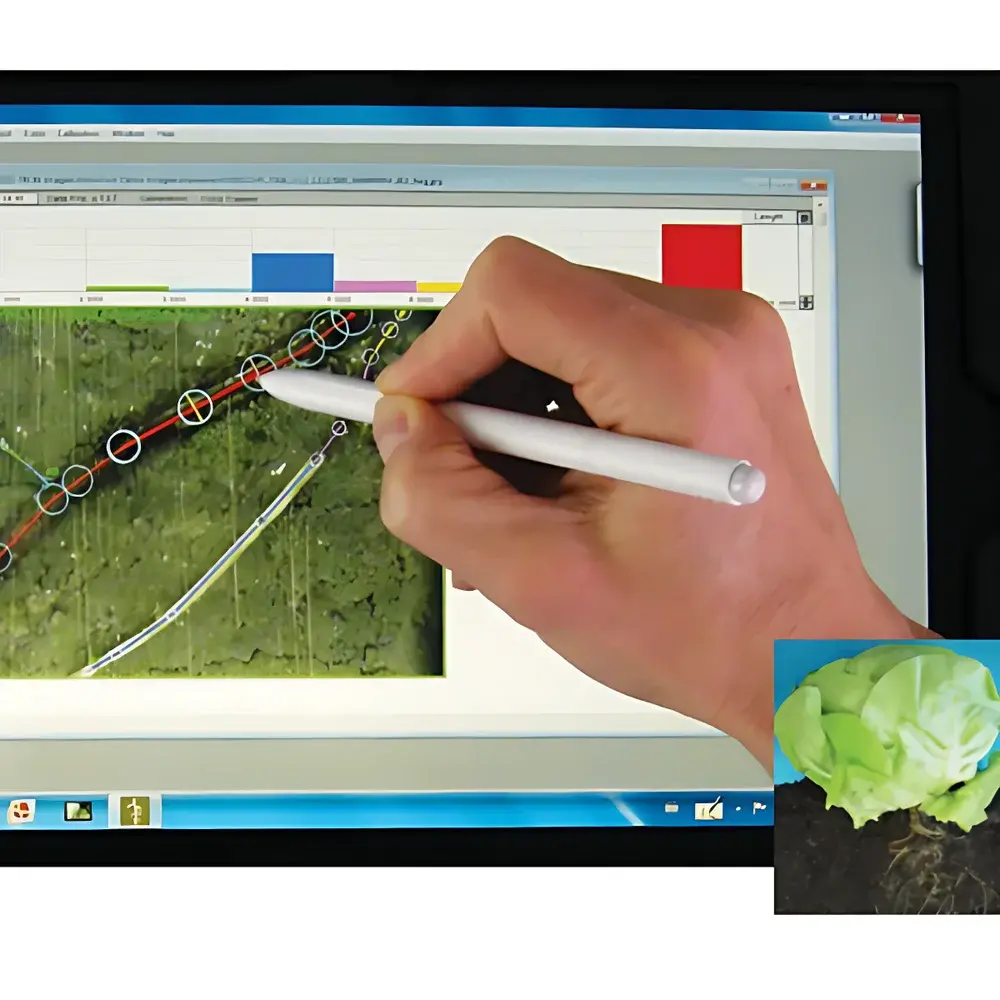
VSI MS-190 Ultra-High-Resolution Minirhizotron Imaging System
| Brand | VSI (Austria) |
|---|---|
| Origin | Austria |
| Model | MS-190 |
| Image Sensor Resolution | 8 MP (3280 × 2464 px) |
| Optical Resolution | 2500 dpi |
| Imaging Speed | <1 s per frame |
| Illumination | Dual-row COB LED (2 × 160–230 lm, software-adjustable) |
| Standardized Output Image Size | 20 mm × 20 mm (distortion-corrected) |
| Compatible Root Tube ID | ≥5.08 cm |
| Max. Tube Length Supported | 500 cm |
| Power Supply | Dual-source (laptop battery + internal Li-ion, 12 h runtime) |
| Camera Module Dimensions | Ø52–62 mm × 170 mm, 420 g |
| Smucker Positioning Handle | Aluminum, 25 mm × 25 mm × 1000 mm, 670 g |
| Software Platform | ICAP 8 (Windows-based), includes real-time preview, experiment scheduling, naming automation, and distortion correction |
| Root Morphometric Analysis | Root length, projected area, surface area, volume, diameter-class distribution, topology & connectivity mapping, multi-frame time-series alignment |
Overview
The VSI MS-190 Ultra-High-Resolution Minirhizotron Imaging System is an engineered solution for non-destructive, in situ quantification of root architecture and rhizosphere dynamics across multiple growth stages. Based on high-fidelity optical imaging through transparent observation tubes (minirhizotrons), the system captures morphologically accurate, geometrically calibrated digital images using a fixed-focus, 8-megapixel CMOS sensor optimized for low-noise performance under controlled illumination. Unlike conventional time-lapse or manual scanning approaches, the MS-190 employs a precision-machined aluminum camera module with integrated dual COB LED arrays—each independently adjustable via ICAP 8 software—to ensure consistent photon flux across variable tube geometries and soil moisture conditions. Its core measurement principle relies on standardized image acquisition at 2500 dpi, followed by geometric normalization to a 20 mm × 20 mm reference frame post-distortion correction, enabling pixel-to-micron traceability essential for longitudinal morphometric comparison. Designed for deployment in field plots, greenhouse rhizotrons, mesocosms, and controlled-environment growth chambers, the system meets the spatial resolution and reproducibility requirements of modern plant phenotyping protocols aligned with FAO, USDA ARS, and ISPM root monitoring guidelines.
Key Features
- Ultra-high optical resolution: 2500 dpi native output with 8 MP sensor (3280 × 2464 pixels), delivering sub-millimeter structural fidelity for fine root detection (≤0.1 mm diameter)
- Sub-second imaging cycle: Full-frame capture and onboard preprocessing completed in <1 second—eliminating motion artifacts and enabling rapid survey of extended root zones
- Smucker precision positioning handle: Engineered aluminum rail system with radial rotation lock and 20 mm standard step increments; supports modular extension up to five segments for deep-root profiling (up to 500 cm depth)
- Dual-power architecture: Simultaneous operation from laptop battery and internal rechargeable Li-ion pack—validated for continuous 12-hour field operation without external power
- Universal tube compatibility: Factory-calibrated for all commercially available minirhizotron tubes with inner diameters ≥5.08 cm, including Bartz BTC and scanning-style formats (e.g., 64 mm ID, 70 mm OD)
- Ruggedized mechanical design: Anodized aluminum camera housing (Ø52–62 mm × 170 mm, 420 g) and shock-absorbing transit case (345 × 285 × 105 mm) rated for ISO 13355-1 transport conditions
Sample Compatibility & Compliance
The MS-190 is validated for use with vertically, horizontally, or obliquely installed minirhizotron tubes embedded in mineral soils, peat substrates, hydroponic matrices, and artificial growth media. Its illumination uniformity and geometric correction algorithms accommodate variations in tube wall thickness (1.5–4.0 mm), refractive index (1.47–1.52), and surface contamination (e.g., biofilm, clay smearing). All hardware components comply with CE marking directives (2014/30/EU EMC, 2014/35/EU LVD), and firmware implements audit-trail logging per GLP Annex 11 principles. While not FDA 21 CFR Part 11-certified out-of-the-box, ICAP 8 supports export of raw TIFFs and metadata logs compatible with validated third-party LIMS integration for regulated agronomic trials.
Software & Data Management
ICAP 8 is a Windows-native application (Win 10/11, 64-bit) providing full control over acquisition parameters—including exposure time, LED intensity per row, image resolution mode (full 8 MP or subsampled), and auto-naming conventions based on timestamp, tube ID, and depth coordinate. Real-time HDMI preview (up to 7 m cable length) enables on-the-fly focus verification and lighting adjustment. Post-acquisition, the software applies lens distortion correction using factory-generated calibration profiles, then resamples each image to a standardized 20 mm × 20 mm grid with embedded scale bar and EXIF metadata. Export options include lossless TIFF, compressed PNG, and CSV-based morphometric reports. The optional VSI RootAnalyzer module performs automated segmentation, skeletonization, and topological analysis—calculating total root length, projected area, convex hull volume estimates, diameter-frequency distributions, and branching hierarchy metrics per ICPM 2022 root phenotyping standards.
Applications
- Long-term root phenotyping in drought, nutrient stress, or elevated CO₂ experiments
- Validation of root architectural QTLs and genome-wide association studies (GWAS)
- In situ assessment of mycorrhizal colonization dynamics and root-hyphal interface geometry
- Monitoring root turnover rates and mortality patterns across seasonal cycles
- Calibration and ground-truthing of proximal soil sensing platforms (e.g., ERT, GPR)
- Evaluation of cover crop root penetration depth and lateral spread in no-till systems
FAQ
What root tube diameters does the MS-190 support?
The system is factory-calibrated for all standard minirhizotron tubes with inner diameters ≥5.08 cm (2 inches), including Bartz BTC (54 mm ID), scanning-style (64 mm ID), and custom acrylic or quartz variants.
Is ICAP 8 compatible with macOS or Linux?
No—ICAP 8 is exclusively developed for Microsoft Windows (64-bit, version 10 or later) and requires DirectX 12 support for real-time preview rendering.
Can the system operate autonomously without a laptop?
No—the MS-190 requires a Windows laptop for control, preview, and data storage; however, its dual-battery design ensures uninterrupted operation even when the host laptop enters sleep mode or experiences brief power loss.
How is image geometric accuracy ensured across different tube types?
Each MS-190 unit ships with pre-loaded calibration profiles derived from physical measurements of lens distortion, tube refraction, and sensor vignetting—applied automatically during ICAP 8’s distortion-correction pipeline.
Does the system support time-series stitching for longitudinal root tracking?
Yes—ICAP 8 allows synchronized loading and overlay of sequential images from the same tube location, and RootAnalyzer enables semi-automated root correspondence mapping using landmark-based registration and diameter-constrained path continuity algorithms.
Related Products



