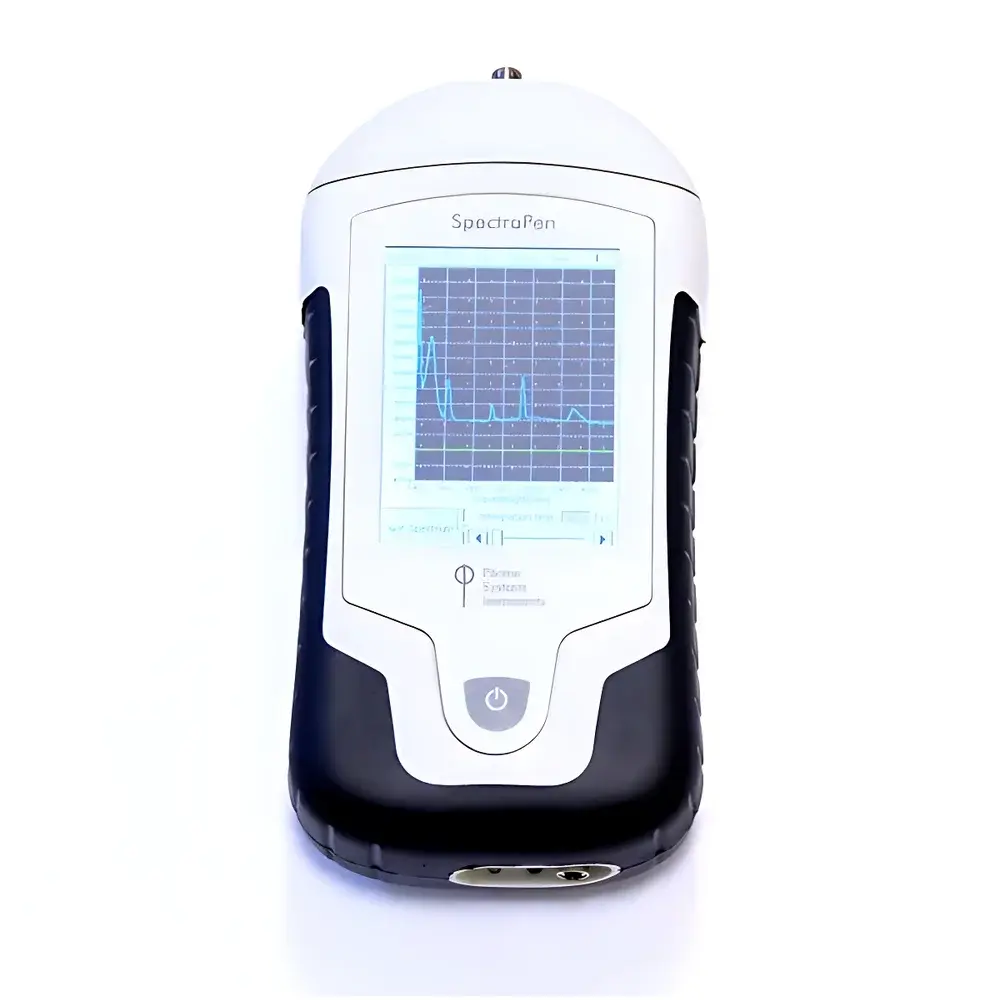
PSI SpectraPen SP110 Handheld Spectrometer
| Brand | PSI (Czech Republic) |
|---|---|
| Origin | Czech Republic |
| Model | SpectraPen SP110 |
| Spectral Range | SP110-UVIS: 340–780 nm |
| SP110-NIR | 640–1050 nm |
| Spectral Resolution (FWHM) | UVIS: 9 nm, NIR: 8 nm |
| Wavelength Repeatability | ±0.5 nm |
| Detector | 256-pixel linear CCD array |
| A/D Conversion | 16-bit |
| Dynamic Range | 1:4300 (high gain), 1:13000 (low gain) |
| Integration Time | 5 ms – 10 s |
| Display | 240×320 pixel TFT touchscreen (65,535 colors) |
| Onboard Memory | 16 MB (≥4000 spectra) |
| Power | Rechargeable Li-ion battery, USB-charged |
| Battery Life | Up to 48 h continuous operation |
| Dimensions | 150 × 75 × 40 mm |
| Weight | 300 g |
| Enclosure | Splash-resistant housing |
| Operating Temperature | 0–50 °C |
| Storage Temperature | −20–70 °C |
| Connectivity | USB 2.0 + Bluetooth 4.0 |
| Optical Interface | SMA905 connector, 0.22 NA single-fiber probe |
| Stray Light | −30 dB |
| Compliance | CE, RoHS |
| Optional Accessories | Cosine corrector (for irradiance measurement), 1-m fiber optic probe |
Overview
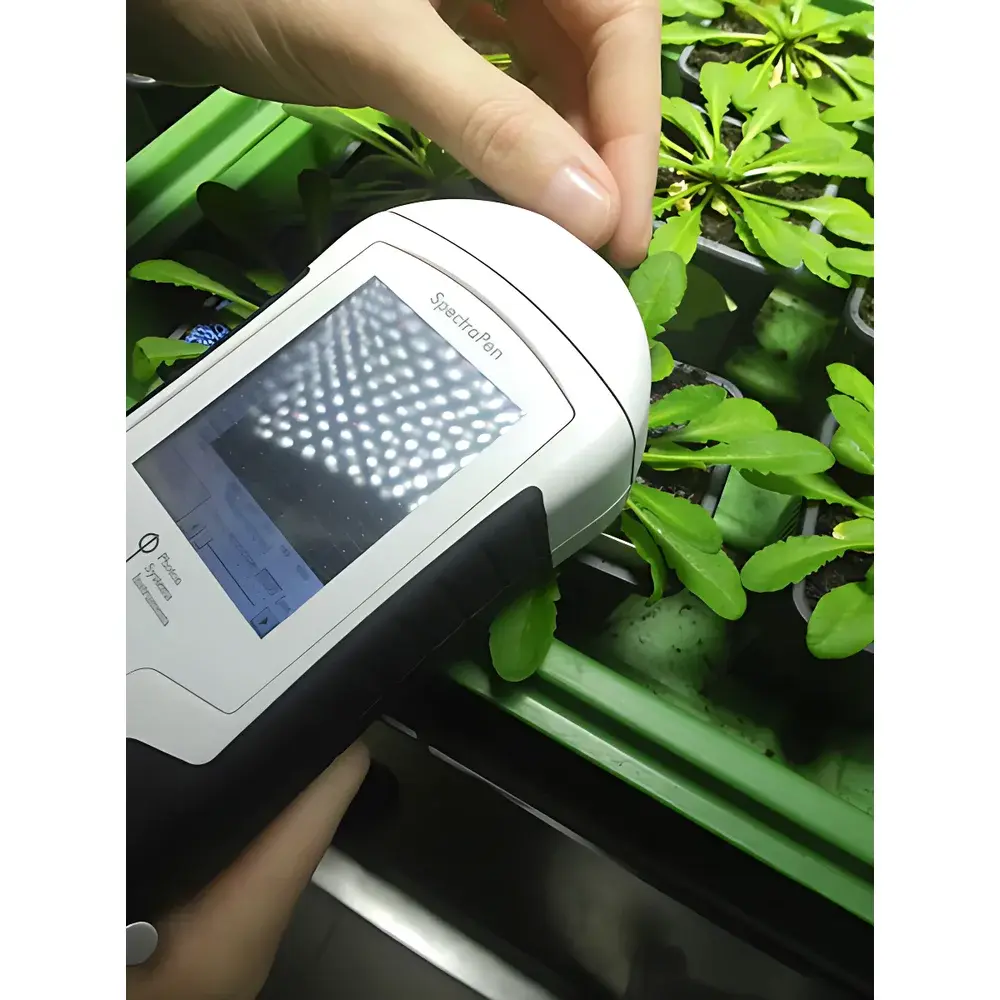
The PSI SpectraPen SP110 Handheld Spectrometer is a field-deployable, high-fidelity optical measurement instrument engineered for quantitative spectral analysis in plant physiology, agroecology, and photobiological research. Based on miniature Czerny–Turner optical architecture with a 256-pixel linear CCD detector, the SP110 delivers calibrated spectral radiance, reflectance, transmittance, absorbance, and fluorescence intensity data across two interchangeable spectral bands: UV-VIS (340–780 nm) and NIR (640–1050 nm). Unlike benchtop spectrometers requiring external light sources or PCs, the SP110 operates autonomously—integrating a rechargeable Li-ion battery, real-time touchscreen interface, onboard memory, and embedded GPS geotagging. Its optical design minimizes stray light (−30 dB) and ensures wavelength repeatability of ±0.5 nm—critical for longitudinal monitoring of spectral shifts associated with pigment composition, leaf senescence, stress response, or canopy structural changes. The device complies with CE and RoHS directives and supports traceable measurements under GLP-aligned workflows when paired with PSI’s optional calibration standards.
Key Features
- Self-contained operation: No external computer required—full spectral acquisition, visualization, and basic calculation performed directly on the 240×320 pixel color touchscreen.
- Dual-band modularity: Select between SP110-UVIS (340–780 nm) and SP110-NIR (640–1050 nm) configurations to match application-specific spectral needs—from chlorophyll-a/b absorption peaks to NIR water band detection.
- Flexible optical coupling: Standard SMA905 interface accommodates interchangeable fiber probes; optional cosine corrector enables irradiance measurement of natural daylight or artificial grow lights per ISO/CIE guidelines.
- High dynamic range & precision: 16-bit analog-to-digital conversion with dual-gain mode (1:4300 / 1:13000) ensures accurate quantification across low-light fluorescence and high-intensity solar reflectance scenarios.
- Georeferenced data capture: Integrated GPS module logs latitude, longitude, altitude, and timestamp for each spectrum—enabling spatially explicit spectral mapping in field surveys or greenhouse zoning studies.
- Robust field readiness: Splash-resistant enclosure, 300 g mass, and 48-hour battery life support extended deployment in orchards, vineyards, controlled-environment chambers, or remote ecological sites.
Sample Compatibility & Compliance
The SpectraPen SP110 is optimized for non-destructive, contactless spectral interrogation of biological and optical materials—including intact leaves, fruit skins, soil surfaces, optical filters, LED panels, and protective glazing. Its spectral response aligns with established plant phenotyping protocols referenced in ISO 17123-8 (optical sensors for vegetation), ASTM E308 (computing tristimulus values), and USP (spectrophotometric analysis). When used with NIST-traceable calibration standards (e.g., diffuse reflectance tiles, irradiance lamps), measurements satisfy audit requirements for GLP and GMP environments. The instrument’s firmware supports user-defined dark/light reference routines, enabling compliant calculation of reflectance (R = Isample/Ireference) and transmittance (T = Itransmitted/Iincident) per ISO 9050 and EN 410 methodologies.
Software & Data Management
Raw spectral data (intensity vs. wavelength) are stored in proprietary .SPX format and exportable via USB mass storage mode to standard CSV or ASCII files for downstream analysis in MATLAB, R, Python (NumPy/Pandas), or commercial platforms such as OriginLab or ENVI. PSI provides the free SpectraPen Control Suite for Windows/macOS, which supports batch processing, spectral normalization, derivative analysis, and vegetation index computation (e.g., NDVI, PRI, ANTH). All data include embedded metadata: GPS coordinates, UTC timestamp, integration time, detector gain setting, and calibration file ID. Audit trail functionality records operator ID, measurement sequence, and firmware version—supporting compliance with FDA 21 CFR Part 11 where electronic records are subject to regulatory review.
Applications
- Plant spectral phenotyping: Quantifying chlorophyll, carotenoid, and anthocyanin absorption features; tracking seasonal pigment dynamics; differentiating C3/C4 photosynthetic pathways via spectral signature clustering.
- Light environment characterization: Measuring spectral power distribution (SPD) of horticultural LEDs, fluorescent tubes, or greenhouse transmitted light to assess phytochrome photoequilibrium (Pfr/Ptot) and cryptochrome activation potential.
- Non-invasive fruit/vegetable quality assessment: Correlating NIR reflectance profiles with soluble solids content (Brix), firmness, or ripeness stage—validated in peer-reviewed studies on grapevine berries and rice panicles.
- Optical material testing: Evaluating transmission cutoffs of UV-blocking films, anti-reflective coatings, or agricultural shade nets using calibrated transmittance spectra.
- Ecophysiological field campaigns: Mapping spatial heterogeneity in canopy reflectance across silvopastoral systems or drought-stressed plots, with geotagged spectra enabling GIS integration.
FAQ
Does the SpectraPen SP110 include an internal light source?
No—the SP110 is a passive spectrometer and does not contain an integrated illuminator. It measures ambient light, reflected light from external sources (e.g., sunlight or lab lamps), or emitted fluorescence excited by user-provided light sources.
Can I measure absolute irradiance without additional hardware?
Absolute irradiance (W·m⁻²·nm⁻¹) requires calibration with a NIST-traceable irradiance standard and use of the optional cosine corrector. The base unit provides relative spectral intensity only.
What is the minimum integration time, and how does it affect signal-to-noise ratio?
Minimum integration time is 5 ms. Shorter times reduce saturation risk under bright illumination but decrease SNR; longer integrations (up to 10 s) improve sensitivity in low-light conditions, especially for weak fluorescence signals.
Is the GPS module operational indoors or under dense canopy?
GPS performance degrades significantly without direct sky visibility. For indoor or forest-floor applications, positional metadata must be manually entered or supplemented with external GNSS loggers.
How is spectral calibration maintained over time and temperature?
The SP110 employs factory-applied wavelength and intensity calibration coefficients stored in non-volatile memory. Users may perform periodic dark/light reference measurements to compensate for thermal drift; no field recalibration tools are provided.