
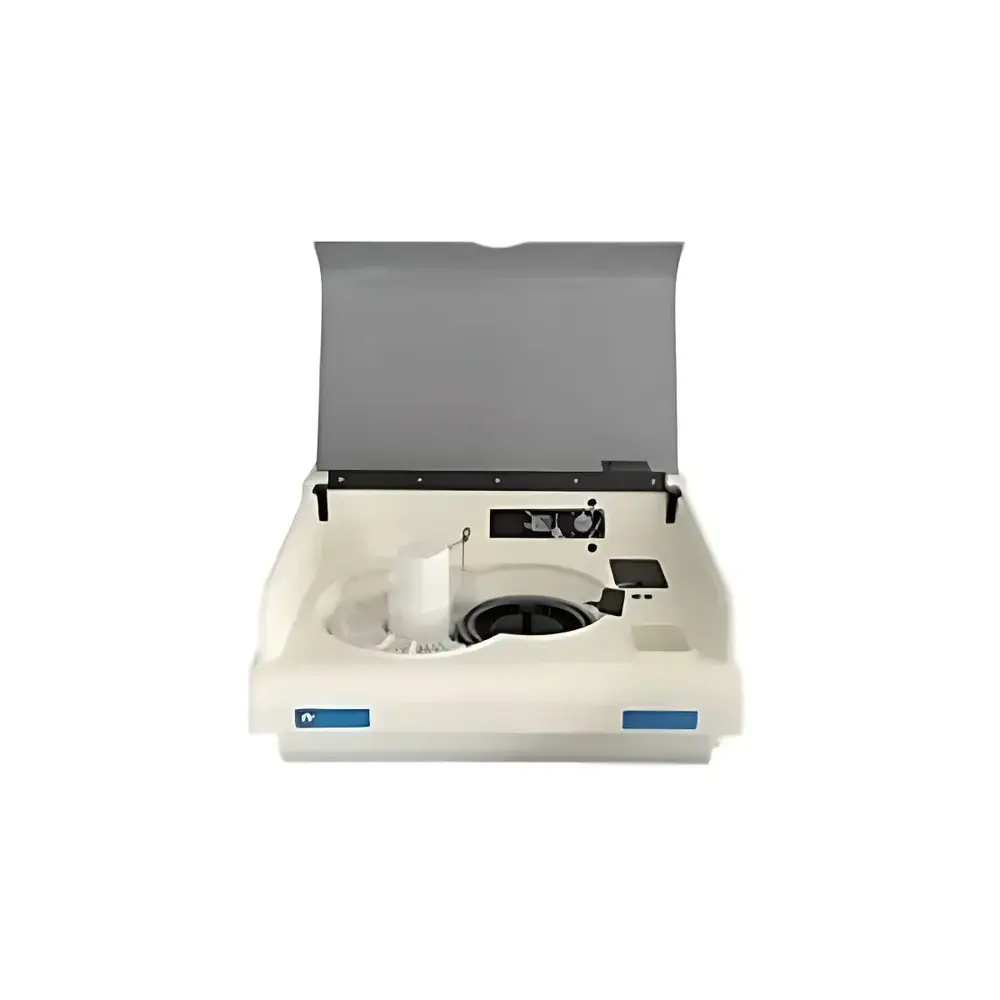
SYSTEA EasyChem Plus Automated Wet-Chemistry Analyzer
| Brand | SYSTEA |
|---|---|
| Origin | Italy |
| Model | EasyChem Plus |
| Optical System | 6 V/10 W halogen lamp with UV extension |
| Filter Wheel | 10-position, 9 interference filters (340, 405, 480, 505, 546, 578, 630, 670, 880 nm |
| Photometric Range | 0–3 Abs |
| Accuracy | ±0.5% or ±1 mAbs (0.1–2.5 Abs) |
| Linearity | ±0.5% (0.1–1.5 Abs) |
| Flow Cell Pathlength | 15 mm or 50 mm selectable |
| Sample Capacity | 60 positions |
| Reagent Carousel | 30-position, refrigerated |
| Analysis Throughput | 60–90 determinations/hour |
| Detection Modes | Endpoint, Differential, Kinetic |
| Calibration Standards | 1–16 points |
| Dilution Precision | 500 µL syringe, 0.096 µL resolution |
| Software Compliance | Audit-trail enabled, QC database with multi-level control (e.g., Westgard rules), automatic pre- and post-dilution, on-board standard series generation |
Overview
The SYSTEA EasyChem Plus Automated Wet-Chemistry Analyzer is a benchtop segmented-flow analyzer engineered for high-precision, multi-parameter determination in environmental, agricultural, and industrial laboratories. It implements standardized wet-chemical methodologies—including colorimetric, enzymatic, and ion-selective reactions—based on ASTM D3370, ISO 15681, USP , and EPA Methods 353.2, 365.2, and 4500-NH3F. Unlike discrete analyzers or direct-reading photometers, the EasyChem Plus employs a single, thermally stabilized flow-through cuvette with precisely controlled reagent/sample segmentation, eliminating inter-cuvette optical variability and ensuring measurement traceability across all parameters. Its core architecture follows the principles of continuous-flow analysis (CFA) as defined in the seminal work of Skeggs (1957), adapted for modern microfluidic precision via computer-synchronized peristaltic pumping, timed reagent injection, and wavelength-specific photometry.
Key Features
- Single-Cuvette Multi-Parameter Architecture: All analyses—regardless of chemistry—occur in one optically calibrated 15 mm or 50 mm pathlength flow cell, enabling rigorous cross-parameter comparability and eliminating calibration drift between dedicated channels.
- Automated Dual-Dilution Capability: Integrated 500 µL syringe with 0.096 µL resolution performs both pre-analytical dilution (for high-concentration samples) and post-measurement auto-dilution (for out-of-range results), maintaining stoichiometric integrity without manual intervention.
- Full-Spectrum Photometric Engine: A stabilized 6 V/10 W halogen source with optional UV enhancement couples with a 10-position filter wheel housing nine certified interference filters (340–880 nm, ±2 nm FWHM). Automatic zeroing at each wavelength ensures baseline stability across extended runs.
- Refrigerated Reagent Management: The 30-position chilled carousel maintains reagent integrity at 4–8 °C, critical for enzyme-based assays (e.g., urease, nitrate reductase) and light-sensitive chemistries (e.g., phenol-hypochlorite).
- Self-Validating Hardware: Onboard diagnostics monitor pump performance, fluidic pressure, lamp intensity, and filter positioning in real time, logging events for GLP/GMP-compliant audit trails.
- Modular Workflow Control: Each sample can be assigned a unique analytical profile—selecting specific wavelengths, reaction times, dilution factors, and calibration curves—enabling heterogeneous batch processing without protocol interruption.
Sample Compatibility & Compliance
The EasyChem Plus supports diverse matrices under validated method frameworks: freshwater, seawater, wastewater, soil extracts (EPA 3050B/3051A), plant digests (AOAC 985.25), wine musts, and fertilizer solutions. For marine applications, the 50 mm flow cell enhances sensitivity for low-abundance analytes such as silicate and ortho-phosphate in oligotrophic systems. Soil and plant analyses leverage optimized digestion protocols compliant with ISO 11260 (total N) and ISO 11261 (total P). All metal determinations—including Cr(VI), Cu, Ni, and Mn—adhere to ISO 11885 and EPA 200.7 requirements for speciation integrity. The system meets EU Directive 2000/60/EC (Water Framework Directive) monitoring criteria and supports data export formats compatible with LIMS integration (ASTM E1467, HL7 v2.x).
Software & Data Management
SYSTEA’s proprietary ChemLab software provides full 21 CFR Part 11 compliance through electronic signatures, role-based access control, immutable audit logs, and automated backup. It enables dynamic calibration curve generation from 1–16 standards with polynomial or linear regression options. Quality control is enforced via integrated Westgard multirule evaluation (12s, 13s, 22s, R4s, 41s, 10x) and Levey-Jennings charting. Raw absorbance data, kinetic traces, and dilution histories are retained with timestamped metadata. Reports conform to ISO/IEC 17025 documentation standards and support PDF, CSV, and XML exports for regulatory submission.
Applications
- Environmental monitoring of nutrient cycling (NH4+, NO2−, NO3−, TN, TP, ortho-PO43−) in estuarine, lacustrine, and wastewater systems
- Speciation analysis of redox-active metals (Fe2+/Fe3+, Cr(VI), Mn2+) in contaminated sediments and leachates
- Food and beverage quality control: urea in wine, phenolics in olive oil extracts, hardness in bottled water
- Agricultural testing: Kjeldahl nitrogen in compost, available phosphorus in fertilizers, micronutrient profiling in foliar sprays
- Research-grade biogeochemical studies requiring traceable, reproducible quantification across multi-year datasets (e.g., long-term nutrient flux modeling in wetlands)
FAQ
Does the EasyChem Plus require external sample preparation for all parameters?
No—most parameters (e.g., ammonia, nitrate, phosphate, sulfate) are measured directly. However, total Kjeldahl nitrogen (TKN), total Kjeldahl phosphorus (TKP), cyanide, fluoride, and phenolics require prior acid digestion, distillation, or derivatization per ISO 5664, ISO 6495, or EPA 4500-CN−.
How does the system ensure long-term photometric stability?
The halogen lamp operates at constant voltage with thermal feedback control; optical alignment is factory-calibrated and verified during startup via reference filter checks. Zeroing occurs automatically before every measurement cycle at the selected wavelength.
Can the instrument interface with laboratory information management systems (LIMS)?
Yes—via configurable ODBC drivers and HL7-compliant message templates. Raw data, QC flags, and calibration logs are exportable in structured formats meeting ISO/IEC 17025 Clause 7.7 requirements.
What maintenance intervals are recommended for routine operation?
Daily: Cuvette cleaning and waste line inspection. Weekly: Pump tubing replacement and reagent level verification. Quarterly: Lamp intensity validation and filter wheel positional calibration. Annual: Full optical path verification and pressure sensor recalibration by SYSTEA-certified service engineers.
Is method validation support available for regulatory submissions?
SYSTEA provides application notes aligned with EPA, ISO, and ASTM methods, including documented LOD/LOQ studies, recovery experiments (spike/recovery across matrix types), and inter-laboratory precision data upon request.






