
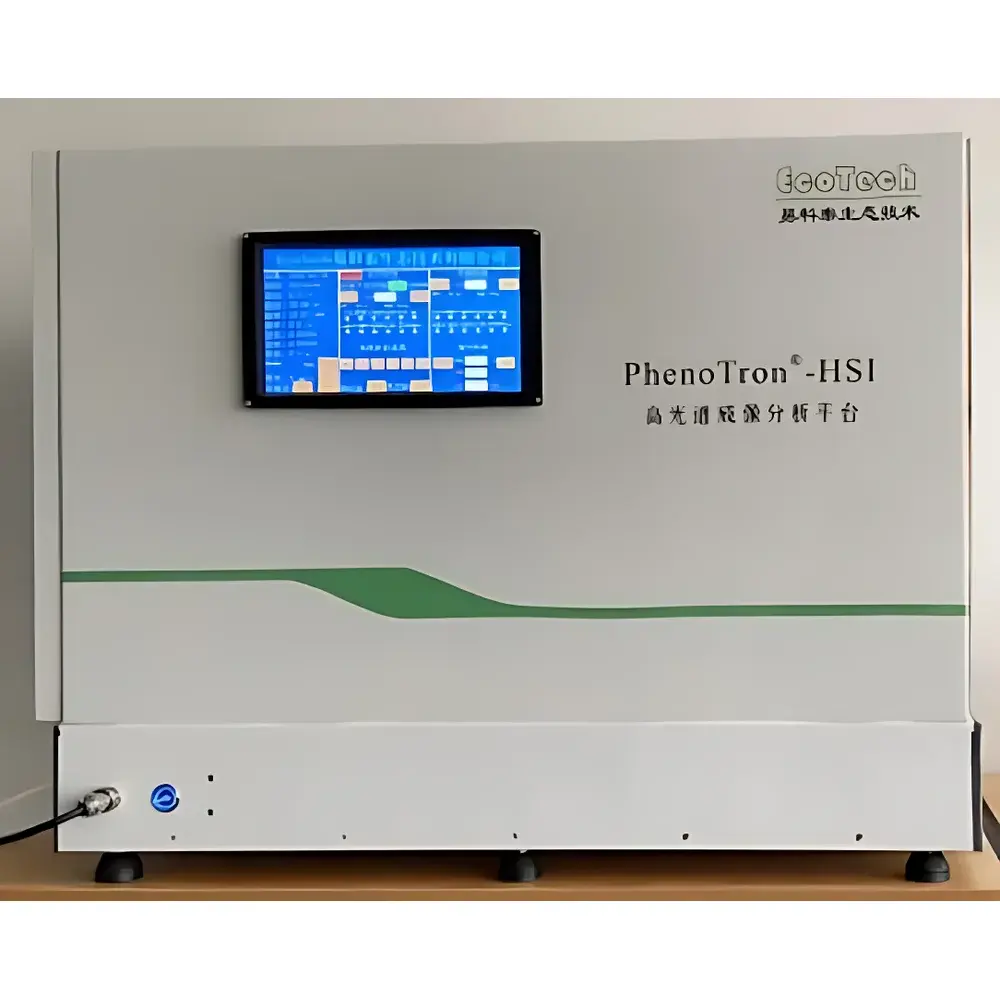
PhenoTron®-HSI Hyperspectral Imaging Analysis System
| Origin | Beijing |
|---|---|
| Manufacturer Type | Distributor |
| Origin Category | Domestic (China) |
| Model | PhenoTron®-HSI |
| Pricing | Upon Request |
| Operating Principle | Push-broom |
| Imaging Method | Dispersive |
| Deployment Mode | Ground-based |
| Spectral Range | 400–1700 nm |
| Spectral Resolution (FWHM) | 5.5 nm (VNIR), 8 nm (NIR) |
| Spatial Resolution (IFOV) | 1024 px (VNIR), 640 px (NIR) |
| Field of View (TFOV) | 38° |
| Frame Rate | 330 Hz (VNIR), 670 Hz (NIR) |
| Spectral Channels | 224 |
| F-number | F/1.7 |
| Scan Area | ≥300 × 300 mm |
| Platform Height (Standard) | 400 mm |
| Translation Speed | 2–40 mm/s (adjustable, ±1 mm accuracy) |
| Integrated Sensors | Ambient temperature, relative humidity, illuminance, real-time clock |
Overview
The PhenoTron®-HSI Hyperspectral Imaging Analysis System is a laboratory-grade, ground-based push-broom hyperspectral imager engineered for quantitative spectral phenotyping and non-destructive material characterization. It operates on the principle of dispersive spectroscopy—using a high-throughput prism-grating spectrometer to spatially separate reflected or transmitted light across contiguous narrowband spectral channels. The system captures full-frame hypercubes (x, y, λ) with high radiometric fidelity, enabling pixel-wise spectral signature extraction from static or slowly translated samples. Designed specifically for controlled-environment applications, it supports VNIR (400–1000 nm) and NIR (900–1700 nm) spectral acquisition in dual-band configuration, with calibrated spectral resolution of 5.5 nm (FWHM) in the visible-near-infrared region and 8 nm (FWHM) in the shortwave infrared region. Its optical architecture—featuring an F/1.7 aperture, uniform collimated illumination, and stray-light suppression—is optimized for reproducible reflectance measurements under standardized lighting conditions, meeting foundational requirements for ASTM E275, ISO 13406-2, and GLP-compliant spectral data acquisition protocols.
Key Features
- PTS (Phenotyping Transmission System) integrated platform: motorized sample translation stage with programmable speed (2–40 mm/s, ±1 mm positional accuracy), synchronized with line-scan acquisition and ambient light shielding enclosure;
- Modular star-topology IoT architecture: supports seamless integration with 5G-enabled remote monitoring, firmware-over-the-air (FOTA) updates, and distributed sensor networks;
- Dual-control interface: embedded Linux-based OS with 10-inch capacitive touchscreen + Windows-compatible SpectrAPP® GUI; wireless operation up to 5 km in line-of-sight conditions;
- Protocol-driven automation: user-defined acquisition sequences (≥10 command steps), including trigger synchronization, illumination ramping, environmental logging, and metadata stamping;
- Onboard environmental sensing: real-time recording of ambient temperature, relative humidity, and illuminance; hardware clock with NTP synchronization capability;
- Optical design: fully adjustable symmetric broadband illumination (angle and height), precision-aligned imaging path, and calibrated flat-field correction to ensure spatial-spectral uniformity across the FOV (38° TFOV).
Sample Compatibility & Compliance
The PhenoTron®-HSI accommodates flat, rigid, or semi-rigid specimens up to 300 × 300 mm (customizable to 500 × 500 mm), including plant organs (leaves, seedlings, roots, fruits), agricultural commodities (grains, seeds, tubers), herbal matrices (dried roots, leaves, powders), soil cores, mineral thin sections, and solid waste particulates. Sample handling complies with ISO 21500 (project management for analytical workflows) and supports traceable metadata generation per ISO/IEC 17025:2017 Annex A.2. The system’s spectral calibration traceability follows NIST-traceable standards (e.g., certified reflectance tiles, tungsten-halogen lamp reference), and raw hypercube export formats (ENVI .hdr/.bil, HDF5) are compatible with FDA 21 CFR Part 11–compliant LIMS environments when deployed with audit-trail-enabled SpectrAPP® modules.
Software & Data Management
SpectrAPP® is a domain-specific analysis suite developed for hyperspectral phenomics and material spectroscopy. It provides native support for ENVI, MATLAB, and Python (via spectral Python library) interoperability. Core functionalities include: pseudo-color and grayscale spectral band visualization; multi-band fusion (e.g., RGB + NDVI overlay); ROI-based spectral averaging and statistical reporting (mean, SD, skewness, kurtosis); spectral index computation (NDVI, PRI, DCNI, CRI, ARI, PSRI, NPQI, EVI, HI, WBI, among >30 preconfigured indices); derivative spectroscopy (1st/2nd order); spectral angle mapper (SAM) classification; and PCA-based feature reduction. All analyses generate timestamped, metadata-embedded reports in PDF, CSV, or GeoTIFF formats. Raw data storage adheres to FAIR principles (Findable, Accessible, Interoperable, Reusable), with optional encryption and DICOM-SR extension for cross-platform archival.
Applications
- Plant phenotyping: non-invasive quantification of chlorophyll content, water status, nitrogen distribution, and stress-induced biochemical shifts during early seedling development, leaf senescence, or abiotic/biotic challenge;
- Seed quality assessment: detection of insect infestation (e.g., Callosobruchus chinensis in mung beans), viability prediction, and purity screening via spectral fingerprinting;
- Agricultural product grading: spatial mapping of soluble solids content (SSC) in apples, firmness in tomatoes, or starch degradation in potatoes;
- Traditional medicine authentication: discrimination of geographical origin and adulteration in Salvia miltiorrhiza, Ginseng, or Scutellaria baicalensis using chemometric models trained on reference spectral libraries;
- Soil and mineralogical analysis: identification of clay mineral assemblages (kaolinite, smectite), organic matter content estimation, and heavy metal contamination proxies via continuum-removed absorption features;
- Environmental forensics: spectral unmixing of landfill leachate residues, microplastic identification in sediment matrices, and vegetation cover change detection in remediation monitoring.
FAQ
What spectral calibration standards are supported?
The system includes factory calibration using NIST-traceable reflectance standards (Spectralon® 99% and 2% tiles) and a tungsten-halogen lamp. Users may perform field recalibration using supplied portable standards.
Is the system compliant with Good Laboratory Practice (GLP) documentation requirements?
Yes—SpectrAPP® supports electronic signatures, audit trails, version-controlled protocol storage, and instrument usage logs required for GLP audits per OECD Principles of GLP and ISO/IEC 17025.
Can the PhenoTron®-HSI be integrated with fluorescence imaging modules?
Yes—its modular design allows mechanical and electrical interfacing with optional chlorophyll fluorescence (PAM) or UV-induced fluorescence attachments, enabling concurrent reflectance-fluorescence hypercube acquisition.
What file formats does SpectrAPP® export for downstream chemometric modeling?
Exports include ENVI BIL/HDR, HDF5 (with metadata schema), CSV (ROI-averaged spectra), and MATLAB .mat files—fully compatible with Unscrambler®, R (hyperSpec), and Python scikit-learn pipelines.
Does the system support dynamic scanning of living root systems in rhizoboxes?
With custom stage adaptation and transparent substrate calibration, the system supports time-series imaging of root architecture and exudate-mediated spectral changes under controlled moisture and nutrient gradients.
Related Products





