
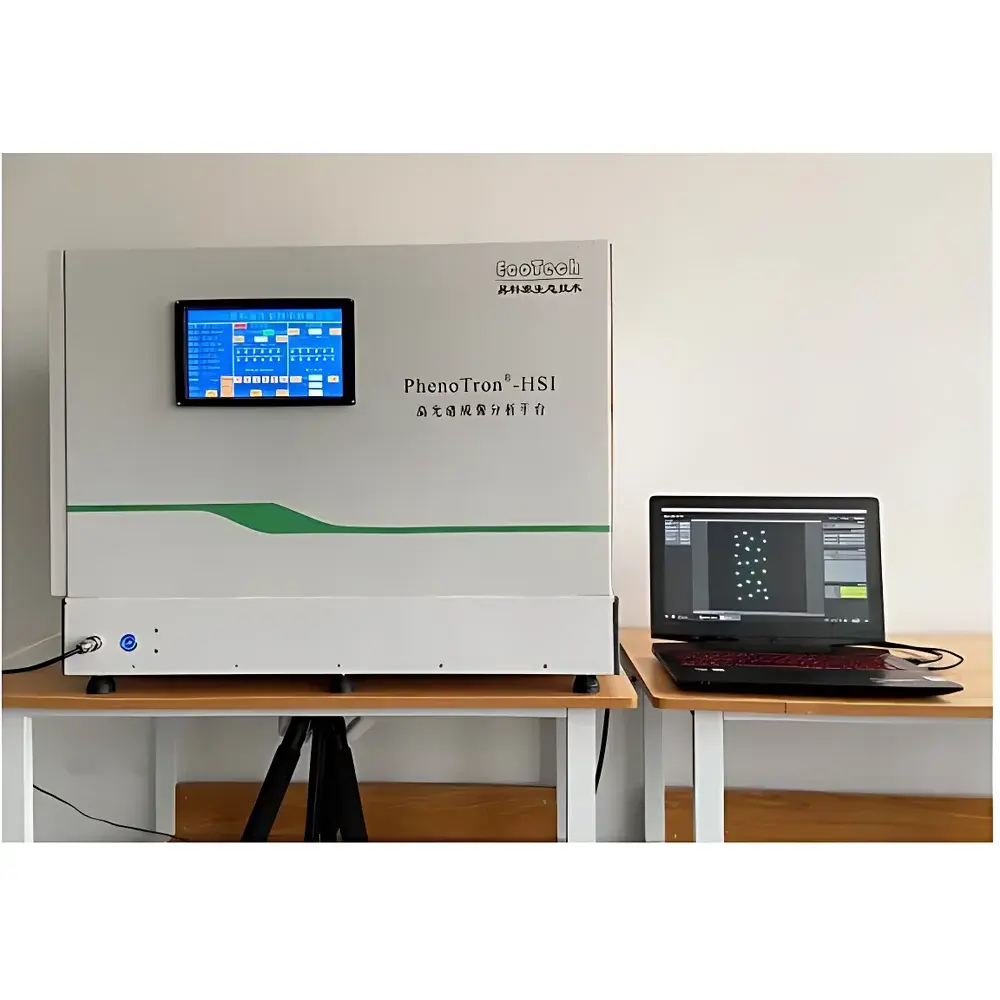
PhenoTron-HSI Multispectral High-Resolution Hyperspectral Imaging Phenotyping System
| Brand | EKO-TECH |
|---|---|
| Origin | Beijing, China |
| Manufacturer Type | Authorized Distributor |
| Country of Origin | China |
| Model | PhenoTron-HSI |
| Pricing | Upon Request |
Overview
The PhenoTron-HSI Multispectral High-Resolution Hyperspectral Imaging Phenotyping System is an integrated, non-destructive, high-throughput platform engineered for quantitative phenotypic characterization of plant genetic resources across developmental stages—from seed and seedling to root architecture and early vegetative growth. Leveraging push-broom hyperspectral imaging (400–1000 nm) coupled with synchronized fluorescence excitation and thermal infrared acquisition, the system captures spatially resolved spectral signatures reflecting biochemical composition (e.g., chlorophyll, carotenoids, anthocyanins), physiological status (e.g., photosynthetic efficiency, stress-induced fluorescence quenching), structural morphology, and metabolic activity. Its core measurement principle combines reflectance-based spectral fingerprinting with fluorescence lifetime-independent intensity ratio analysis (e.g., F690/F740, F520/F690) and thermal dissipation mapping—enabling robust, operator-independent assessment of seed vigor, abiotic/biotic stress resilience, germination synchrony, and seedling developmental competence. Designed for controlled-environment phenotyping labs, germplasm banks, and breeding programs, the PhenoTron-HSI supports GLP-aligned experimental workflows and scalable digital trait capture.
Key Features
- PTS (Phenotyping Transport & Synchronization) modular platform: motorized conveyor with ±1 mm positional repeatability, ambient light isolation chamber, and real-time environmental monitoring (integrated temperature, humidity, and PAR sensors)
- Dual-control architecture: embedded Linux-based touchscreen interface (10″ capacitive display) + Windows-compatible GUI software (SpectrAPP® & FluorVision©) with wireless operation and remote protocol scheduling
- Customizable acquisition protocols: up to 12 sequential command sets per experiment—including stage-triggered illumination switching, multi-spectral scan sequencing, and synchronized thermal/fluorescence capture
- Multi-modal sensor integration: standard visible-NIR hyperspectral imager (VNIR, 400–1000 nm, 5 nm FWHM); optional add-ons include thermographic IR module (7.5–13.5 µm, 640 × 512 resolution) and UV-excited fluorescence imaging (365 nm LED array, BGF & ChlF detection)
- Optimized optical environment: symmetrical full-spectrum illumination source with adjustable height and incident angle; stray-light suppression baffling ensures radiometric stability (±0.8% inter-scan repeatability under constant lab conditions)
Sample Compatibility & Compliance
The PhenoTron-HSI accommodates flat, planar biological samples up to 300 × 300 mm (customizable to 500 × 500 mm), including intact seeds (cereal, legume, oilseed), germinated seedlings (coleoptile/hypocotyl/root systems), detached leaves, and tissue sections. Sample trays are compatible with standard Petri dishes, germination paper, agar plates, and hydroponic mats. The system meets ISO/IEC 17025 calibration traceability requirements for spectral radiance measurements and supports audit-ready data provenance via embedded time-stamped metadata (UTC-synchronized clock, environmental logs, user ID tagging). Software modules comply with FDA 21 CFR Part 11 for electronic records and signatures when deployed in regulated breeding or seed certification environments.
Software & Data Management
SpectrAPP® delivers comprehensive reflectance-based analysis: ROI-driven spectral extraction, VI computation (NDVI, PRI, ARI, PSRI, WBI, EVI, HI, NPQI, DCNI, CRI), multivariate clustering (PCA, PLS-DA), and exportable spectral libraries compliant with SpectralDB and CropOntology standards. FluorVision© enables quantitative fluorescence phenotyping: pixel-wise ratio mapping (F690/F740, F440/F740), kinetic-free parameter derivation, morphometric quantification (circularity, solidity, aspect ratio, convex hull area), and batch-mode statistical reporting (ANOVA, Tukey HSD). Both applications generate FAIR-compliant outputs (Findable, Accessible, Interoperable, Reusable), including CSV, GeoTIFF, and HDF5 formats, and integrate with BreedBase and BrAPI v2.0 for upstream breeding database ingestion.
Applications
- Seed vigor assessment via metabolic heat signature (IR) + chlorophyll fluorescence kinetics (Fv/Fm analogs) + NIR protein/lipid absorption modeling
- Early-stage biotic stress detection: Callosobruchus chinensis infestation in mung bean seeds using spectral anomaly detection at 550–570 nm and 720–740 nm bands
- High-throughput screening of drought-tolerant maize lines via PRI (Photochemical Reflectance Index) dynamics and stomatal conductance proxy mapping
- Digital germplasm passport generation: spectral fingerprint archiving linked to morphological descriptors (root length density, shoot biomass proxies) and biochemical markers (anthocyanin index, carotenoid reflectance ratio)
- Root architecture phenotyping under transparent gel media using NIR transmittance imaging and spectral unmixing of root vs. medium signatures
FAQ
What spectral range does the standard hyperspectral sensor cover?
The base configuration includes a VNIR push-broom imager spanning 400–1000 nm with 5 nm spectral sampling and <1.5 nm optical resolution.
Can the system operate in ambient laboratory lighting?
Yes—the PTS enclosure provides >99.9% ambient light rejection; internal illumination is fully controllable and spectrally stable.
Is spectral calibration performed in-house prior to shipment?
Each unit undergoes NIST-traceable radiometric and wavelength calibration using certified reference panels and mercury-argon lamp sources; calibration certificates are provided.
How is data integrity ensured during long-term deployment in breeding trials?
All acquisitions embed EXIF-like metadata (timestamp, sensor temp, exposure, stage position, ambient RH/T), and software enforces version-controlled protocol templates with digital signature logging.
Does the system support integration with automated greenhouse or growth chamber control systems?
Yes—via TCP/IP API and Modbus RTU interfaces, enabling synchronization with environmental controllers (e.g., Priva, Argus) for time-resolved stress imposition and response capture.





