PSI PlantScreen Conveyor-Based High-Throughput Plant Phenotyping Platform
| Brand | PSI (Czech Republic) |
|---|---|
| Origin | Czech Republic |
| Model | PlantScreen Conveyor Edition |
| Compliance | CE, EN 60529, EN 55011, 2006/42/EC, 2004/108/EC, 73/23/EEC |
| Data Storage Capacity | 12 TB MySQL Database |
| Imaging Throughput | Up to 100 plants per 100 minutes (protocol-dependent) |
| Conveyor Capacity | Standard 50 pots (expandable to 400) |
| Max Plant Height | 200 cm |
| Weighing Accuracy | ±0.2 g (small plants), ±2 g (large plants) |
| Irrigation Flow Rate | 3 L/min |
Overview
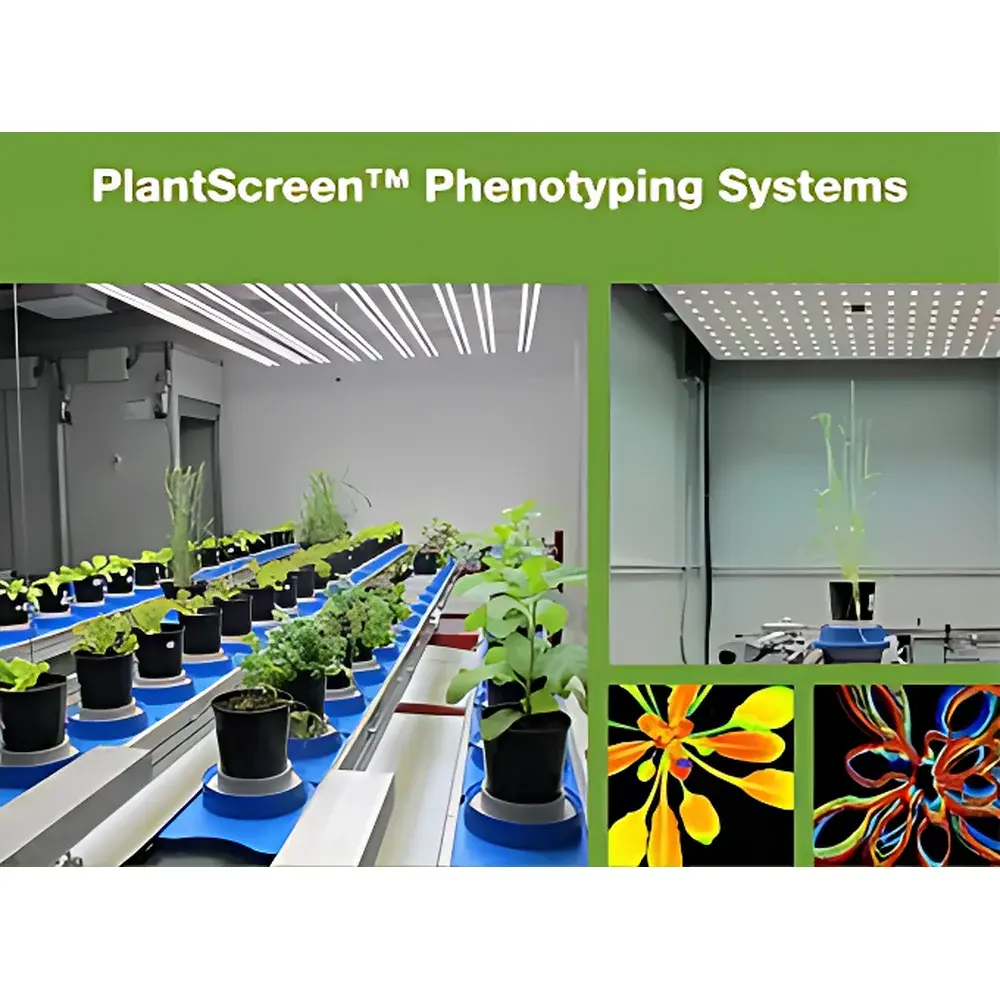
The PSI PlantScreen Conveyor-Based High-Throughput Plant Phenotyping Platform is an integrated, fully automated imaging and analysis system engineered for rigorous, reproducible, and scalable plant phenomics research. Designed and manufactured by Photon Systems Instruments (PSI), a pioneer in chlorophyll fluorescence instrumentation since the 1990s, the PlantScreen platform implements a modular, conveyor-driven architecture that enables non-destructive, longitudinal, multi-modal acquisition of structural, physiological, and functional traits across hundreds of plants per day. Its core measurement principles span quantum yield-based photosynthetic efficiency (via PAM fluorometry), thermal emissivity mapping (infrared thermography), water absorption spectroscopy (NIR imaging), spectral reflectance profiling (VNIR/SWIR hyperspectral imaging), geometric reconstruction (3D laser scanning), and root architecture quantification (RhizoTron optical window imaging). The system operates under controlled environmental conditions—including programmable photoperiods, PAR intensity, temperature, and humidity—and integrates pre-imaging acclimation protocols to ensure biological comparability across timepoints and experimental replicates. It is deployed globally in academic plant science laboratories, public crop breeding programs, agribiotech R&D centers, and regulatory ecotoxicology facilities conducting GLP-compliant stress-response studies.
Key Features
- Modular, expandable hardware architecture supporting concurrent or sequential deployment of up to nine complementary imaging modalities: chlorophyll fluorescence (FluorCam), RGB 3D morphology, VNIR/SWIR hyperspectral reflectance, infrared thermography, near-infrared (NIR) water status imaging, multi-spectral fluorescence (GFP/YFP, phenolic compounds), 3D laser scanning, RhizoTron root imaging, and automated irrigation/weighing.
- Conveyor-based sample handling with RFID/QR-code identification, laser height sensing, and precision PLC-controlled positioning—enabling unattended operation over multi-week experiments with full traceability of each pot, plant, and measurement event.
- Dedicated light-adaptation chamber equipped with tunable cold-white (6500 K) and far-red (735 nm) LED arrays (0–100% intensity, 1% steps), active ventilation, vertical curtain isolation, and IP monitoring—ensuring standardized photochemical state prior to fluorescence or thermal measurements.
- High-fidelity imaging sensors: 12.8 MP RGB CMOS (top/side), 1.4 MP cooled CCD for fluorescence (16-bit A/D), 640×480 microbolometer IR camera (30 mK sensitivity), InGaAs NIR sensor (900–1700 nm), push-broom VNIR (400–950 nm, 1920 bands) and SWIR (900–1700 nm, 510 bands) spectrometers.
- Advanced 3D data fusion capability: RGB and laser-scanned point clouds serve as spatial scaffolds onto which fluorescence quantum yields, thermal maps, NIR moisture indices, and hyperspectral vegetation indices are co-registered and visualized in anatomically accurate context.
- Fully programmable measurement protocols via PSI’s proprietary Phenotype Management System (PMS), supporting user-defined sequences, conditional logic (e.g., “if weight loss >15%, trigger drought protocol”), dynamic scheduling, and audit-trail logging compliant with FDA 21 CFR Part 11 requirements.
Sample Compatibility & Compliance
The PlantScreen Conveyor Edition accommodates standard polypropylene growth pots (5 L, 24 cm diameter; adaptable to 3 L) and supports monocots (maize, wheat, rice), dicots (soybean, tomato, Arabidopsis), and tropical species (coconut seedlings) up to 200 cm tall. Root imaging is performed using RhizoTron transparent growth chambers (44 × 29.5 × 5.8 cm) with three-tier irrigation and CMOS-based top-down capture. All mechanical, electrical, and optical subsystems conform to EU regulatory frameworks including CE marking, Machinery Directive 2006/42/EC, Low Voltage Directive 73/23/EEC, EMC Directive 2004/108/EC, and IP-rated enclosure standards (CSN EN 60529). Environmental monitoring modules (PAR, temperature, humidity) provide real-time metadata synchronized with image acquisition. Data integrity mechanisms—including timestamped raw file storage, checksum validation, role-based access control, and immutable experiment logs—support GLP/GMP-aligned workflows and regulatory submissions.
Software & Data Management
The platform is driven by PSI’s Phenotype Management System (PMS), a distributed client-server application built on a 12 TB MySQL relational database. PMS provides web-accessible dashboards for remote experiment monitoring, protocol editing, and result visualization. Core capabilities include: automated leaf-tracking algorithms for longitudinal growth modeling; batch processing pipelines for NDVI, PRI, NPQI, MCARI, OSAVI, and >20 additional vegetation indices; statistical comparison tools (ANOVA, PCA, hierarchical clustering); and export interfaces for MATLAB, Python (via HDF5/NetCDF), and R. All image-derived metrics—including Fv/Fm, ΦPSII, stomatal conductance proxies, canopy temperature differentials, water content gradients, and 3D biomass estimates—are stored with full provenance: instrument configuration, calibration history, environmental metadata, and operator identity. Audit trails record every parameter change, data export, and user login. Software updates are delivered remotely and installed automatically without interrupting scheduled acquisitions.
Applications
The PlantScreen Conveyor Edition serves as a foundational infrastructure for hypothesis-driven and discovery-oriented plant science. Primary use cases include: high-throughput screening of genetic resources for abiotic stress tolerance (drought, heat, salinity, nutrient deficiency); quantitative evaluation of biostimulant efficacy under controlled deficit irrigation; kinetic modeling of photosynthetic recovery post-stress; non-invasive detection of early pathogen infection via thermal or fluorescence anomalies; root-shoot coordination analysis under varying soil moisture regimes; spectral signature development for precision phenotyping in breeding pipelines; and ecotoxicological assessment of herbicide or heavy metal exposure using multi-parametric response curves. Published applications span peer-reviewed studies in Molecular Plant, Plant Methods, Frontiers in Plant Science, and Remote Sensing, validating its utility in trait discovery, QTL mapping, and translational crop improvement programs.
FAQ
What environmental controls are integrated into the system?
The platform includes programmable LED lighting (PAR, far-red), climate-controlled growth chambers (optional), real-time PAR, temperature, and humidity sensing, and a dedicated light-adaptation module with active ventilation and thermal isolation—ensuring consistent physiological baselines across experiments.
Can the system operate unattended for extended periods?
Yes. Fully automated conveyor movement, sample identification, acclimation, imaging, irrigation, weighing, and data archiving are orchestrated by the PLC-based control layer and PMS software, enabling 24/7 operation with minimal human intervention.
How is data security and regulatory compliance ensured?
Role-based authentication, encrypted database connections, immutable audit logs, electronic signatures, and 21 CFR Part 11–compliant electronic records management support ISO 17025, GLP, and GxP validation requirements.
Is remote access and troubleshooting supported?
All software components are accessible via secure HTTPS; remote diagnostics, firmware updates, and collaborative analysis sessions are facilitated through PSI’s global support network.
What level of technical support does PSI provide?
PSI offers on-site installation, protocol optimization workshops, annual maintenance contracts, and direct access to its Plant Phenotyping Research Center in Drásov, Czech Republic—including participation in the annual International Plant Phenotyping Symposium.
Related Products