
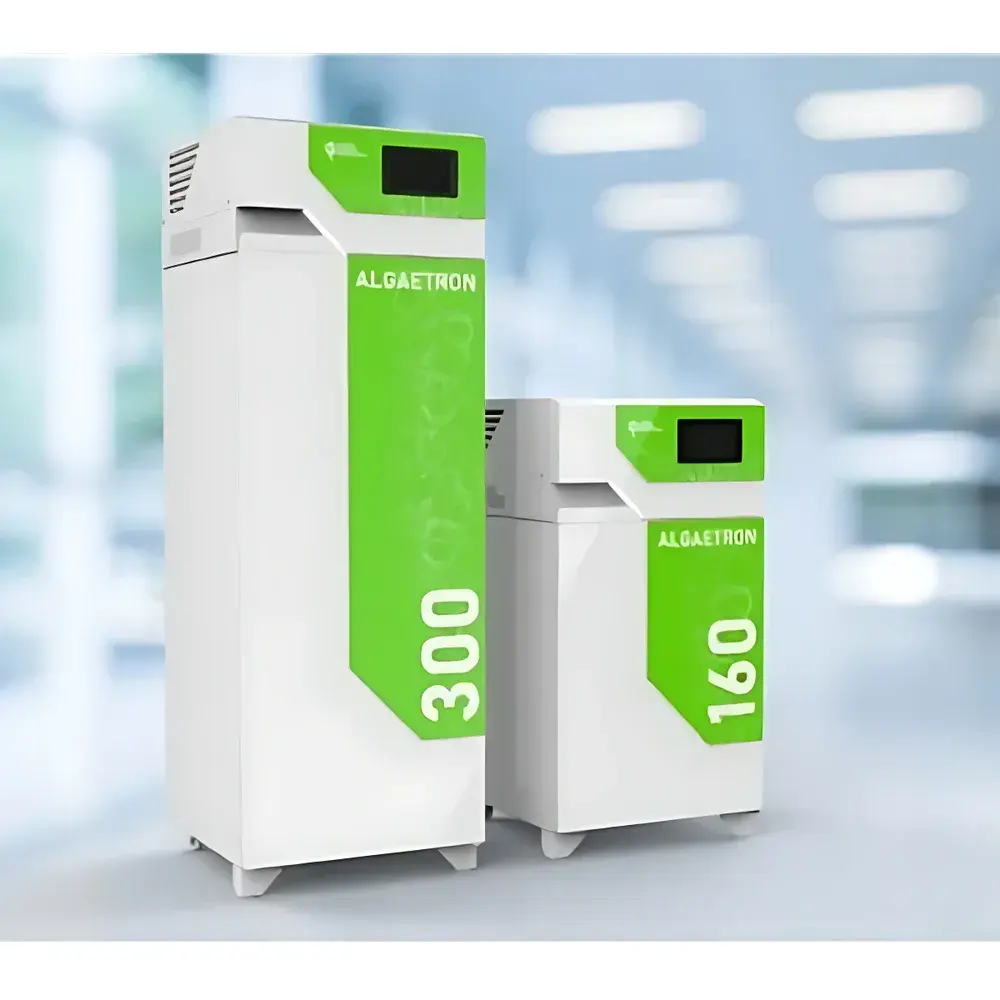
PSI AlgaeTron AG160 & AG300 LED-Controlled Algal Photobioreactor Incubation System
| Brand | PSI |
|---|---|
| Origin | Czech Republic |
| Model | AlgaeTron AG160 / AG300 |
| Capacity | 163 L (AG160) / 307 L (AG300) |
| Temperature Range | 10–45 °C |
| Illumination | White + 735 nm Far-Red LEDs |
| Max Photosynthetic Photon Flux Density (PPFD) | 1500 µmol/m²·s (top, upgradable) / 500 µmol/m²·s (lower, upgradable) |
| Illumination Layers | 2 (AG160) / 4 (AG300) |
| Total Cultivation Area | 0.38 m² (AG160) / 0.75 m² (AG300) |
| Internal Dimensions | 51 × 45 × 71 cm (AG160) / 51 × 45 × 135 cm (AG300) |
| External Dimensions | 60 × 62 × 114 cm (AG160) / 60 × 62 × 177 cm (AG300) |
| Airflow | 150 L/h |
| Refrigerant | R290 |
| Display | 7″ color LCD touchscreen |
| Programmable Protocols | Up to 100 user-defined sequences including diel cycles, dynamic light gradients, and rapid light fluctuations |
Overview
The PSI AlgaeTron AG160 and AG300 are precision-engineered, LED-based photobioreactor incubation systems designed for controlled, reproducible cultivation of microalgae, cyanobacteria, and photosynthetic model organisms under fully programmable environmental conditions. Unlike conventional growth chambers relying on fluorescent or halogen lighting, the AlgaeTron integrates spectrally tunable, high-output white and far-red (735 nm) LED arrays with active thermal management and forced-air convection—enabling quantitative photosynthetic research at physiological relevance. Its architecture supports both static and orbital agitation via integrated shaker platforms compatible with Petri dishes, multi-well plates, Erlenmeyer flasks, and custom bioreactor vessels. The system operates across a broad temperature range (10–45 °C) and delivers calibrated photosynthetic photon flux densities (PPFD) up to 1500 µmol/m²·s—critical for studying photoinhibition, non-photochemical quenching, and light-acclimation kinetics. Designed in compliance with ISO 17025-aligned laboratory infrastructure requirements, the AlgaeTron serves as a core platform for mechanistic plant physiology, climate change biology, and synthetic biology workflows requiring stringent environmental replication.
Key Features
- High-fidelity spectral control: Dual-channel LED illumination combining cool-white (400–700 nm) and far-red (735 nm) emitters enables precise modulation of phytochrome photoequilibrium and shade-avoidance responses.
- Multi-layer vertical illumination architecture: AG160 features two independently controllable light zones (top + bottom); AG300 extends to four layers (1 top + 3 lower), optimizing space utilization and inter-replicate uniformity.
- Programmable environmental dynamics: Onboard 7″ capacitive touchscreen interface supports creation and execution of up to 100 custom protocols—including circadian entrainment (e.g., 12:12 h light:dark), transient light pulses, ramped PPFD gradients, and stochastic irradiance profiles.
- Thermally stable chamber design: R290 refrigerant-based cooling ensures low-GWP operation and maintains ±0.3 °C stability across the full 10–45 °C range; airflow rate of 150 L/h minimizes thermal stratification and CO₂ boundary layer effects.
- Modular cultivation support: Standardized 48.5 × 38.5 cm shelving accommodates standard tissue culture plates (e.g., 6-/12-/24-/96-well), glass or plastic flasks (50–500 mL), and custom-mounted mini-bioreactors with integrated pH/DO probes.
Sample Compatibility & Compliance
The AlgaeTron is validated for use with unicellular algae (Chlamydomonas reinhardtii, Chlorella vulgaris, Dunaliella salina), filamentous strains (Spirogyra, Oscillatoria), nitrogen-fixing cyanobacteria (Synechocystis sp. PCC 6803), and heterotrophic bacterial co-cultures requiring synchronized light cues. Chamber materials comply with USP Class VI biocompatibility standards; interior surfaces are electropolished stainless steel (AISI 316L) with antimicrobial passivation. The system meets CE marking requirements per Directive 2014/30/EU (EMC) and 2014/35/EU (LVD), and its firmware architecture supports audit-ready data logging aligned with GLP and FDA 21 CFR Part 11 principles—ensuring traceability of parameter changes, user authentication, and electronic signature capability when integrated with PSI’s optional LabManager software suite.
Software & Data Management
Embedded firmware provides real-time acquisition of temperature, PPFD (via internal quantum sensor calibration), and protocol stage progression, visualized as time-series plots directly on the touchscreen. All parameters—including light intensity per channel, spectral ratio (white:far-red), ramp rates, dwell times, and setpoint transitions—are stored with timestamped metadata in CSV-compatible format. Exported logs include instrument serial number, operator ID, and protocol version hash—facilitating cross-laboratory reproducibility assessments. Optional integration with PSI LabManager enables centralized fleet monitoring, remote protocol deployment, automated backup to network drives, and export to MATLAB, Python (Pandas), or R environments for downstream statistical modeling of growth kinetics and phenotypic variance.
Applications
- Quantitative photophysiology: Measurement of PSII quantum yield (ΦPSII), NPQ induction kinetics, and electron transport rate (ETR) under dynamically modulated light spectra.
- Abiotic stress phenotyping: Controlled imposition of combined stressors (e.g., elevated temperature + fluctuating light + nutrient limitation) to assess resilience biomarkers and QTL mapping cohorts.
- Algal strain selection & domestication: High-throughput screening of mutant libraries under ecologically relevant diel cycles to identify variants with enhanced lipid accumulation or carbon fixation efficiency.
- Climate change simulation: Replication of projected future irradiance regimes (e.g., increased UV-B fraction, altered red:far-red ratios mimicking canopy shading shifts) to evaluate transcriptional and metabolic adaptation.
- Transgenic validation: Phenotypic confirmation of CRISPR-edited lines under standardized, traceable environmental envelopes—supporting regulatory submissions under OECD Consensus Documents.
FAQ
Can the AlgaeTron accommodate custom vessel geometries beyond standard flasks and plates?
Yes—the shelving system accepts third-party bioreactor modules with external mounting brackets; maximum load per shelf is 8 kg, and clearance height allows vessels up to 25 cm tall.
Is spectral calibration traceable to NIST standards?
Each unit ships with factory-applied quantum sensor calibration certificates traceable to PTB (Physikalisch-Technische Bundesanstalt); annual recalibration services are available through PSI-certified service centers.
Does the system support CO₂ enrichment or O₂ monitoring?
CO₂ injection ports and optional gas-mixing manifolds (0–5% v/v) are available as add-on modules; integrated dissolved oxygen and pH probe interfaces require the AlgaeTron SensorHub expansion kit.
How is data integrity ensured during power interruption?
Non-volatile memory retains all active protocols and logged data; upon recovery, the system resumes from last known state with automatic timestamp correction and event-flagged interruption markers.
What maintenance intervals are recommended for long-term operational reliability?
LED output verification every 12 months; condenser coil cleaning every 6 months; refrigerant pressure check every 24 months—full service schedule is documented in the IEC 62304-compliant maintenance manual.





