

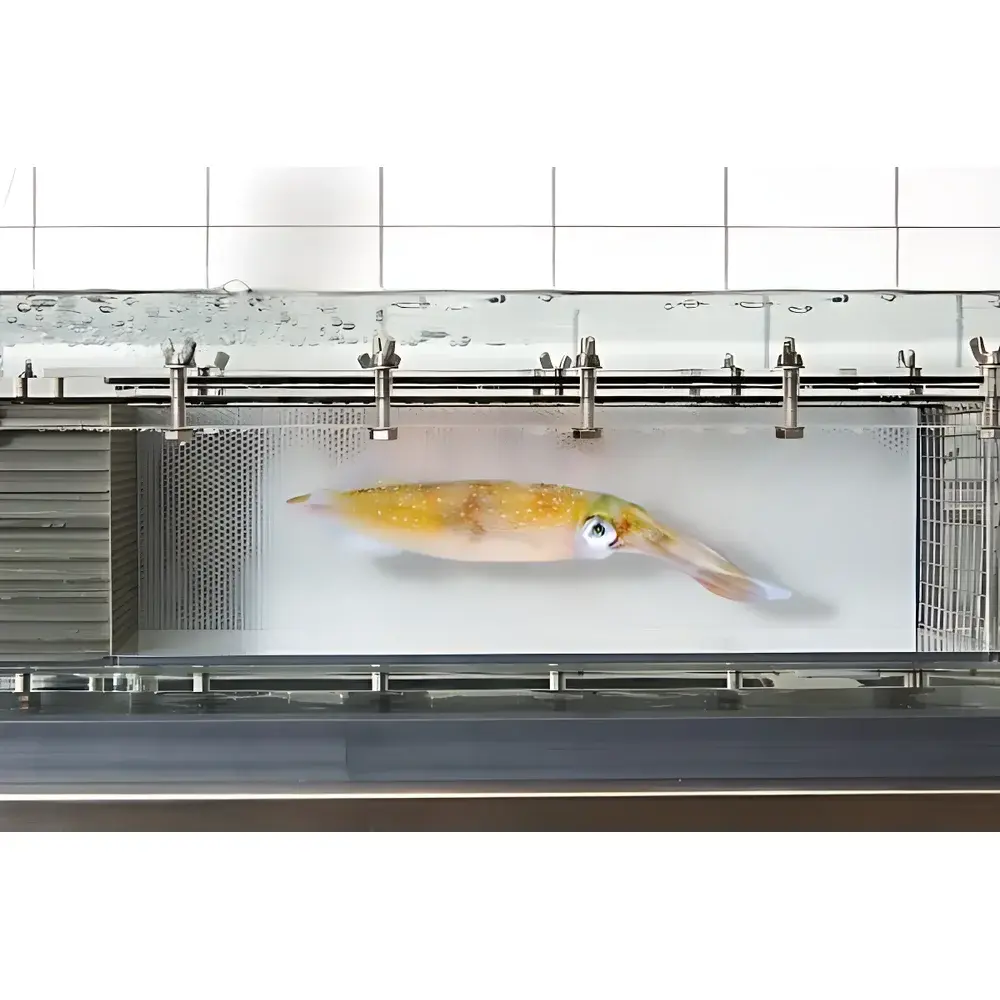
Loligo Systems Fish Swimming Performance System
| Brand | Loligo Systems |
|---|---|
| Origin | Denmark |
| Model | Fish Swimming Performance System |
| Flow Velocity Range | 0.7–200 cm/s |
| Chamber Options | Mini (SW10000, SW10030), Large (SW10050–SW10200), Extra-Large (SW10250, SW10300) |
| Software | AutoSwim v5.x |
| Calibration Options | DPTV Particle Tracking (Mini chambers) or Handheld Pitot-Style Flow Probe (0.01–3 m/s, Large/Extra-Large chambers) |
| Sample Mass Range | 1 g – 15 kg |
| Max Simultaneous Chambers per PC | 7 |
| Unit Flexibility | cm/s, BL/s, body lengths per second |
| Solid Blocking Correction | Yes |
| Compliance Support | ASTM E2917-22 (Standard Practice for Determining Critical Swimming Speed of Fish), ISO 10872:2021 (Aquatic Toxicology — Measurement of Locomotor Performance) |
Overview
The Loligo Systems Fish Swimming Performance System is a purpose-engineered platform for quantitative assessment of aquatic locomotion in fish, grounded in the hydrodynamic principles of steady-state and incremental velocity-controlled swim tunnel respirometry. It implements the standardized critical swimming speed (Ucrit) protocol—defined as the highest sustained water velocity a fish can maintain for a prescribed duration (typically 20 min intervals)—to objectively quantify aerobic capacity, neuromuscular coordination, metabolic demand, and behavioral resilience. Unlike generic flow tanks, this system integrates precision fluid dynamics control with biologically relevant chamber geometry, enabling reproducible measurement of Ucrit, fatigue onset, burst-coast transitions, and forced activity responses under controlled thermal, oxygen, and pH conditions. Its design conforms to internationally recognized methodologies for ecophysiological and toxicological testing, including ASTM E2917-22 and ISO 10872:2021, ensuring data compatibility across regulatory, academic, and aquaculture research contexts.
Key Features
- Modular swim chamber architecture supporting three scalable tiers: Mini (SW10000/SW10030), Large (SW10050–SW10200), and Extra-Large (SW10250/SW10300), accommodating specimens from 1 g larval zebrafish to 15 kg adult salmonids.
- Computer-controlled laminar flow generation with closed-loop velocity regulation (0.7–200 cm/s), programmable ramp profiles, and real-time feedback stabilization to minimize turbulence and shear stress artifacts.
- AutoSwim v5.x software suite providing full experimental automation: multi-chamber synchronization (up to 7 chambers per host PC), customizable Ucrit protocols, dynamic unit conversion (cm/s ↔ BL/s), and built-in Solid Blocking correction algorithms that compensate for velocity distortion induced by fish morphology and positioning.
- Dual-path calibration support: high-resolution Digital Particle Tracking Velocimetry (DPTV) using fluorescent microspheres and laser illumination for Mini chambers; NIST-traceable handheld pitot-style flow probes (0.01–3 m/s range) for Large and Extra-Large configurations.
- Structural materials compliant with aquatic toxicity standards (e.g., USP Class VI-certified acrylic, non-leaching stainless steel fasteners), suitable for long-term exposure studies involving sensitive life stages or contaminant-spiked water matrices.
Sample Compatibility & Compliance
The system accommodates a broad phylogenetic and ontogenetic range—from Danio rerio larvae (5–10 mm) to Oncorhynchus mykiss juveniles and Salmo salar adults—without chamber redesign. Each chamber variant maintains consistent aspect ratios and flow uniformity metrics (±3% velocity deviation across test section) per ISO 10872 Annex B. All hardware and software components meet CE marking requirements for laboratory instrumentation. AutoSwim supports audit-trail logging and user-access controls aligned with GLP-compliant workflows. Raw velocity, timing, and event-triggered metadata are stored in vendor-neutral CSV and HDF5 formats, facilitating integration with third-party analysis pipelines (e.g., MATLAB, R, Python-based biomechanics toolkits).
Software & Data Management
AutoSwim operates on Windows 10/11 (64-bit) and requires no proprietary runtime environments. It features a deterministic real-time scheduler for millisecond-accurate stimulus delivery and sensor sampling. Experimental logs include timestamped velocity setpoints, actual measured flow (when calibrated), chamber temperature, and user-annotated behavioral events (e.g., loss of equilibrium, contact with rear grid). The software exports time-series datasets with embedded metadata headers (chamber ID, fish ID, trial number, calibration date, operator name), enabling automated batch processing via scripting interfaces. Optional FDA 21 CFR Part 11 compliance packages include electronic signatures, role-based permissions, and immutable audit trails for regulated aquaculture or pharmaceutical environmental safety assessments.
Applications
- Ecotoxicology: Quantifying sublethal impacts of ocean acidification, hypoxia, or chemical contaminants (e.g., pesticides, PFAS) on locomotor endurance—exemplified by NOAA Southwest Fisheries Science Center’s study on juvenile rockfish under dual-stressor conditions.
- Neuroethology: Investigating spinal motor neuron plasticity during locomotor training, as demonstrated in the Karolinska Institutet’s PNAS (2018) study linking Ucrit-driven exercise to neurotransmitter phenotype switching in adult zebrafish.
- Aquaculture R&D: Optimizing feeding regimes, stocking densities, and selective breeding programs using Ucrit as a heritable fitness proxy correlated with feed conversion ratio and disease resistance.
- Climate Change Physiology: Assessing thermal performance curves and oxygen limitation thresholds by coupling swim tunnels with respirometry modules for simultaneous MO2 and Ucrit derivation.
- Biomechanics Modeling: Generating empirical input parameters (e.g., drag coefficients, Strouhal numbers, propulsive efficiency) for CFD simulations of fish swimming kinematics.
FAQ
What is the minimum and maximum fish size supported by the system?
The Mini chambers (SW10000/SW10030) accommodate specimens as small as 1 g (e.g., 15–20 mm zebrafish), while the Extra-Large chambers (SW10250/SW10300) support fish up to 15 kg, such as mature Atlantic salmon.
Can AutoSwim control multiple chambers with independent protocols?
Yes—each chamber may run a unique Ucrit ramp profile, rest interval, or velocity step sequence, all synchronized and logged within a single AutoSwim session.
Is Solid Blocking correction applied in real time during experiments?
Yes—AutoSwim applies empirically derived correction factors based on fish length, cross-sectional area, and chamber geometry to adjust target velocity setpoints dynamically before each increment.
Does the system integrate with oxygen or CO2 sensors for concurrent respirometry?
The swim chambers feature standardized 1/4″ NPT ports and electrical feedthroughs compatible with commercial optical DO sensors (e.g., PreSens, PyroScience) and IR-based CO2 analyzers, enabling modular respirometry expansion.
Are firmware and software updates provided post-purchase?
Loligo Systems offers free minor version updates and paid major-version upgrades with extended technical support contracts, including remote configuration assistance and validation documentation upon request.
Related Products



