
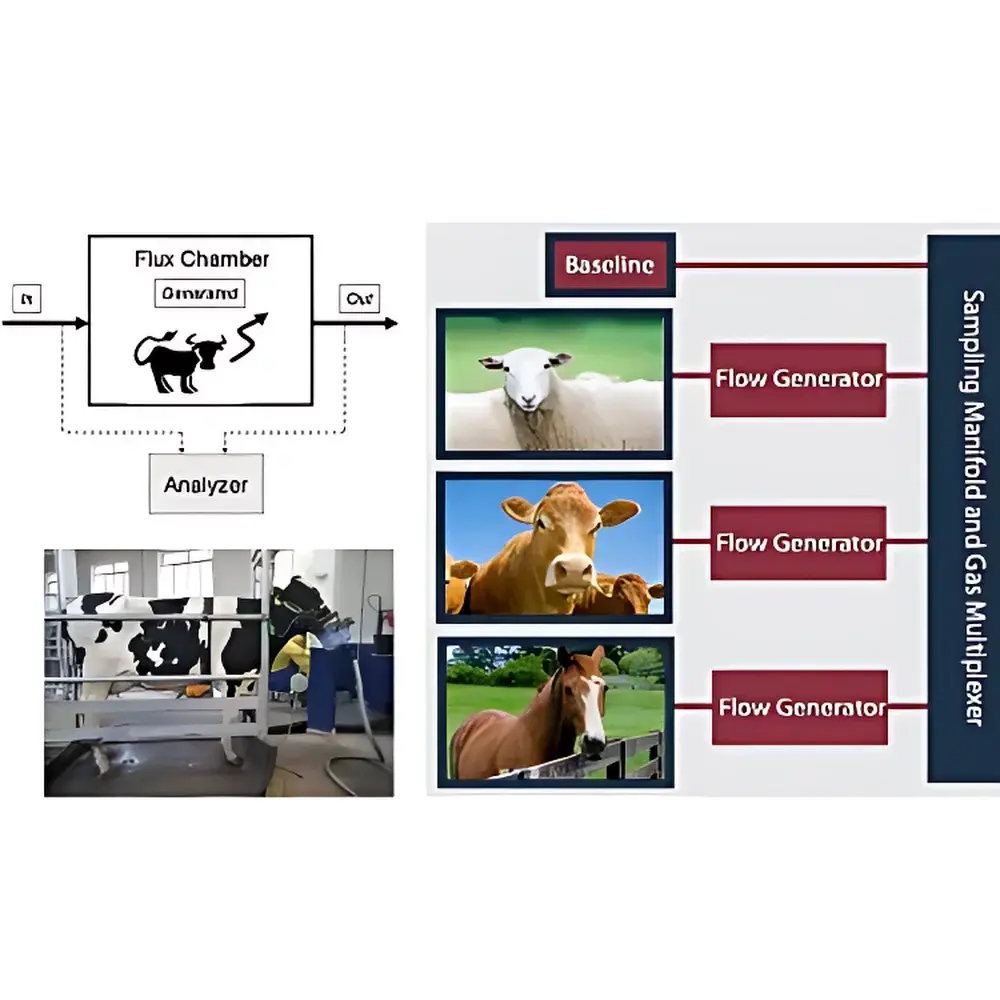
Indirect Calorimetry-Based Animal Energy Metabolism & Greenhouse Gas Emission Measurement System
| Origin | USA |
|---|---|
| Category | Imported Instrument |
| Distribution Model | Authorized Distributor |
| Compliance | ASTM E2583, ISO 8573-1 (gas purity), ISO 9001-certified manufacturing processes |
| Software Validation | FDA 21 CFR Part 11–compliant audit trail and electronic signature support |
| Gas Analysis Accuracy | O₂ ±0.1% (2–100% range), CO₂ ±1% of reading, CH₄ ±1% of reading (optional), H₂O ±1% RH |
| Flow Control Range | 10–1650 L/min (multi-stage PID-regulated) |
| Data Acquisition | 12-channel synchronized sampling at 100 Hz, 16-bit ADC resolution |
| Thermal Imaging | 640 × 512 IR resolution, NETD ≤30 mK, calibrated to NIST-traceable blackbody standards |
Overview
The Indirect Calorimetry-Based Animal Energy Metabolism & Greenhouse Gas Emission Measurement System is a research-grade platform engineered for quantitative assessment of whole-animal energy expenditure, substrate oxidation, and enteric gas emissions—including CO₂, CH₄, and H₂O—under controlled or semi-natural conditions. It operates on the principle of open-circuit indirect calorimetry, wherein precise measurement of inspired and expired gas concentrations (O₂ depletion, CO₂ production, CH₄ generation, and water vapor output), combined with real-time airflow quantification, enables calculation of oxygen consumption (VO₂), carbon dioxide production (VCO₂), methane emission (VCH₄), respiratory exchange ratio (RER), and ultimately, heat production and metabolizable energy. Designed for rigorous life science applications, the system supports both individual- and group-level metabolic phenotyping across avian and mammalian species—from broilers and turkeys to calves, goats, and adult cattle—while maintaining full compliance with GLP-aligned data integrity requirements.
Key Features
- Modular architecture supporting single- or multi-channel parallel measurements, scalable from benchtop face-mask setups to large-volume metabolic chambers (up to 10 m³).
- Customizable animal interface modules: stainless-steel metabolic chambers (with integrated load-cell weighing platform, feed/water access, and fecal/urine collection), head-box enclosures with flexible neck seals, and lightweight portable respiratory masks—all fabricated to species-specific anthropometric specifications.
- Dual-gas analysis core: high-stability electrochemical O₂ sensor (fuel cell technology, temperature/pressure compensated) and dual-wavelength NDIR CO₂ analyzer (1 ppm resolution, <0.5 s response time), both featuring 16-bit ADC, RS-232 and 0–5 V analog outputs, and embedded environmental compensation.
- Optional certified gas analyzers: laser-based CH₄ detector (1 ppm LOD, pressure-compensated) and capacitive RH/H₂O vapor sensor (0–100% RH, ±1% accuracy), each compliant with ISO 8573-1 compressed air purity standards for trace gas metrology.
- Thermo-RGB multimodal monitoring system: calibrated infrared thermal imaging (640 × 512 pixels, ±2% accuracy, -25°C to +150°C range) with ROI-based dynamic thermography, real-time 3D surface temperature mapping, and automated thermal profile extraction aligned to behavioral events.
- Integrated physiological telemetry: implantable biologgers (19 g, 19-month battery life) for concurrent core temperature (±0.2°C), heart rate (100–800 Hz sampling), and 3-axis accelerometry; supplemented by external wearable activity/temperature loggers.
- Environmental control and monitoring: optional ambient CO₂, relative humidity, barometric pressure, and photoperiod sensors—synchronized with metabolic data streams for multivariate physiological modeling.
Sample Compatibility & Compliance
The system accommodates a broad spectrum of livestock and poultry models without requiring surgical intervention or behavioral restraint. Metabolic chambers are configurable for animals up to 500 kg (e.g., Holstein heifers), while head-boxes and masks enable non-invasive longitudinal studies in broilers, laying hens, lambs, and growing pigs. All gas path components—including sample lines, flow cells, and calibration ports—adhere to ISO 8573-1 Class 2 particulate/gas purity requirements to prevent sensor fouling or drift. Hardware and firmware meet IEC 61000-4 electromagnetic compatibility standards. Software architecture implements FDA 21 CFR Part 11–compliant user authentication, role-based access control, immutable audit trails, and electronic signature workflows—validated for use in regulatory submissions under USDA ARS, EFSA, and FAO-aligned protocols.
Software & Data Management
The proprietary acquisition and analysis suite provides real-time visualization of gas concentration waveforms, flow profiles, thermal maps, and biometric signals. Raw data are stored in HDF5 format with embedded metadata (timestamp, sensor ID, calibration epoch, operator ID). Built-in algorithms compute VO₂, VCO₂, VCH₄, RER, heat production (kcal/h), and net energy balance using Weir equation variants and stoichiometric corrections for non-protein respiration. Batch processing supports alignment of metabolic metrics with feeding events, activity bouts, or circadian phases. Export modules generate CSV, Excel, and MATLAB-compatible files. Audit logs record all parameter changes, calibration actions, and data exports—fully traceable to GLP/GMP documentation requirements.
Applications
This system serves as a foundational tool in animal nutrition research (e.g., dietary energy evaluation, lipid supplementation effects on methane yield), genetic selection programs (metabolic efficiency phenotyping), climate-smart agriculture initiatives (enteric CH₄ mitigation trials), and comparative physiology (thermoregulatory responses to heat stress). Peer-reviewed applications include: quantifying net energy retention in crossbred dairy heifers (Front. Anim. Sci., 2022); evaluating palm oil supplementation on tropical grass-fed ruminants (Fermentation, 2022); and characterizing protein diet efficacy under thermoneutral vs. heat-stress conditions in broilers (Anim. Feed Sci. Technol., 2020). Its modular design also supports translational work in preclinical metabolic disease models.
FAQ
What animal sizes can be studied with this system?
Metabolic chambers support animals up to 500 kg and 140 cm shoulder height; head-boxes and masks accommodate species from quail to juvenile cattle—custom dimensions available upon request.
Is methane measurement mandatory or optional?
CH₄ analysis is an optional module, recommended for ruminant studies; it integrates seamlessly with the core O₂/CO₂ platform via shared flow control and synchronization logic.
How is data integrity ensured during long-term deployments?
All analyzers feature continuous self-diagnostics, automatic zero/span validation triggers, and hardware-level timestamping; software enforces ALCOA+ principles (Attributable, Legible, Contemporaneous, Original, Accurate) per GxP guidelines.
Can the system operate in field environments or only in climate-controlled labs?
While optimal performance is achieved indoors, chamber and head-box variants are rated for ambient operation between 0–50°C and non-condensing humidity; portable mask units are routinely deployed in barn-side trials.
Does the system support third-party integration with farm management software?
Yes—via RESTful API and standardized OPC UA interfaces, enabling bidirectional data exchange with herd management platforms (e.g., DairyCOMP, FarmWizard) and IoT environmental networks.





