
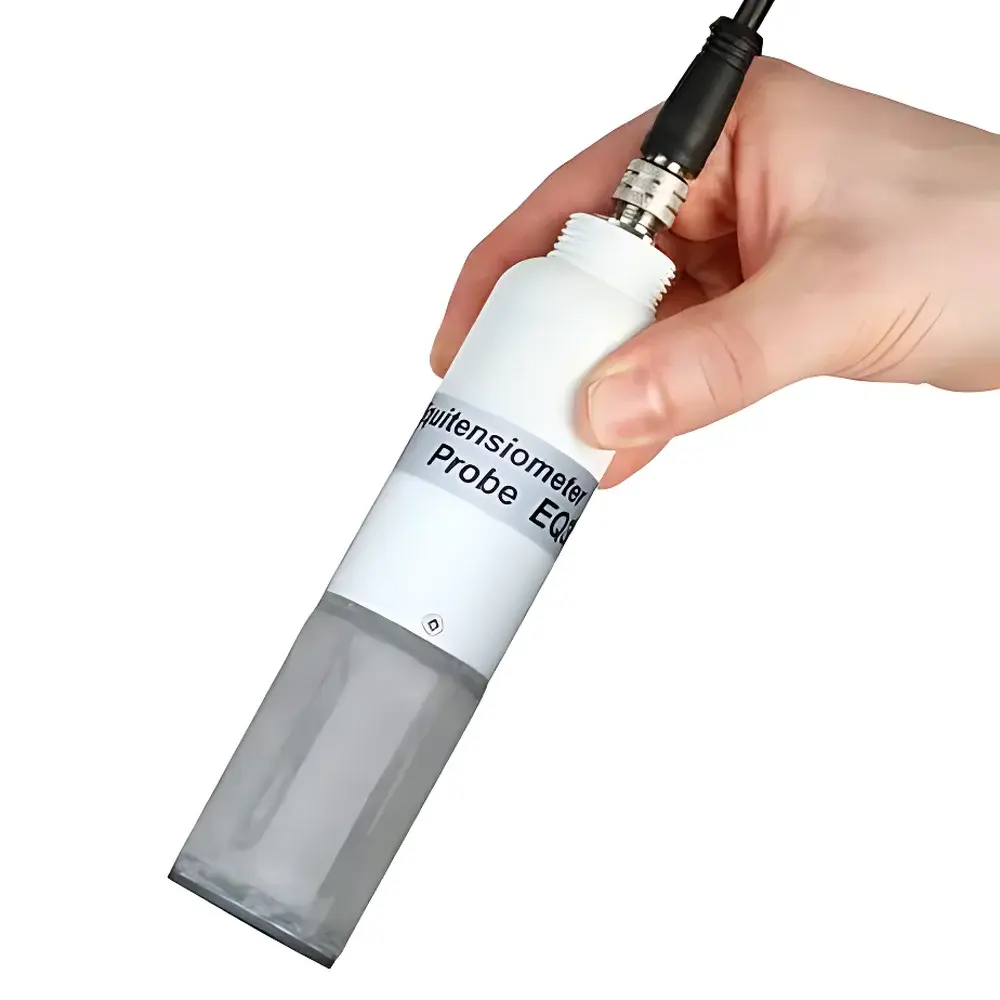
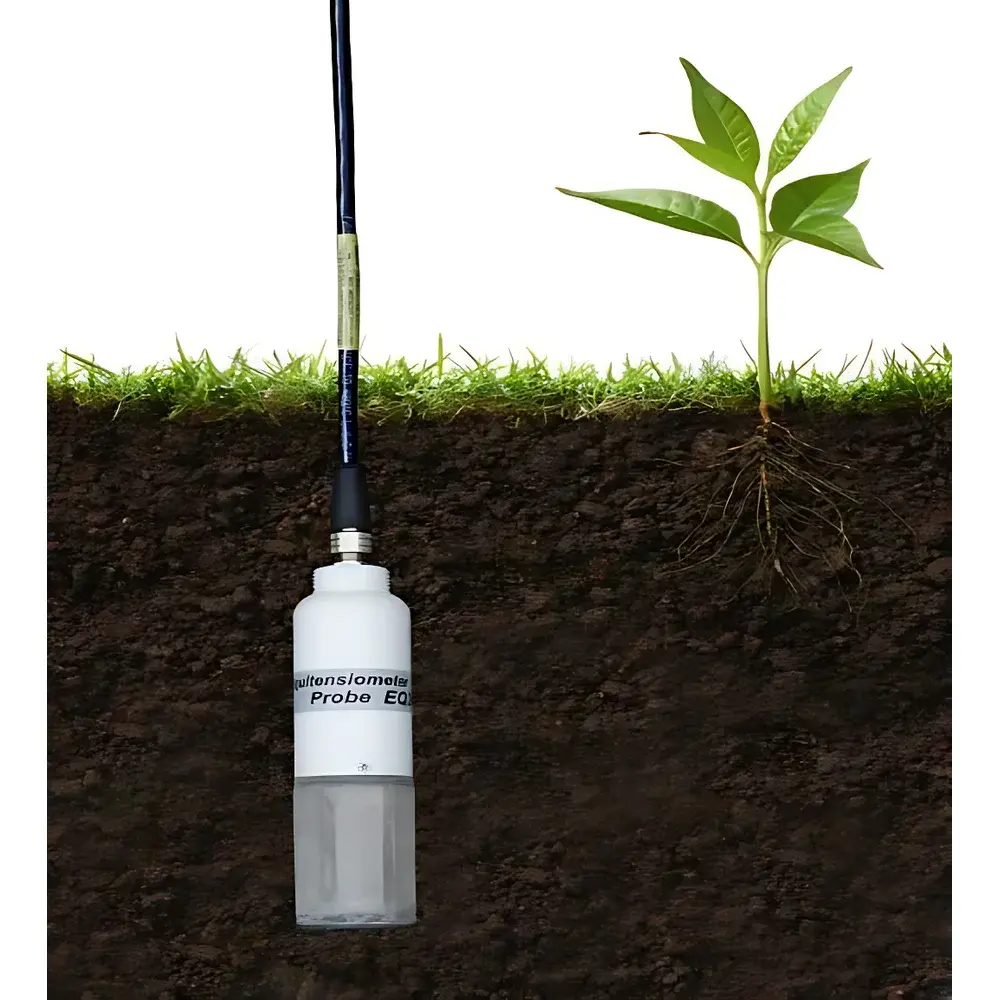
Delta-T EQ3 Equitensiometer Soil Water Potential Meter
| Brand | Delta-T |
|---|---|
| Origin | United Kingdom |
| Model | EQ3 Equitensiometer |
| Measurement Range | 0 to −1000 kPa (0 to −10 bar) |
| Accuracy | ±10 kPa (0 to −100 kPa) or ±10% of reading (−100 to −1000 kPa) |
| Temperature Accuracy | ±0.5 °C (0–40 °C), ±0.75 °C (−20 to +60 °C) |
| Output | 0–1.0 V (non-linear), thermistor resistance 5.8 Ω to 28 kΩ |
| Power Supply | 5–14 V DC, 18 mA/s |
| IP Rating | IP68 |
| Probe Dimensions | 181 mm × 40.5 mm dia |
| Weight | 0.3 kg |
| Calibration | Individual sensor calibration provided |
Overview
The Delta-T EQ3 Equitensiometer is a precision-engineered soil water potential meter designed for long-term, in-situ monitoring of matric potential in non-saline soils and growing media. Unlike traditional tensiometers that rely on liquid-filled ceramic cups and require frequent maintenance, the EQ3 employs a robust equilibrium-based measurement principle grounded in the physical relationship between volumetric water content and matric potential. At its core lies the ML3 ThetaProbe moisture sensor embedded within a calibrated porous ceramic equilibrium body. When inserted into soil, this body equilibrates with the surrounding matrix, enabling direct measurement of the equilibrium water content—then converted to matric potential using a sensor-specific calibration curve. This method eliminates hydraulic discontinuity, bubble formation, and freezing-related failure common in fluid-based tensiometers, making the EQ3 uniquely suited for arid, semi-arid, and seasonally frozen environments where reliable −100 to −1000 kPa measurements are critical.
Key Features
- True matric potential measurement across 0 to −1000 kPa (0 to −10 bar), optimized for high-precision detection between −100 and −500 kPa—ideal for plant water stress studies and drought physiology;
- IP68-rated stainless-steel probe housing enables permanent burial and continuous operation in saturated, dry, or frozen soils down to −20 °C;
- Integrated Pt1000-class thermistor provides simultaneous soil temperature measurement with ±0.5 °C accuracy (0–40 °C) and traceable thermal compensation;
- Maintenance-free operation: no refilling, no air purging, no ceramic cup replacement—significantly reducing field labor and data gaps;
- Non-linear 0–1.0 V analog output compatible with standard data loggers; each unit ships with individual calibration data (including polynomial coefficients and temperature correction tables);
- Low power consumption (18 mA/s at 5–14 V DC) supports solar- or battery-powered deployments over multi-season campaigns.
Sample Compatibility & Compliance
The EQ3 is validated for use in non-saline mineral soils, loams, peats, coir, perlite, and other horticultural substrates where pore-size distribution allows effective equilibration with the ceramic balance body. It is not intended for highly saline soils (>4 dS/m EC) due to deviations in the water retention curve under osmotic dominance. The sensor complies with ISO 11277:2023 (soil physical analysis — determination of water retention characteristics) and supports GLP-aligned data collection when paired with Delta-T GP2 or DL6 loggers featuring audit-trail-capable firmware. Its construction adheres to IEC 60529 for IP68 ingress protection and meets RoHS 2011/65/EU environmental compliance requirements.
Software & Data Management
Data acquisition is fully interoperable with Delta-T’s ecosystem: HH2 handheld meter for spot checks, GP2 or DL6 for autonomous logging with programmable sampling intervals (1 min to 24 h), and PC-based DeltaLINK software for visualization, batch calibration application, and export to CSV or Excel. All calibration files are stored as ASCII-readable .CAL files containing third-order polynomial coefficients and temperature-compensation parameters. When integrated into regulated environments (e.g., agricultural research under USDA-NRCS protocols or EU Horizon-funded field trials), the system supports metadata tagging, time-stamped event logging, and export formats compliant with FAIR data principles (Findable, Accessible, Interoperable, Reusable). Optional SDI-12 firmware upgrade enables direct integration with Campbell Scientific, Onset HOBO, or Decagon EM50 loggers.
Applications
- Long-term phenological monitoring of root-zone water status in crop breeding programs and irrigation scheduling trials;
- Ecophysiological studies of xerophytic species under controlled drought stress, including stomatal conductance correlation and leaf water potential validation;
- Permafrost and seasonally frozen soil hydrology—stable operation below 0 °C without mechanical damage or signal drift;
- Civil engineering applications such as landfill cover monitoring, embankment stability assessment, and unsaturated zone modeling;
- Green infrastructure evaluation—including green roof substrate drying dynamics and biofiltration media performance;
- Calibration reference for remote sensing-derived soil moisture products (e.g., Sentinel-1 SAR backscatter inversion models).
FAQ
How does the EQ3 differ from traditional tensiometers?
The EQ3 measures matric potential indirectly via equilibrium water content in a porous ceramic body, eliminating reliance on water columns, vacuum generation, or ceramic permeability—thus avoiding freezing failure, air entry, and maintenance downtime.
Can the EQ3 be used in saline soils?
It is validated only for non-saline soils (EC < 4 dS/m); elevated salinity alters the soil water characteristic curve and compromises calibration integrity.
What is the recommended recalibration interval?
Delta-T recommends recalibration every 24 months under typical field conditions; more frequent verification is advised after exposure to extreme desiccation or mechanical impact.
Is temperature compensation automatic?
Yes—the built-in thermistor provides real-time temperature data; calibration curves include temperature-dependent polynomial terms applied during post-processing or embedded in compatible loggers.
Does the EQ3 require soil-specific calibration?
No—each sensor is factory-calibrated against standardized ceramic materials and shipped with individual calibration files; soil-specific adjustments are unnecessary unless validating against independent psychrometric methods.
Related Products




