
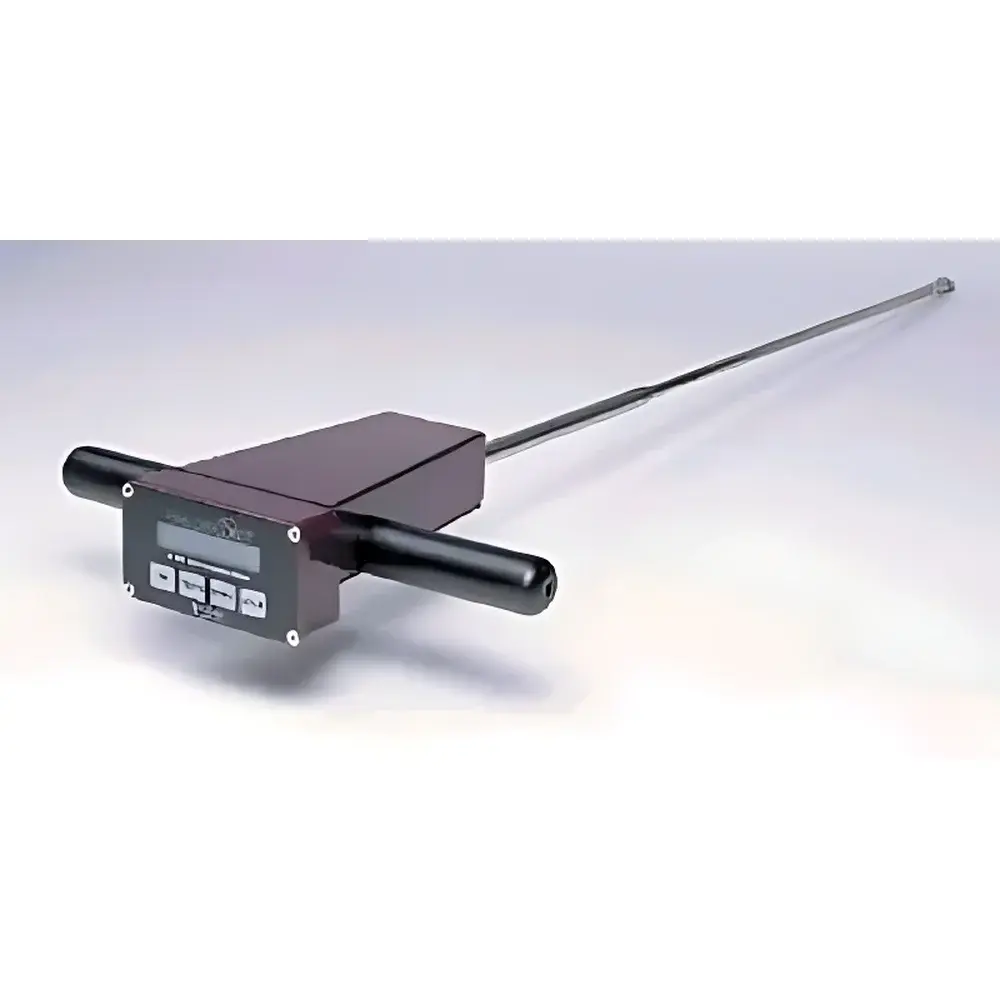
SC-900 Soil Compaction Meter
| Origin | USA |
|---|---|
| Manufacturer Type | Authorized Distributor |
| Origin Category | Imported |
| Model | SC-900 |
| Pricing | Available Upon Request |
| Measurement Range | 0–7000 kPa (0–1000 PSI) |
| Penetration Depth | 0–450 mm |
| Cone Tip Diameter | 12.827 mm |
| Depth Resolution | 2.5 cm |
| Pressure Resolution | 35 kPa (5 PSI) |
| Depth Accuracy | ±1.25 cm |
| Pressure Accuracy | ±103 kPa (±5 PSI) |
| Battery Life | ~12 months (4 × AA alkaline) |
| Data Storage Capacity | 772 readings (579 with GPS enabled) |
| Interface | RS232 serial output |
| Compliance | ASAE S313.3 (Soil Cone Penetrometer Standard) |
| GPS Integration | Yes, NMEA 0183 compatible |
| Display Units | Switchable between PSI/in and kPa/cm |
| Audible Alert | Triggered upon excessive insertion speed |
Overview
The SC-900 Soil Compaction Meter is a field-deployable, hand-held cone penetrometer engineered for quantitative assessment of soil mechanical resistance—commonly referred to as soil compaction. Operating on the principle of quasi-static cone penetration, the instrument measures the axial force required to advance a standardized conical probe (12.827 mm diameter, 30° apex angle per ASAE S313.3) into undisturbed soil at controlled insertion rates. This force, normalized by the cone’s cross-sectional area, yields in-situ soil bearing pressure expressed in kilopascals (kPa) or pounds per square inch (PSI). The SC-900 delivers depth-synchronized pressure profiles at discrete 2.5 cm intervals—enabling stratified analysis of compaction layers across the 0–450 mm depth range. Its design prioritizes repeatability under variable field conditions, supporting agronomic decisions where root zone restriction, infiltration rate reduction, and water-holding capacity degradation correlate directly with elevated compaction indices.
Key Features
- ASAE S313.3-compliant conical probe geometry ensures measurement consistency with internationally recognized agricultural engineering protocols.
- Real-time dual-unit digital display (kPa/cm or PSI/in), configurable via front-panel toggle for regional unit preference and reporting alignment.
- Integrated audible alert system activates when insertion velocity exceeds 2 cm/s—mitigating dynamic loading artifacts and preserving static penetration validity.
- Onboard non-volatile memory stores up to 772 depth-resolved pressure readings; storage reduces to 579 entries when GPS metadata (latitude, longitude, timestamp) is concurrently logged.
- RS232 serial interface enables direct data transfer to Windows-based desktop applications using standard terminal emulation or custom scripts—no proprietary drivers required.
- Low-power architecture sustains operation for approximately 12 months on four standard AA alkaline cells, validated under typical field duty cycles (≤50 measurements/day).
- Ruggedized aluminum housing with IP54-rated ingress protection withstands exposure to dust, light rain, and mechanical shock during transport and deployment.
Sample Compatibility & Compliance
The SC-900 is validated for use in mineral soils ranging from sandy loam to heavy clay, provided moisture content remains within the plastic limit (ASTM D4318). It is not intended for saturated, frozen, stony (>10% gravel fraction), or highly organic (>30% OM) matrices where cone deviation or tip clogging may compromise data integrity. All hardware and firmware comply with ASAE S313.3 (2021 revision) for cone penetrometer performance, calibration traceability, and reporting format. While not certified for GLP or ISO/IEC 17025 environments, its measurement uncertainty budget—±103 kPa (±5 PSI) pressure and ±1.25 cm depth—is documented per manufacturer’s technical validation report (Ref. SC-900-TVR-2023 Rev. B) and supports QA/QC workflows in USDA-NRCS, FAO, and university extension soil health programs.
Software & Data Management
Data export occurs via ASCII-formatted RS232 transmission at 9600 baud, yielding tab-delimited records containing depth (cm), pressure (kPa), timestamp (HH:MM:SS), and—when active—WGS84 coordinates (DD.DDDDD°). Third-party GIS platforms (e.g., QGIS, ArcGIS Pro) import these files directly for spatial interpolation and contour mapping of compaction severity zones. Optional companion software (SC-View v2.1, Windows 10/11 compatible) provides automated layer identification (e.g., plow pan detection via gradient thresholding), statistical summary (mean, SD, CV per depth interval), and export to CSV, Excel, or PDF. Audit trails are maintained through embedded firmware logging of calibration events and battery voltage history—supporting basic traceability requirements under USDA-NRCS Field Data Collection Standards.
Applications
- Agronomic site assessment prior to tillage planning, enabling targeted subsoiling only where compaction exceeds 2000 kPa in the 15–30 cm zone.
- Long-term monitoring of no-till systems to quantify temporal changes in surface and subsurface resistance.
- Validation of cover crop root penetration efficacy in reducing biologically induced compaction.
- Calibration support for proximal sensing tools (e.g., EM38, Veris pH/EC carts) by establishing ground-truthed compaction benchmarks.
- Educational use in soil physics laboratories for empirical correlation of penetrometer resistance with bulk density, porosity, and saturated hydraulic conductivity (Ksat).
FAQ
What calibration standards does the SC-900 use?
The device is factory-calibrated against NIST-traceable deadweight testers; users receive a certificate of calibration valid for 12 months. Field verification kits (certified load cells) are available separately.
Can the SC-900 be used in wet or frozen soils?
No. Measurements in saturated or frozen conditions violate ASAE S313.3 assumptions and produce non-representative resistance values due to pore water pressure effects or ice fracture mechanics.
Is GPS data synchronized with each pressure reading?
Yes—when connected to an NMEA 0183-compliant GPS receiver (e.g., Garmin GPSMAP 66i), position and time stamps are appended to every depth-pressure pair before storage.
How is measurement repeatability ensured across operators?
Standardized insertion technique training is required; the audible alert enforces ≤2 cm/s speed, while the fixed-cone geometry eliminates operator-dependent tip geometry variables.
Does the SC-900 meet FDA or ISO 17025 requirements for regulated testing?
It is not designed for GxP-regulated environments. Its uncertainty budget and documentation align with agricultural research standards—not clinical or pharmaceutical quality systems.







