
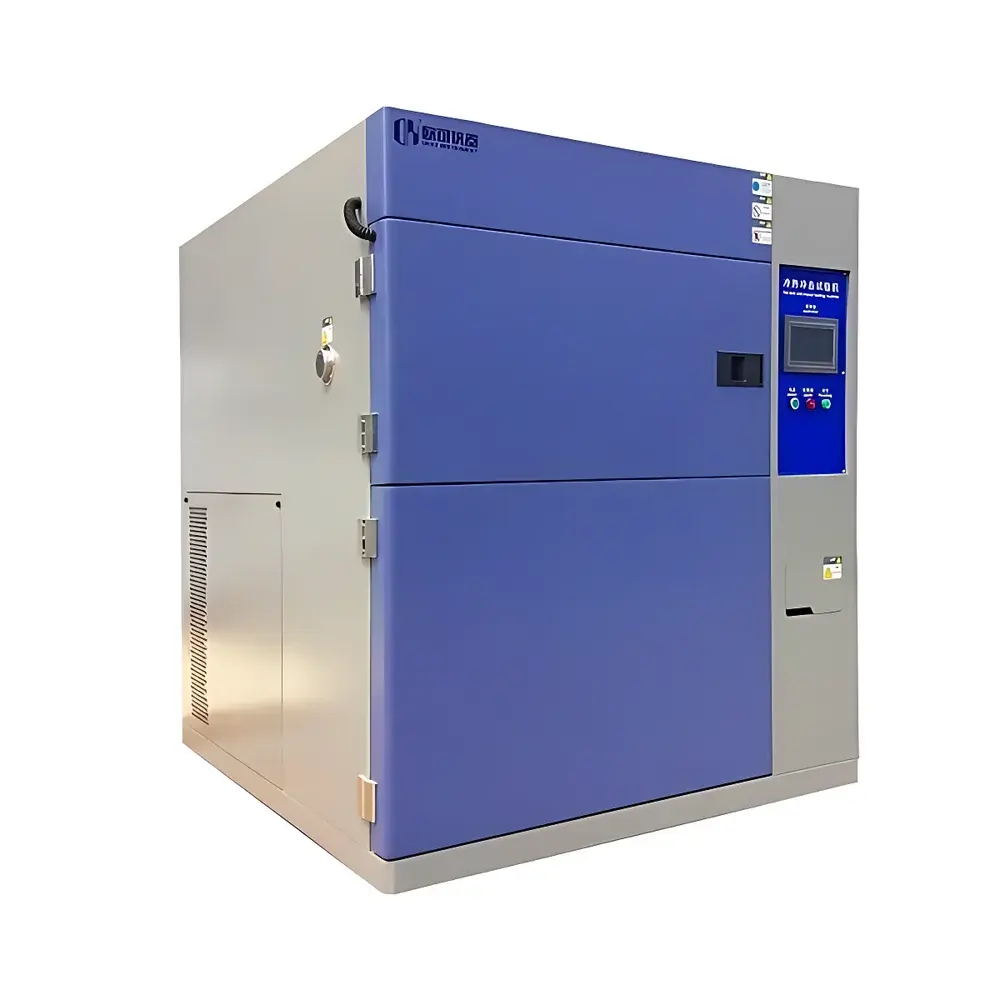
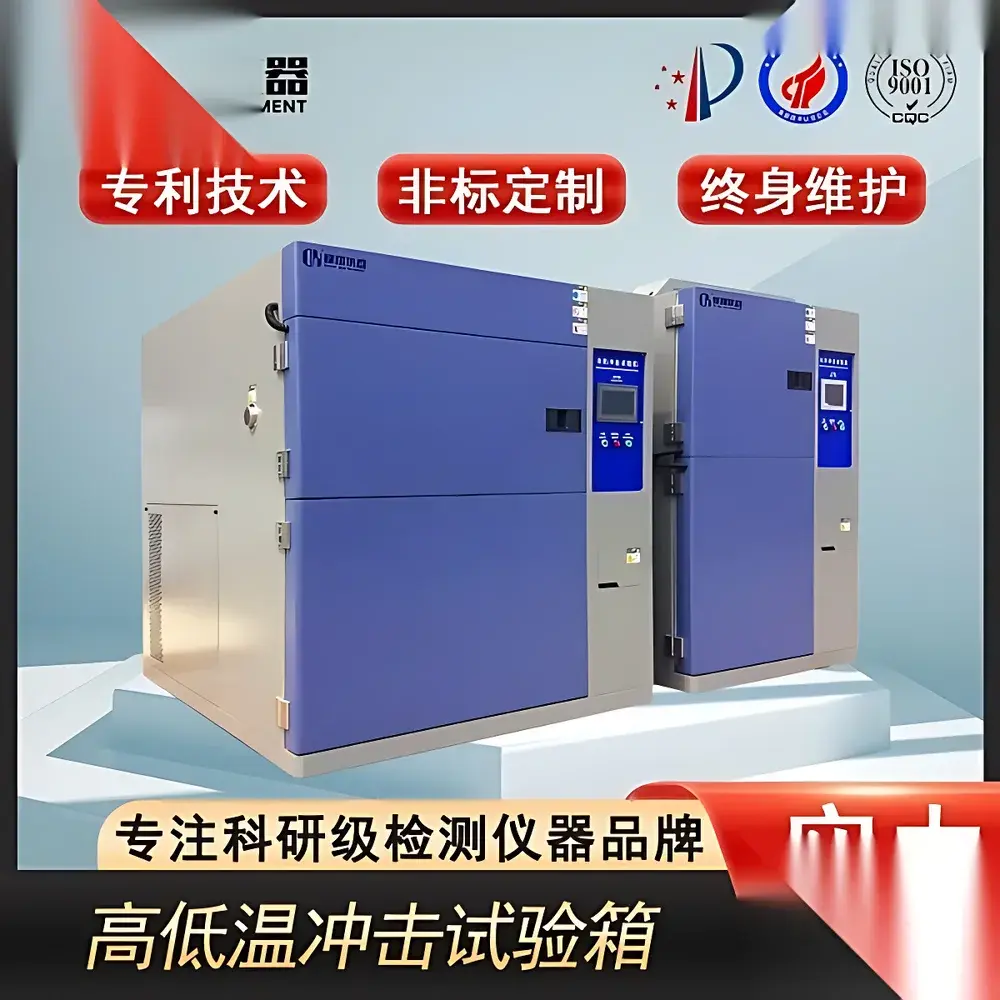
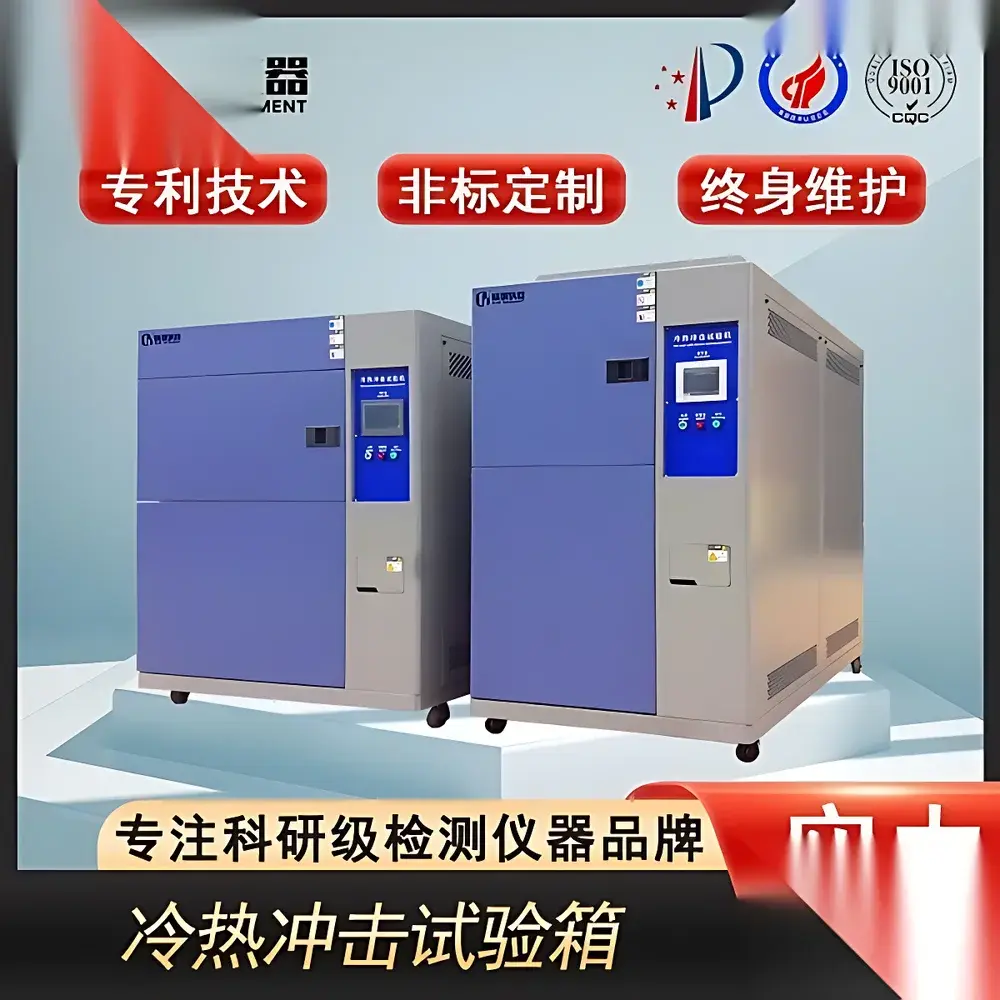
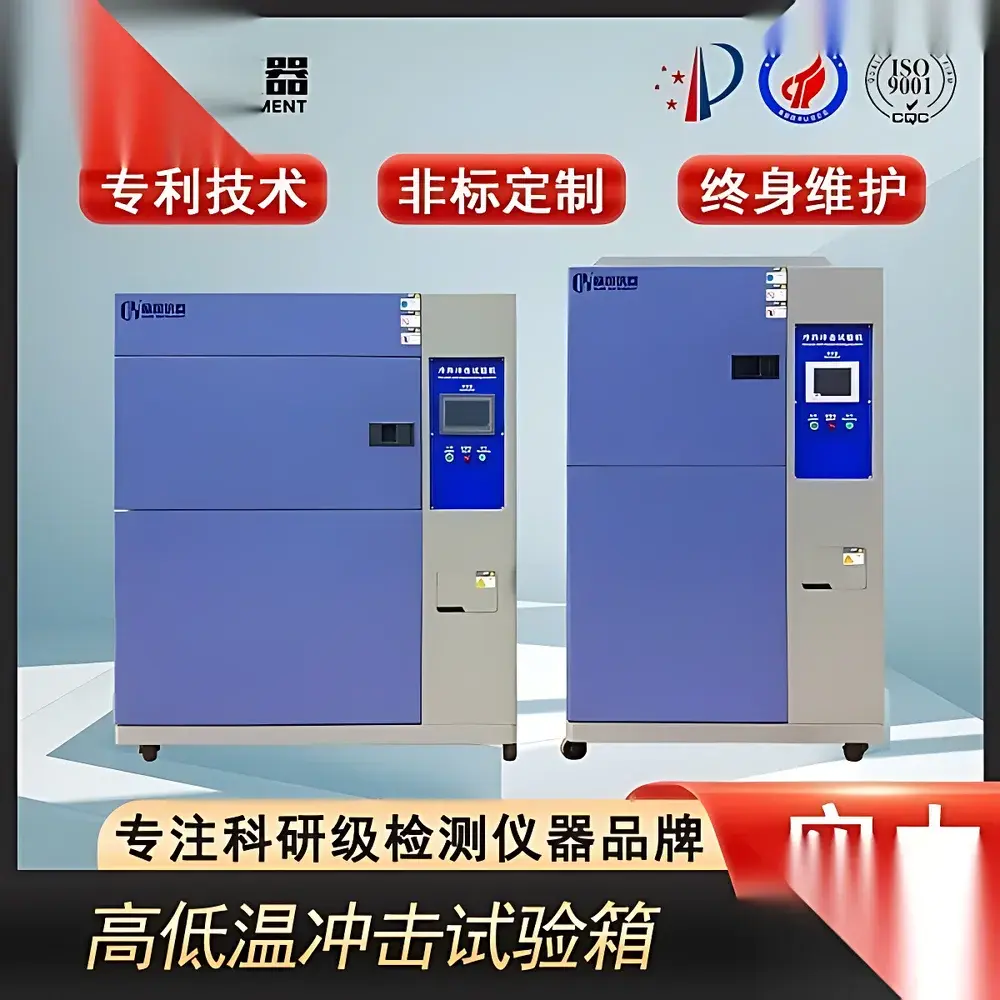
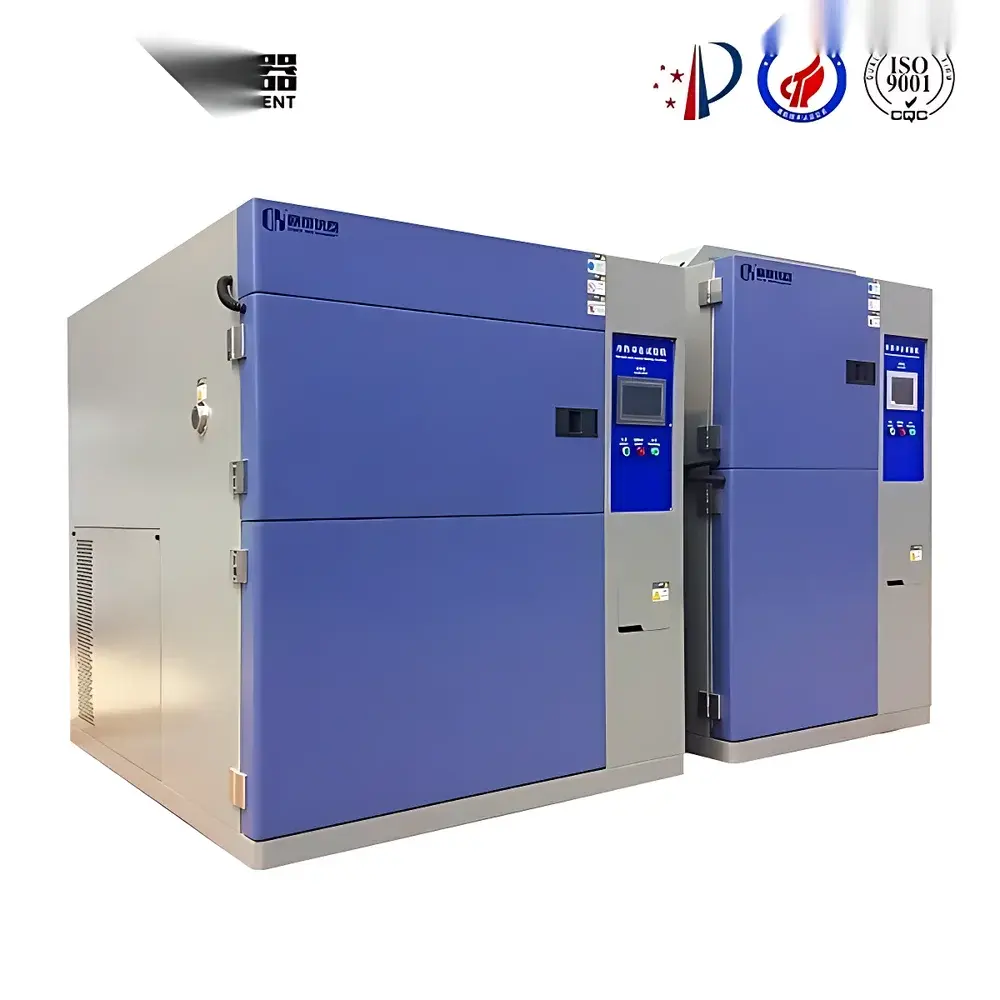
Thermal Shock Test Chamber – Industrial-Grade Two-Zone Rapid Temperature Transition System
| Brand | OEM / Custom-Built |
|---|---|
| Origin | Imported (Germany/USA Engineering Standard) |
| Manufacturer Type | Authorized Distributor |
| Cooling System | Dual-Stage Cascade Refrigeration with External Water-Cooled Condenser |
| Temperature Range | -65°C to +180°C (Standard Configuration) |
| Transition Rate | ≥10°C/s (Typical, 5–15°C/s depending on load & chamber size) |
| Compliance | GB/T 2423.1–2001, GB/T 2423.2–2001, GB/T 2423.22–1989, GJB 150.5–1986, GJB 360.7–1987, GJB 367.2–1987, IEC 60068-2-14 (Test N), SJ/T 10186–1991 & SJ/T 10187–1991 |
Overview
The Thermal Shock Test Chamber is an industrial-grade environmental stress screening (ESS) system engineered for rapid, repeatable thermal transition testing of materials and electronic assemblies. It operates on the principle of abrupt temperature displacement—transferring test specimens between independently controlled high-temperature and low-temperature zones within a single enclosure (two-box configuration) or via dynamic air-stream modulation (single-box variant). This methodology subjects samples to extreme thermal gradients, simulating real-world operational stresses encountered during launch, aerospace deployment, automotive under-hood cycling, or consumer electronics field use. The chamber’s core architecture adheres to the thermodynamic definition of thermal shock: a transient thermal load inducing differential expansion/contraction across material interfaces, thereby revealing latent defects such as interfacial delamination, solder joint fatigue, coating adhesion loss, or microcrack propagation. Unlike steady-state thermal chambers, this system delivers quantifiable thermal inertia metrics—including dwell time, transfer time (<5 s typical), and ramp rate—enabling precise correlation between thermal history and failure mode.
Key Features
- Dual-zone independent control architecture with separate heating (electric resistive) and refrigeration (cascade) circuits for high-fidelity temperature maintenance at extremes (–65°C to +180°C).
- Imported semi-hermetic dual-stage cascade refrigeration system using environmentally compliant R404A/R23 refrigerant pairs; optimized for rapid cooldown and stable low-temperature hold.
- External water-cooled condenser requiring user-supplied cooling tower (10 m³/h flow capacity at 32°C inlet); eliminates ambient heat rejection constraints in laboratory settings.
- Energy modulation control logic dynamically adjusts compressor staging and expansion valve opening to maintain setpoint accuracy ±0.5°C while minimizing power consumption and mechanical wear.
- Stainless steel 304 interior chamber with insulated double-wall construction and silicone-sealed access door; equipped with PT100 Class A sensors at multiple spatial locations for ISO/IEC 17025-compliant temperature uniformity verification.
- Integrated safety interlocks including over-temperature cutoff, refrigerant pressure monitoring, door-open freeze protection, and emergency stop circuit per IEC 61000-6-2 EMC standards.
Sample Compatibility & Compliance
This chamber accommodates rigid and semi-rigid specimens up to 500 mm × 500 mm × 500 mm (W×D×H) and mass ≤ 25 kg. Compatible sample types include metallic alloys (Al 6061, Ti-6Al-4V), polymer composites (CFRP, PEEK), PCBAs with BGA/CSP packaging, hermetically sealed optoelectronic modules, and elastomeric seals. All operational protocols conform to internationally recognized qualification standards: GB/T 2423 series (China National Standards), GJB 150.5–1986 (PLA Military Standard), IEC 60068-2-14 (Temperature Change, Test N), and SJ/T 10186–1991 (Two-Chamber Method). Validation documentation supports GLP/GMP audit readiness, including traceable calibration certificates (NIST-traceable RTDs), temperature mapping reports (per ASTM E2297), and deviation log templates aligned with FDA 21 CFR Part 11 data integrity requirements.
Software & Data Management
Control is managed via embedded Linux-based HMI with 10.1″ capacitive touchscreen interface. Firmware supports programmable test profiles with up to 99 segments per cycle, variable dwell times (1 min–999 h), and automatic transition triggers based on chamber stability criteria (e.g., “hold until ΔT < 0.3°C over 60 s”). Real-time data logging records temperature, pressure, compressor status, and alarm events at configurable intervals (100 ms–10 s resolution). Export formats include CSV, PDF test reports, and XML for LIMS integration. Optional PC software enables remote monitoring, multi-chamber fleet management, and automated report generation compliant with ISO/IEC 17025 clause 7.8.2 (data review and retention).
Applications
- Qualification testing of avionics components per DO-160 Section 4 (Temperature Variation).
- Reliability screening of automotive ECUs exposed to under-hood thermal cycling (SAE J2223).
- Failure analysis of MEMS devices and wafer-level packaging subjected to CTE mismatch stress.
- Material compatibility validation for cryogenic sealants and thermal interface materials (TIMs).
- Accelerated life testing of battery modules (Li-ion, solid-state) under repeated charge/discharge thermal transients.
- Process validation for reflow soldering and conformal coating curing processes.
FAQ
What is the standard temperature range for this thermal shock chamber?
The base configuration operates from –65°C to +180°C. Extended ranges (–75°C or +225°C) are available upon request with modified refrigerant circuits or heater upgrades.
Is external cooling water mandatory?
Yes. A dedicated closed-loop cooling tower delivering 10 m³/h at ≤32°C inlet temperature is required for stable operation below –40°C. Air-cooled alternatives reduce low-temperature capability and increase energy consumption.
How is temperature uniformity validated?
Per IEC 60068-3-5, 9-point sensor mapping is performed at three load conditions (empty, 50% volume, full load) to verify ±2.0°C uniformity across the working volume.
Can the system be integrated into an existing MES or QMS platform?
Yes. OPC UA and Modbus TCP protocols are supported. API documentation and driver libraries are provided for seamless integration with Siemens Opcenter, Rockwell FactoryTalk, or ETQ Reliance.
Does the chamber support automated specimen transfer?
Manual basket transfer is standard. Robotic arm integration (e.g., Stäubli TX2-60) is available as a factory-installed option with E-stop synchronization and position feedback.



