
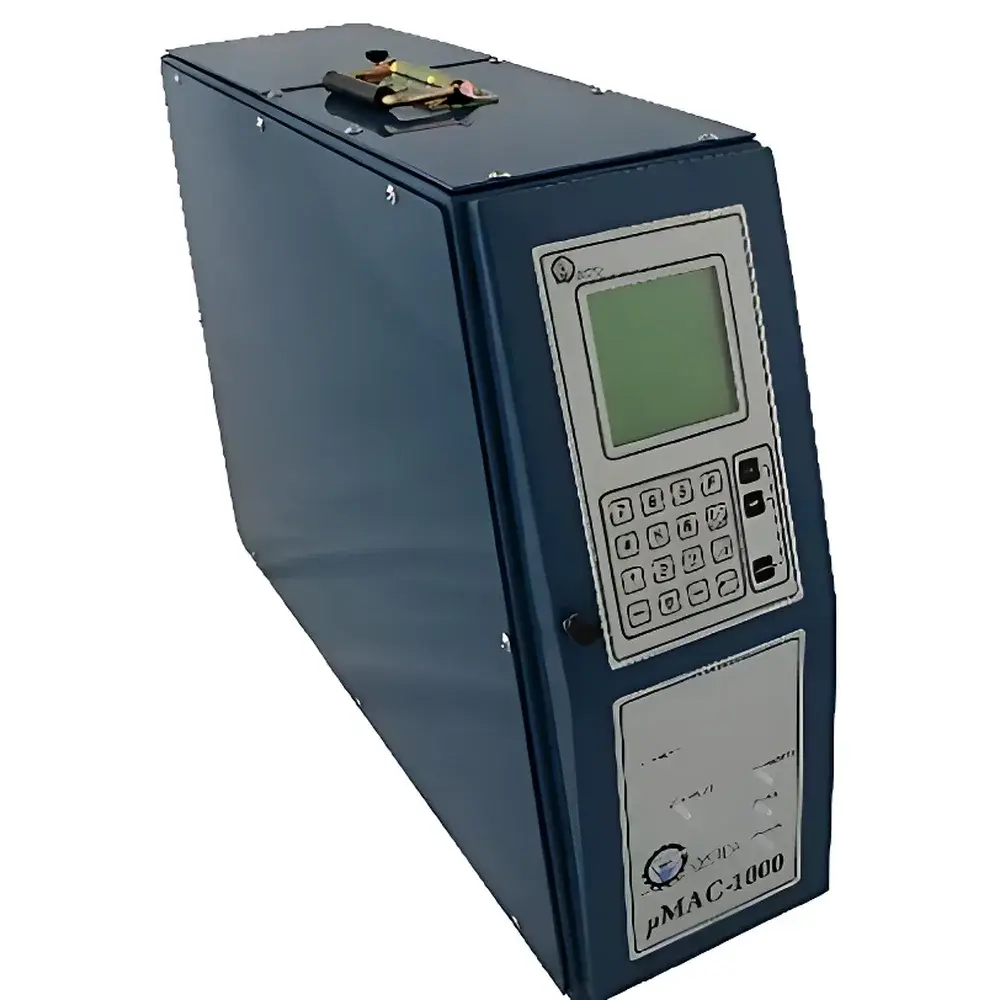
Micromac 1000 Portable Multi-Parameter Water Quality Analyzer
| Origin | Italy |
|---|---|
| Manufacturer Type | Authorized Distributor |
| Origin Category | Imported |
| Model | MICROMAC 1000 |
| Pricing | Upon Request |
Overview
The Micromac 1000 is a fully automated, portable, multi-parameter online water quality analyzer engineered for high-precision, unattended chemical analysis of diverse aqueous matrices—including seawater, surface water, drinking water, wastewater, industrial process water, soil leachates, and beverage formulations. It operates on the principle of photometric colorimetry: analytes react with specific reagents to form colored complexes whose absorbance is quantified across multiple wavelengths using a dual-beam, multi-wavelength silicon photodetector. The system employs a patented Loop Flow Reactor (LFA) architecture, integrating mixing coils, solenoid valves, temperature-controlled zones, and flow path optimization within a compact 10 mL reaction volume. This design ensures reproducible reaction kinetics, minimal carryover, and robust performance under variable field conditions. Unlike benchtop spectrophotometers or single-parameter sensors, the Micromac 1000 delivers laboratory-grade accuracy in a field-deployable platform—designed explicitly for continuous 24/7 monitoring without operator intervention.
Key Features
- True multi-parameter capability: Simultaneous configuration for up to four independent parameters per measurement cycle (e.g., NH₄⁺-N, NO₃⁻-N, PO₄³⁻, SiO₂), executed sequentially with automatic method switching.
- Ultra-low reagent consumption: As little as 200–500 µL per analysis, reducing operational cost, hazardous waste generation, and frequency of reagent replacement (typically every 4–10 weeks depending on duty cycle).
- LFA reactor technology: Integrated, thermally stabilized flow-through reactor with programmable heating elements, precise fluidic routing, and self-cleaning hydraulic pathways—eliminating manual disassembly for routine maintenance.
- ppb-level detection sensitivity: Achieved via high-stability LED light sources, precision-machined optical flow cells (10–50 mm path length, configurable for high-turbidity or marine applications), and dual-beam compensation for drift correction.
- Full automation suite: Onboard auto-calibration (using user-loaded standards), blank correction for turbid/colored samples, programmable dilution (up to 100×), and adaptive sampling intervals (user-defined from minutes to hours).
- Ruggedized field deployment: IP55 ingress protection (upgradable to IP65), operating temperature range of 5–40°C, 12 V DC power input (3 W standby / 10 W active), and integrated peristaltic sampling pump with standardized 3.2 mm OD × 1.6 mm ID tubing interface.
Sample Compatibility & Compliance
The Micromac 1000 accommodates a broad spectrum of sample types without pretreatment: turbid or colored waters are corrected via real-time blank referencing; pH tolerance spans 3–12 (method-dependent); sample temperature is maintained between 10–30°C using optional low-temperature reagent cooling modules. All implemented analytical methods conform to internationally recognized standard protocols—including U.S. EPA Methods (e.g., EPA 350.1 for nitrate, EPA 365.3 for phosphate), ISO standards (e.g., ISO 15681-1 for orthophosphate), and DIN norms (e.g., DIN 38405-9 for ammonium). The system supports GLP-compliant data integrity through timestamped audit trails, non-erasable memory storage (400 complete records: date, time, absorbance, calculated concentration), and secure calibration history logging.
Software & Data Management
Embedded firmware provides intuitive menu navigation via integrated keypad and backlit LCD display. Users select analytical methods, configure dilution factors, initiate calibration routines, and run diagnostic self-tests without external hardware. Data output includes analog 4–20 mA (400 Ω load) and digital RS-232 interfaces (RS-485 optional); all signals are linearly proportional to concentration. Remote operation is supported via optional PC-based control software or industrial GSM telemetry modules—enabling real-time parameter adjustment, historical data download, alarm notification, and firmware updates over cellular networks. The system’s PC-104 CPU architecture ensures deterministic timing and deterministic I/O response, critical for regulatory reporting environments subject to FDA 21 CFR Part 11 or EU Annex 11 requirements.
Applications
- Real-time nutrient monitoring in coastal and estuarine ecosystems (NH₄⁺, NO₃⁻, PO₄³⁻, SiO₂).
- Drinking water treatment plant compliance tracking for disinfection by-products and trace metals (As, Cr, CN⁻, phenol).
- Industrial effluent discharge verification against local and national permit limits.
- In-situ process control in food & beverage production (e.g., sugar refinery wastewater, soft drink formulation water).
- Soil remediation site leachate characterization under EPA Region-specific protocols.
- Mobile environmental assessment campaigns where laboratory access is constrained.
FAQ
What sample volume is required per analysis?
Each analysis consumes 20–30 mL of sample, drawn automatically by the onboard peristaltic pump.
Can the instrument operate unattended for extended periods?
Yes—designed for continuous 24/7 operation with maintenance intervals up to 30 days, depending on measurement frequency and reagent stability.
Is method validation documentation available?
Yes—manufacturer-supplied method validation reports include linearity, LOD/LOQ, precision (RSD <3%), interference studies, and inter-laboratory comparison data aligned with ISO/IEC 17025 principles.
How is calibration traceability ensured?
Calibration standards are traceable to NIST-certified reference materials; onboard calibration routines log operator ID, standard lot numbers, and deviation metrics for audit readiness.
Does the system support regulatory electronic record requirements?
Yes—the embedded memory retains immutable, time-stamped results with full audit trail functionality; optional remote software enables 21 CFR Part 11–compliant electronic signatures and role-based access control.
Related Products







