
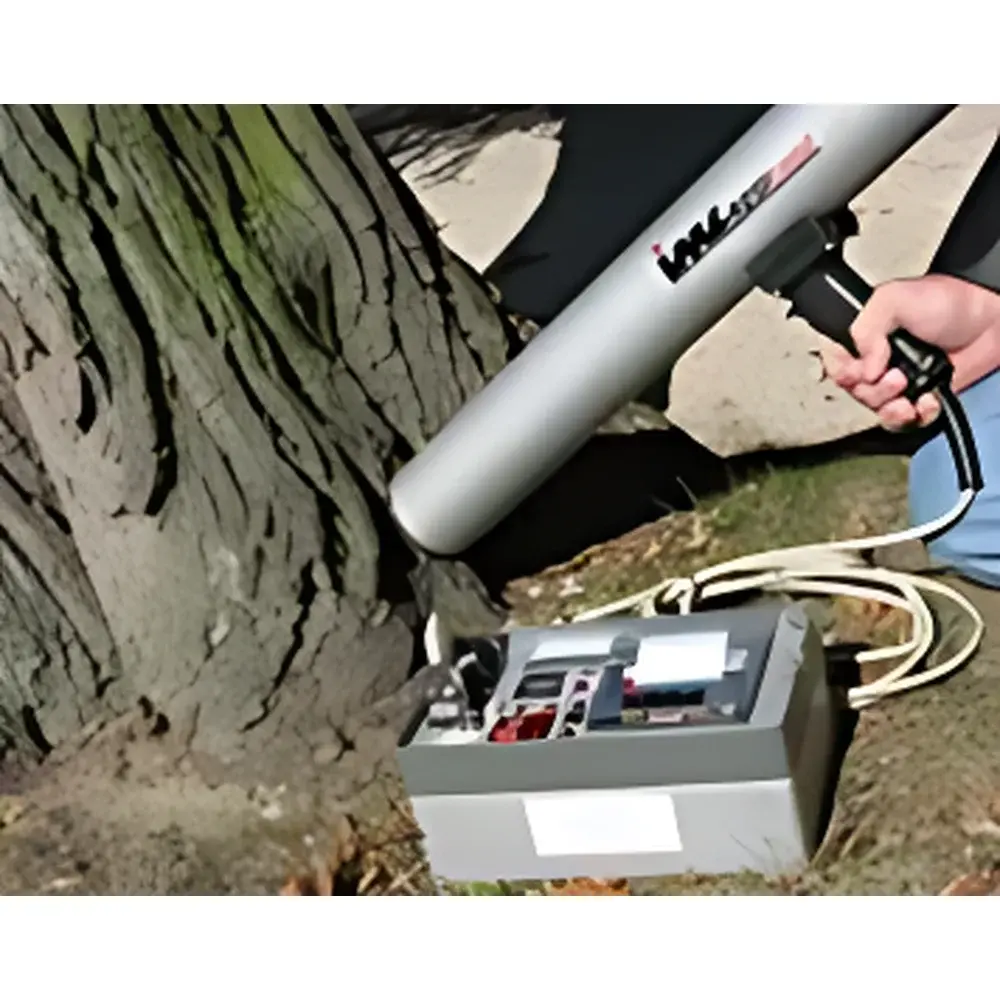
Arbotom E-Series In-Situ Tree Resistograph for Rapid Arboricultural Diagnosis
| Origin | Germany |
|---|---|
| Manufacturer Type | Authorized Distributor |
| Origin Category | Imported |
| Model | E-Series Tree Resistograph |
| Quotation | Available Upon Request |
| Penetration Depth | 300 mm / 400 mm |
| Penetration Speed | 10–45 cm/min |
| Spatial Resolution | 0.1 mm |
| Data Storage Capacity | 256 KB (~20 m), 512 KB (~40 m), or 1 MB (~90 m) |
| Probe Lifespan | 200–300 insertions in softwood |
| Power Supply | 7.2 V, 1.7 Ah / 2.0 Ah NiCd rechargeable battery |
| Charger Input | 110 V / 220 V AC |
| Operating Temperature | 0–50 °C |
Overview
The Arbotom E-Series In-Situ Tree Resistograph is an electromechanical resistivity profiling instrument engineered for non-destructive, field-based structural assessment of living trees and standing timber. It operates on the principle of micro-resistography: a precision-ground stainless-steel drill probe (diameter ≤ 3 mm) is advanced into wood at a controlled linear velocity while continuously measuring the torque resistance encountered by the motor. This analog torque signal—proportional to local wood density, moisture content, and structural integrity—is digitized, time-stamped, and spatially resolved at 0.1 mm increments. The resulting resistogram provides a high-fidelity vertical profile of internal anomalies including decay columns, cavities, reaction wood zones, and annual growth ring boundaries. Designed for arborists, forest pathologists, municipal tree officers, and heritage conservation teams, the E-Series delivers quantitative, auditable data without compromising tree vitality—making it compliant with ISO 14040-based life-cycle assessment protocols for urban forestry interventions.
Key Features
- Motor-driven, variable-speed probe insertion (10–45 cm/min) with real-time torque feedback and automatic stall detection
- Integrated thermal line printer producing 1:1 scale resistogram charts during measurement—enabling immediate visual interpretation in situ
- Modular memory options (256 KB / 512 KB / 1 MB) supporting up to 90 meters of cumulative profile data per session
- Minimal-invasiveness: 2.5–3.0 mm diameter probe; self-cleaning withdrawal mechanism reinserts displaced wood fibers, preserving cambial continuity and minimizing infection risk
- Ruggedized control unit with IP54-rated enclosure, ergonomic handgrip, and integrated battery management system
- Onboard diagnostics that flag anomalous signal patterns—including sudden resistance drops (indicating voids), sustained low resistance (suggesting advanced decay), or periodic oscillations (correlating with growth ring transitions)
Sample Compatibility & Compliance
The E-Series is validated for use across broadleaf and coniferous species, including but not limited to Quercus robur, Fagus sylvatica, Picea abies, and Pinus sylvestris. It accommodates stem diameters from 15 cm to >120 cm and is routinely deployed in accordance with DIN EN 1995-1-1 (Eurocode 5) Annex B guidelines for timber condition assessment. All firmware and printed output comply with GLP documentation standards: each resistogram includes embedded metadata (date/time, operator ID, GPS-derived location if externally synced, probe serial number, and calibration timestamp). Data files generated by E-Tools Pro support audit trails required under ISO/IEC 17025-accredited laboratory workflows.
Software & Data Management
Raw resistogram data are exportable via USB 2.0 as ASCII (.txt) or proprietary .RES binary files. The companion software suite—E-Tools (basic version) and E-Tools Pro (advanced)—enables multi-profile alignment, cross-sectional reconstruction, decay volume quantification (per ASTM D2555-22 Annex A3 methodology), and comparative trend analysis across longitudinal monitoring campaigns. E-Tools Pro implements role-based user access control, electronic signature capture, and FDA 21 CFR Part 11-compliant audit logging for regulated environments such as municipal heritage tree programs or insurance-backed risk assessments.
Applications
- Pre-emptive hazard evaluation of urban street trees prior to storm season
- Longitudinal health monitoring of historic or culturally significant specimens (e.g., veteran oaks, commemorative plantings)
- Validation of non-invasive imaging modalities (e.g., sonic tomography, radar) through targeted ground-truthing
- Forensic dendrochronological analysis where core sampling is prohibited
- Post-storm damage triage—rapidly distinguishing structurally compromised trunks from superficial bark injury
- Research applications in wood science, including reaction wood formation kinetics and fungal decay progression modeling
FAQ
How does the E-Series differ from traditional increment borers?
Unlike mechanical coring tools that extract physical samples—and thereby introduce wound pathways—the E-Series generates a continuous resistivity trace without material removal. Its sub-millimeter resolution enables detection of early-stage decay invisible to macroscopic inspection.
Is calibration required before each use?
A factory-calibrated reference curve is embedded in firmware. Field verification using the included calibration block (certified hardwood sample) is recommended prior to critical assessments or after prolonged storage.
Can data be integrated with GIS platforms?
Yes—E-Tools Pro supports KML export and attribute mapping compatible with ArcGIS Pro and QGIS 3.30+, enabling spatial visualization of decay prevalence across municipal tree inventories.
What maintenance is required for the drill probe?
Probes should be cleaned with ethanol after each use and inspected under 10× magnification for tip deformation. Replacement is advised after exceeding manufacturer-specified insertion counts per wood hardness class, documented in the onboard log.
Is training provided with purchase?
All units ship with ISO 9001-certified operator certification materials, including video modules, field protocol checklists, and a digital copy of the IUFRO Technical Note No. 12 on resistographic interpretation standards.





