
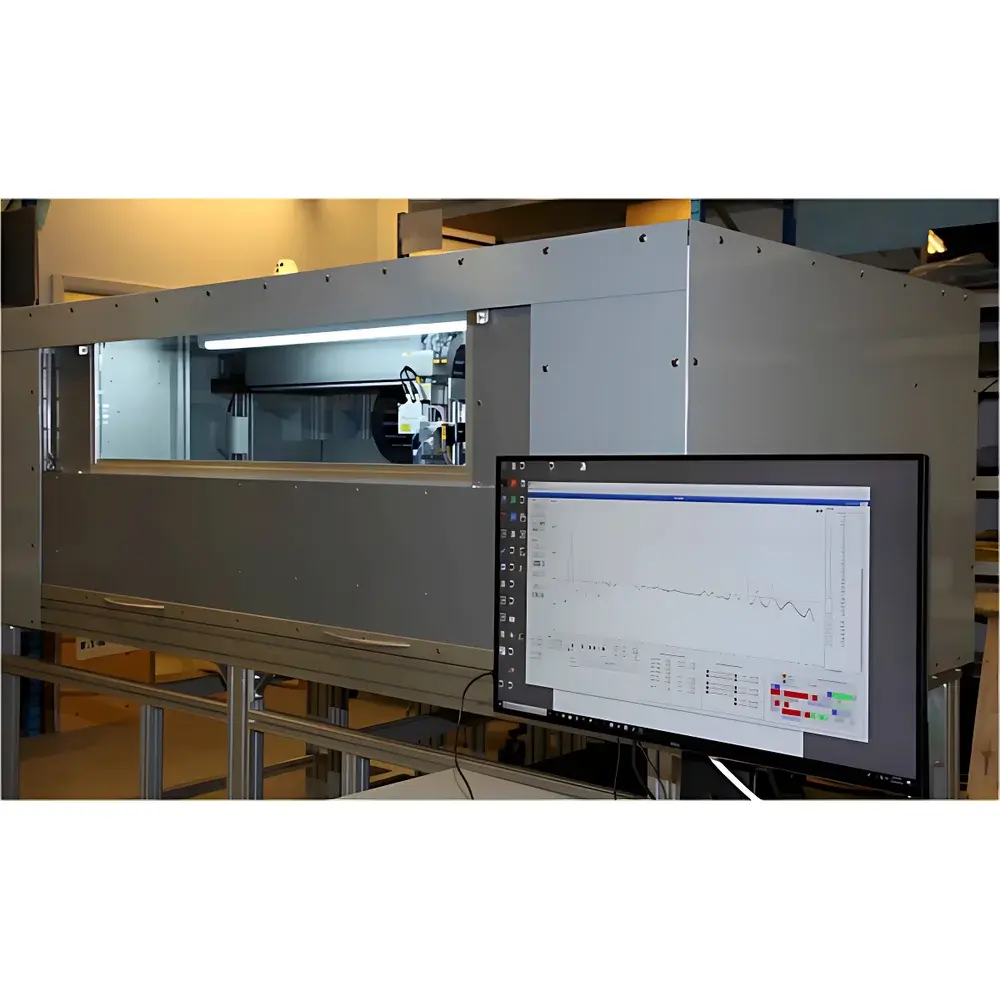
ITRAX XRF Scanner Core Elemental Scanning System
| Origin | Sweden |
|---|---|
| Manufacturer Type | Authorized Distributor |
| Origin Category | Imported |
| Model | XRF Scanner |
| Price Range | USD 27,000 – 68,000 (FOB) |
Overview
The ITRAX XRF Scanner Core Elemental Scanning System is a high-performance, non-destructive core logging instrument engineered for quantitative elemental mapping of geological drill cores, sediment cores, and rock slabs. Developed by ITRAX AB (Sweden) as the successor to the CoreScanner platform, it integrates three complementary imaging modalities—energy-dispersive X-ray fluorescence (ED-XRF), digital X-ray radiography (density imaging), and high-resolution RGB optical imaging—within a single, synchronized scanning pass. Unlike conventional benchtop or handheld XRF analyzers, the ITRAX system employs a fixed, micro-focused Rh-anode X-ray tube (50 W) coupled with a large-area silicon drift detector (SDD) to deliver high-count-rate, high-energy-resolution spectral acquisition (135 eV FWHM at Mn Kα) without helium purging or vacuum requirements. Its Polyflat™ X-ray focusing optics enable sub-millimeter beam definition and stable signal-to-noise performance across variable sample topographies—including fractured surfaces, inclined bedding planes, and irregular core diameters—ensuring consistent quantification integrity over extended unattended operation.
Key Features
- Simultaneous acquisition of ED-XRF spectra, X-ray density maps, and true-color optical images in one continuous scan
- Full-element coverage from Na (Z=11) to U (Z=92), including all rare earth elements (REEs), without spectral interference or calibration switching
- Standard spatial resolution: 1–10 mm step size; optional ultra-high-resolution mode down to 0.1 mm step increment
- No helium purge required—reduces consumable costs and simplifies lab infrastructure integration
- Robust industrial-grade gantry architecture rated for 24/7 unattended operation under GLP-compliant conditions
- Polyflat™ micro-beam optics enabling precise point-by-point excitation and configurable averaging (e.g., per cm, per core section, or full-core mean)
- Integrated RGB camera (≥5 MP), LED illumination system, and barcode reader for automated sample tracking and metadata linkage
- Optional UV fluorescence imaging module for organic phase identification and diagenetic assessment
Sample Compatibility & Compliance
The XRF Scanner accommodates cylindrical core samples up to 1 m in length and 120 mm in diameter (extendable to 150 mm upon request). Two configurations are available: the SC (Single-Core) variant (1900 × 700 × 1650 mm, 420 kg), optimized for high-precision analysis of individual cores; and the MC (Multi-Core) variant (1900 × 1200 × 1650 mm, 500 kg), supporting up to eight parallel cores depending on diameter. All mechanical and electrical subsystems comply with CE, IEC 61000-6-3 (EMC), and IEC 61000-6-4 standards. Data acquisition workflows support audit-trail generation aligned with FDA 21 CFR Part 11 requirements when deployed with validated software modules. Instrument operation meets ISO/IEC 17025 traceability principles for geochemical measurement, and analytical protocols are compatible with ASTM D7348 (XRF analysis of soils and sediments) and ISO 13195 (geochemical core logging).
Software & Data Management
The proprietary ITRAX CoreScan Suite provides end-to-end data processing—from raw spectrum deconvolution and matrix correction (using fundamental parameter algorithms) to multi-layer visualization and statistical correlation analysis. Spectral libraries include certified reference materials (CRMs) for marine sediments (e.g., PACS-3, MESS-4), igneous rocks (e.g., BCR-2, AGV-2), and ore standards (e.g., NIST SRM 278). The software supports batch processing of hundreds of cores, exports calibrated elemental concentrations (mg/kg or wt%) in CSV, HDF5, and GeoTIFF formats, and enables cross-modal correlation (e.g., Fe–S–Mo co-variation indicating sulfidic redox conditions). Built-in PCA, hierarchical clustering, and element ratio profiling tools facilitate mineral phase identification (e.g., Y–Ce–Nd correlations confirming monazite/xenotime association) and paleoenvironmental interpretation. All processing steps are logged with timestamps, user IDs, and parameter versions to satisfy GLP/GMP documentation requirements.
Applications
- High-resolution chemostratigraphy of marine and lacustrine sediment cores for paleoclimate reconstruction
- Exploration geochemistry: rapid REE distribution mapping in rare-metal pegmatites and carbonatites
- Diagenetic modeling via redox-sensitive element couples (e.g., V/Cr, Mo/U, Ce/Ce*)
- Core-scale characterization of shale gas reservoirs—including TOC proxies (V, Ni, Mo, U), clay mineral indicators (Al, K, Ti, Rb), and fracture-related elemental mobility
- Archaeological and environmental sediment profiling (e.g., heavy metal contamination plumes, anthropogenic Pb signatures)
- Quality control in mining and metallurgical core logging programs compliant with JORC and NI 43-101 reporting standards
FAQ
Does the ITRAX XRF Scanner require helium or vacuum for operation?
No—it operates in ambient air using a sealed Rh-target X-ray tube and high-efficiency SDD detector, eliminating gas consumption and associated infrastructure.
Can it quantify light elements such as C, N, or O?
No—detection begins at Na (Z=11); light elements are outside the effective energy range of the Rh-tube/SDD configuration.
What is the typical detection limit for trace metals in sediment cores?
Detection limits vary by element and matrix but typically range from 1–10 mg/kg for transition metals (e.g., Cu, Zn, Pb) and 0.1–1 mg/kg for enriched REEs under standard 1-mm/5-s acquisition.
Is the system compatible with third-party GIS or petrophysical modeling software?
Yes—exported GeoTIFF and CSV files integrate natively with Petrel, QGIS, RockWorks, and Python-based geoscience libraries (e.g., xarray, pandas, scikit-learn).
How is calibration maintained over long-term deployments?
Calibration stability is verified daily using onboard ceramic reference tiles; full recalibration against CRMs is recommended every 6 months or after major maintenance.





