
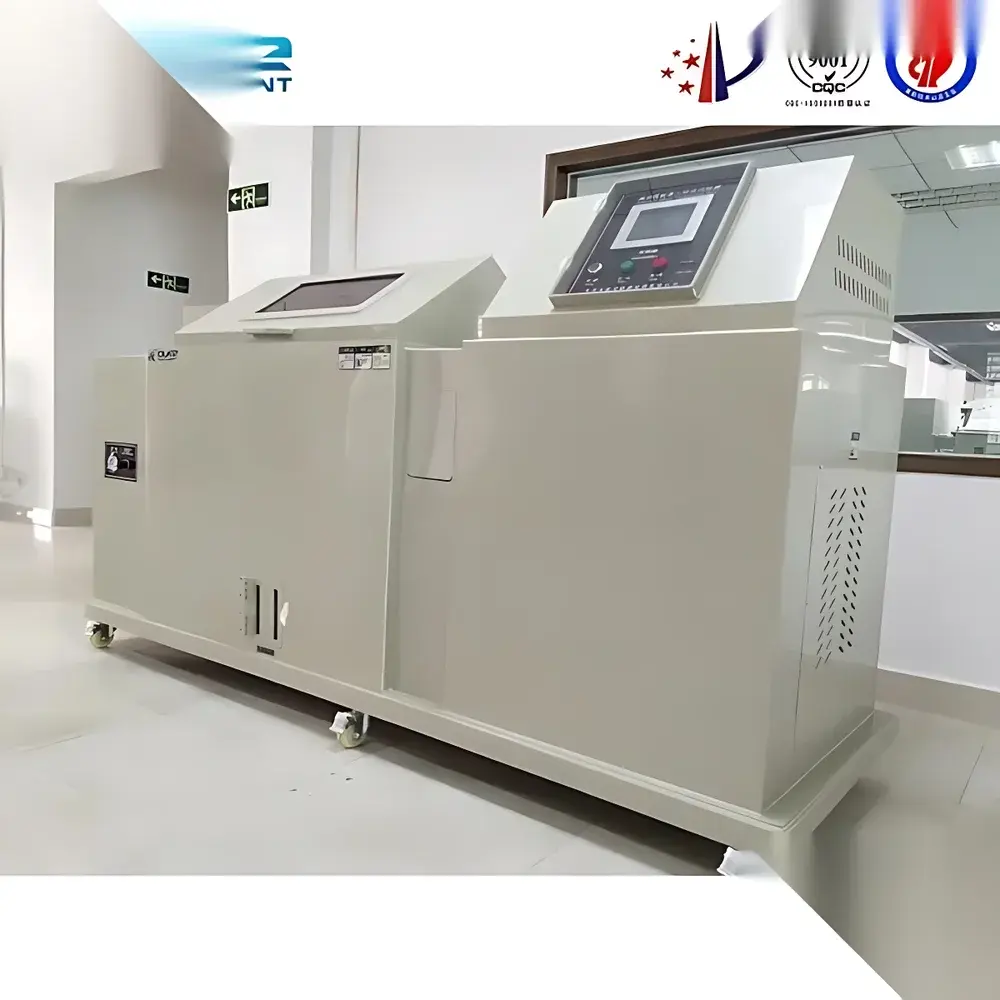
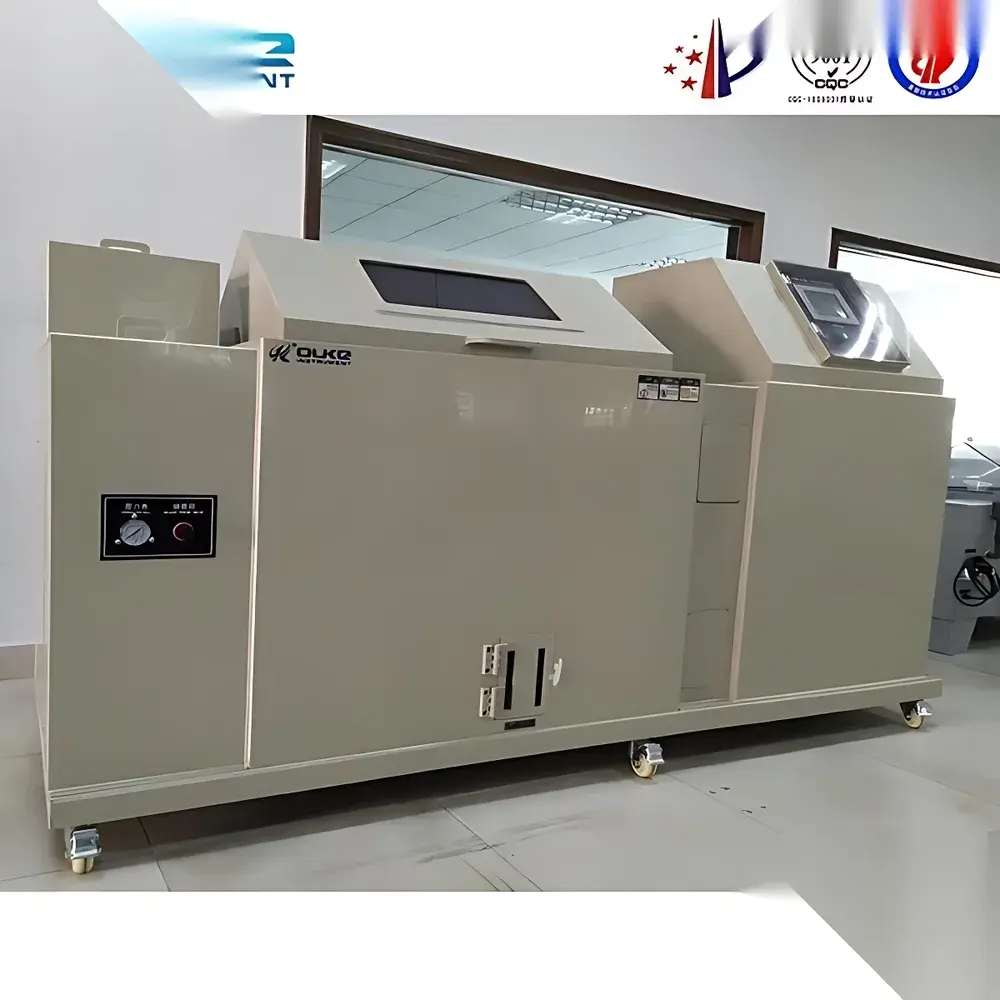
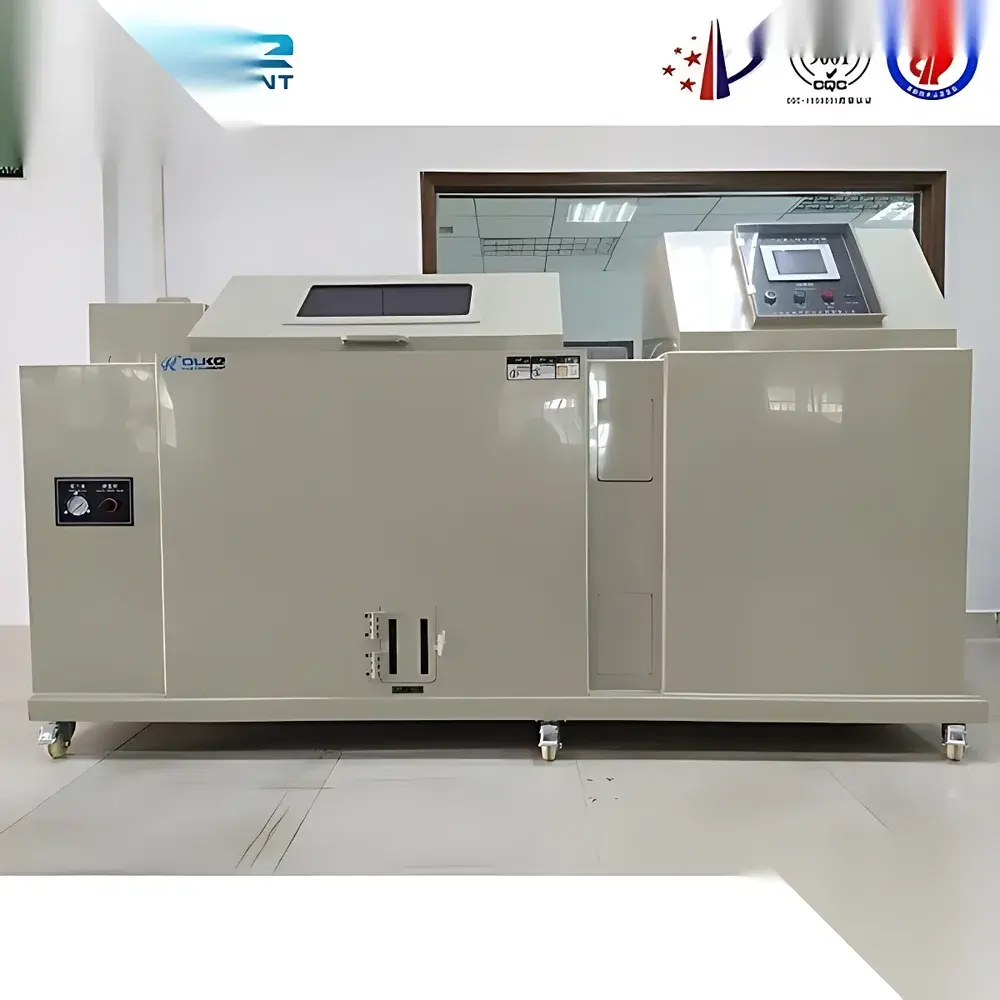
OK-FH-90 Tri-Environmental Corrosion Test Chamber (Temperature/Humidity/Salt Spray)
| Brand | Other Brands |
|---|---|
| Origin | Imported |
| Manufacturer Type | Authorized Distributor |
| Chamber Internal Dimensions (W×D×H) | 900 × 600 × 500 mm |
| External Dimensions (W×D×H) | 1420 × 780 × 1280 mm |
| NSS Test Temperature | 35 ± 1 °C |
| SATURATED AIR BUCKET TEMP (NSS) | 47 ± 1 °C |
| CASS Test Temperature | 50 ± 1 °C |
| SATURATED AIR BUCKET TEMP (CASS) | 63 ± 1 °C |
| Air Supply Pressure | 1 kg/cm² (two-stage adjustable) |
| Safety Features | Low-water-level cutoff, Overtemperature cutoff, Visual/audible alarm system, Low-salt-solution warning indicator |
| Note | Compressed air source and deionized water supply must be provided by user |
Overview
The OK-FH-90 Tri-Environmental Corrosion Test Chamber is an integrated environmental stress screening system engineered for accelerated corrosion evaluation of coated, plated, and surface-treated metallic components. It combines precisely controlled temperature, relative humidity, and salt spray exposure within a single chamber architecture—enabling sequential or simultaneous execution of standardized electrochemical degradation protocols including Neutral Salt Spray (NSS), Acetic Acid Salt Spray (AASS), and Copper-Accelerated Acetic Acid Salt Spray (CASS). The chamber operates on the principle of continuous fog generation via pneumatic atomization of conditioned saline solution, with independent thermal regulation of both test chamber and saturated air reservoir to maintain strict compliance with ISO 9227, ASTM B117, JIS Z2241, and GB/T 2423.17. Its tri-environmental capability supports multi-stress interaction studies critical for validating long-term field reliability of protective finishes in automotive, aerospace, marine, and electronics manufacturing.
Key Features
- Triple-function environmental control: Independent regulation of temperature (range: ambient to 55 °C), relative humidity (up to 98% RH), and salt fog concentration (adjustable via nozzle pressure and solution flow rate)
- Dual-zone thermal management: Separate PID-controlled heating circuits for test chamber and saturated air bucket ensure stable thermal gradients required for NSS (35 ± 1 °C chamber / 47 ± 1 °C bucket) and CASS (50 ± 1 °C chamber / 63 ± 1 °C bucket) testing
- Two-stage air pressure regulation system (1 kg/cm² nominal) with precision needle valves to optimize droplet size distribution and fog uniformity across the test volume
- Corrosion-resistant internal construction: PVC-coated stainless steel chamber walls and acid-resistant glass viewing window minimize cross-contamination and extend service life
- Comprehensive safety interlock suite: Automatic power cutoff at low water level or overtemperature conditions; real-time visual and audible alarms for low salt solution, chamber door open, and system fault states
- Ergonomic design: Front-access test specimen rack with adjustable height, removable drip tray, and calibrated fog collection funnels per ISO 9227 requirements
Sample Compatibility & Compliance
The OK-FH-90 accommodates specimens up to 900 mm (W) × 600 mm (D) × 500 mm (H), supporting standard test panels (e.g., 150 mm × 70 mm), fasteners, stamped parts, and assembled subassemblies. It is validated for use with common test solutions—including 5 wt% NaCl (NSS), 5 wt% NaCl + 0.26 mL/L glacial acetic acid (AASS), and 5 wt% NaCl + 0.26 mL/L glacial acetic acid + 0.25 g/L CuCl₂·2H₂O (CASS)—and complies with sample orientation, rack angle (15–30° from vertical), and fog deposition rate (1.0–2.0 mL/80 cm²/h) specifications defined in ISO 9227 Annex A. All operational parameters are traceable to NIST-traceable reference instruments, and the system supports GLP-compliant recordkeeping when integrated with external data loggers.
Software & Data Management
While the OK-FH-90 features a dedicated digital controller with real-time display of chamber temperature, saturated air temperature, and elapsed test time, it does not include embedded PC-based software. However, its analog output signals (0–10 V or 4–20 mA) for temperature and pressure are compatible with third-party SCADA systems, programmable logic controllers (PLCs), or data acquisition hardware compliant with IEC 61131-3 standards. Users may configure automated reporting templates aligned with ISO/IEC 17025 documentation requirements, including audit trails for parameter changes, alarm events, and calibration history—supporting FDA 21 CFR Part 11 readiness when paired with validated electronic signature modules.
Applications
This chamber is routinely deployed in quality assurance laboratories for evaluating corrosion resistance of zinc-nickel plating on automotive chassis components, chromate conversion coatings on aluminum aerospace alloys, epoxy-polyester powder coatings on outdoor enclosures, and vapor-phase corrosion inhibitors (VpCI) used in military packaging. It also supports comparative lifecycle assessment of alternative surface treatments under combined thermal-hygrometric-saline stress, enabling R&D teams to rank coating performance metrics such as blistering onset time, red rust propagation rate, and adhesion retention after cyclic exposure.
FAQ
What compressed air specifications are required for reliable fog generation?
A clean, oil-free, and desiccated air supply at 1 kg/cm² (≈14.2 psi) is mandatory; moisture or particulate contamination will clog nozzles and compromise fog uniformity.
Is deionized water required for the salt solution preparation?
Yes—resistivity ≥5 MΩ·cm is recommended to prevent unintended electrolytic effects and ensure reproducible corrosion morphology.
Can the chamber perform humidity-only or temperature-only cycles?
Yes—the controller allows standalone operation in humidity mode (20–98% RH, 25–60 °C) or temperature mode (ambient to 55 °C), independent of salt fog generation.
How often must the saturated air bucket be cleaned and recalibrated?
Monthly inspection and cleaning with dilute nitric acid solution are advised; temperature sensor calibration should be verified quarterly using a traceable RTD probe.
Does the system meet CE or UKCA marking requirements?
As supplied, the unit conforms to IEC 61000-6-2 (immunity) and IEC 61000-6-4 (emissions); full CE/UKCA certification requires integration into the end-user’s site-specific risk assessment and electrical installation validation.



