
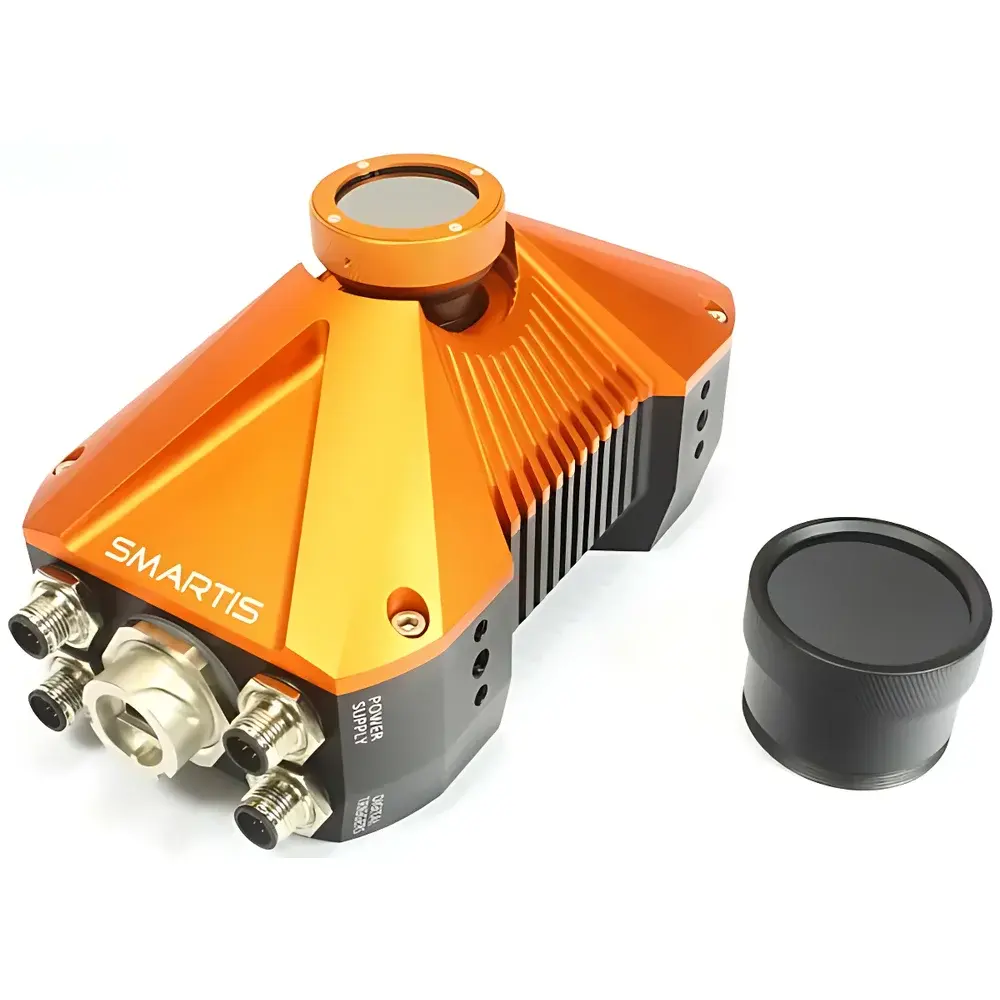
Workswell SMARTIS Intelligent Infrared Thermal Imaging Camera
| Brand | Workswell |
|---|---|
| Origin | Czech Republic |
| Model | SMARTIS |
| Thermal Detection Range | Up to 1500 °C (fully calibrated across full range) |
| Spectral Band | 7.5–13.5 µm |
| Detector Resolution Options | 336 × 256 or 640 × 512 |
| Interface | 100 Mbps Ethernet (RJ-45), TCP/IP, Built-in Web Server |
| I/O | Digital Inputs, Analog Outputs (0–24 mA / 12 V) |
| Compliance | CE, RoHS, EN 61000-6-2/6-4, IEC 61326-1 |
Overview
The Workswell SMARTIS Intelligent Infrared Thermal Imaging Camera is a fully integrated, industrial-grade thermal vision system engineered for autonomous operation in automated manufacturing and process control environments. Based on uncooled microbolometer detector technology operating in the long-wave infrared (LWIR) spectral band (7.5–13.5 µm), the SMARTIS delivers radiometrically accurate surface temperature measurements without requiring external cooling or real-time PC dependency. Its monolithic architecture embeds the thermal imaging sensor, real-time image processing unit, deterministic I/O subsystem, and a standards-compliant embedded web server—all within a single ruggedized enclosure. This design eliminates traditional integration bottlenecks by enabling direct communication with PLCs, SCADA systems, and MES platforms via native TCP/IP over 100 Mbps Ethernet (RJ-45), supporting deterministic latency and seamless interoperability in Industry 4.0 infrastructure.
Key Features
- Integrated embedded web server enabling remote configuration, live thermal stream access, and real-time visualization of measurement data via standard web browsers—no proprietary software required.
- Full radiometric calibration across the entire operational temperature range (up to 1500 °C), traceable to NIST-traceable reference sources, ensuring measurement consistency in high-temperature industrial processes.
- Dual-resolution detector options: 336 × 256 and 640 × 512 pixel arrays, optimized for balance between spatial resolution, frame rate stability, and thermal sensitivity (NETD < 50 mK typical).
- Deterministic digital I/O interface supporting hardware-triggered image capture, external event synchronization, and programmable alarm outputs—compatible with standard 24 V DC industrial logic levels.
- Analog output channel (0–24 mA or 0–12 V) configurable per user-defined measurement region (e.g., max temp in ROI), enabling direct integration into legacy analog control loops and PID controllers.
- On-device measurement tools including linear temperature profiles, discrete spot measurements, and min/max evaluation zones—processed in real time with timestamped metadata embedded in each thermal frame.
Sample Compatibility & Compliance
The SMARTIS is designed for non-contact surface temperature monitoring of metallic, ceramic, polymer, and composite materials under dynamic thermal conditions. It complies with electromagnetic compatibility (EMC) standards EN 61000-6-2 (immunity) and EN 61000-6-4 (emission), as well as electrical safety standard IEC 61326-1 for industrial measurement equipment. The device meets CE marking requirements and RoHS Directive 2011/65/EU for hazardous substance restriction. While not certified for intrinsic safety in explosive atmospheres (ATEX/IECEx), its IP65-rated housing provides protection against dust ingress and low-pressure water jets, making it suitable for deployment in demanding factory-floor environments. Calibration certificates are provided per unit and include uncertainty budgets aligned with ISO/IEC 17025 principles.
Software & Data Management
Configuration, monitoring, and data export are performed exclusively through the built-in HTTP/HTTPS web interface—accessible from any network-connected device with a modern browser. All thermal images and measurement metadata (including timestamps, ROI definitions, emissivity settings, and ambient compensation parameters) are encoded in standard JPEG+JSON or CSV formats. For integration into validated environments, the SMARTIS supports audit trail logging of all configuration changes and measurement parameter modifications, meeting foundational requirements for GLP and GMP-aligned documentation workflows. While no local storage is included, continuous streaming via RTSP or HTTP multipart/x-mixed-replace enables integration with third-party video management systems (VMS) or time-series databases (e.g., InfluxDB, TimescaleDB) for long-term thermal trend analysis.
Applications
- Real-time thermal feedback control in metal heat treatment lines (annealing, quenching, brazing), where analog output drives furnace zone power modulation.
- Non-destructive monitoring of composite curing cycles in aerospace component manufacturing, detecting resin flow anomalies and exothermic hotspots.
- Automated food processing line surveillance—verifying oven belt temperature uniformity, fryer oil stability, and post-bake cooling profiles per HACCP critical control points.
- Early-stage fire detection in conveyor-fed material handling systems, using programmable max-temperature thresholds and digital alarm triggering to initiate suppression protocols.
- R&D validation of thermal interface materials (TIMs) and battery cell thermal management systems, leveraging high-speed profile acquisition across active charge/discharge cycles.
- Machine vision-guided robotic welding supervision, where thermal signatures confirm weld pool geometry and solidification behavior in real time.
FAQ
Does the SMARTIS require a dedicated PC for operation?
No. All configuration, streaming, and measurement functions are accessible via its embedded web server—only a network connection and standard web browser are required.
Can the analog output be assigned to a custom temperature region?
Yes. Users define rectangular or polygonal ROIs via the web interface and assign the analog output to report min, max, or average temperature within that region.
Is firmware update supported remotely?
Yes. Firmware updates are performed securely via HTTPS upload through the web interface, with checksum verification and rollback capability.
What is the typical thermal sensitivity (NETD) at 30 °C?
The specified NETD is ≤50 mK at 30 °C for both resolution variants, measured under standard laboratory conditions per ISO 18434-1 Annex B.
Does SMARTIS support synchronization with external encoders or motion triggers?
Yes. Digital input channels accept TTL or 24 V DC pulse signals for hardware-synchronized image capture, enabling precise correlation with machine position or process events.





