
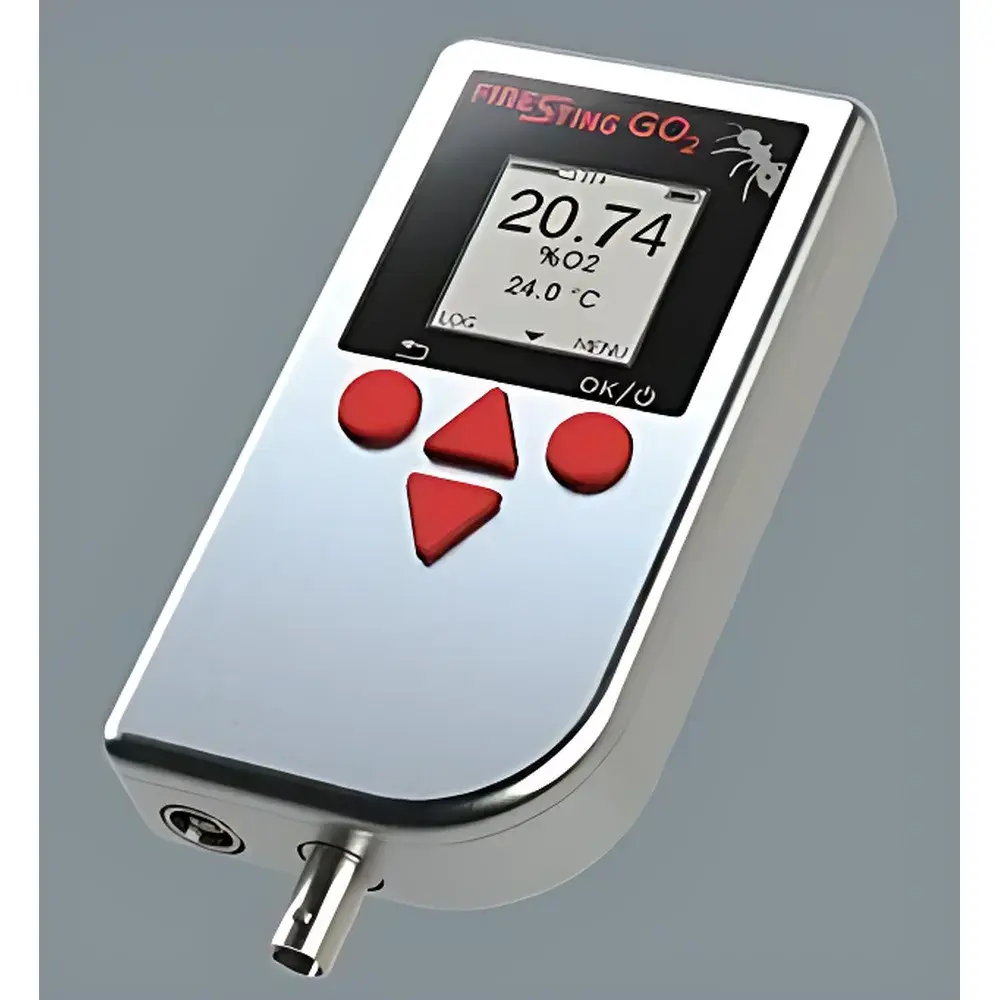
PyroScience FireSting GO2 Handheld Fiber-Optic Oxygen Meter
| Origin | Europe |
|---|---|
| Manufacturer Type | Authorized Distributor |
| Product Category | Imported Instrument |
| Model | FireSting GO2 |
| Pricing | Available Upon Request |
Overview
The PyroScience FireSting GO2 is a compact, single-channel handheld fiber-optic oxygen meter engineered for high-precision, non-invasive O2 quantification in diverse scientific and industrial environments. It operates on the principle of phase-modulation fluorometry using PyroScience’s proprietary REDFLASH technology — a solid-state, oxygen-sensitive indicator embedded in polymer matrices at the distal end of optical fibers. When excited by modulated red light (620 nm), the REDFLASH indicator emits near-infrared fluorescence (760–790 nm); molecular oxygen quenches this emission in a concentration-dependent manner, resulting in measurable phase shifts in the fluorescent signal. The FireSting GO2 precisely resolves these phase delays to calculate O2 partial pressure (pO2) with high temporal resolution and minimal photobleaching. Unlike electrochemical sensors, it requires no electrolyte, consumes no O2, and exhibits negligible drift over extended deployments — making it ideal for long-term monitoring in biological, environmental, and bioprocess applications.
Key Features
- Single-channel design compatible with the full suite of PyroScience RF-O2 optical sensors: needle-type microprobes, contactless surface sensors, flow-through cuvettes, respirometry chambers, and custom-configured sensor tips
- Integrated dual compensation: real-time temperature correction via built-in thermistor and barometric pressure compensation via onboard MEMS pressure sensor
- High-resolution LCD display (128 × 64 pixels) with intuitive menu navigation and live parameter visualization
- Onboard 2 GB flash memory enabling autonomous data logging without external devices — supports up to 30 days of continuous recording at 4 Hz sampling rate
- Rechargeable Li-ion battery (up to 12 h operational life per charge) and ultra-compact form factor (52 × 97 × 20 mm; 150 g)
- Multi-platform connectivity: direct operation via device interface, remote control via Android application (Android 10+), or PC-based acquisition via USB 2.0
- Detection limits: 0.02% O2 (standard sensor) and 0.005% O2 (trace sensor), with measurement ranges of 0–50% O2 and 0–10% O2, respectively
- Calibration flexibility: two-point calibration (0% and 21% O2 in air) yields accuracy of ±0.2% at 20% O2 and ±0.02% at 10% O2
Sample Compatibility & Compliance
The FireSting GO2 interfaces exclusively with PyroScience’s REFLUX-coupled RF-O2 optical sensors, which are chemically inert, autoclavable (where specified), and certified for use in aqueous, semi-solid, gaseous, and tissue-embedded media. Sensor tip geometries support measurements across spatial scales — from sub-millimeter sediment profiles to macro-scale bioreactor headspace analysis. All sensors comply with ISO 846:2019 (plastics — evaluation of microbial effects) and meet material compatibility requirements for GLP-compliant environmental monitoring. While the FireSting GO2 itself is not FDA-cleared, its traceable calibration protocol and audit-ready data export (CSV, TXT) align with laboratory quality management systems operating under ISO/IEC 17025 and USP guidelines for analytical instrument qualification.
Software & Data Management
Data acquisition and post-processing are supported through three interoperable pathways: the embedded firmware interface, the PyroStudio Android app (available on Google Play), and the desktop PyroStudio software suite (Windows/macOS). All platforms support time-stamped metadata tagging (temperature, pressure, sensor ID, operator), configurable sampling intervals (0.25–60 s), and export of raw phase-shift values alongside calculated pO2 and %O2. Exported datasets include full calibration history and sensor-specific response curves, facilitating traceability in regulated environments. The system logs all user-initiated actions (e.g., calibration events, memory clears) with timestamps — satisfying basic audit-trail requirements per FDA 21 CFR Part 11 when used in conjunction with institutional electronic record policies.
Applications
- Aquatic ecology: dissolved O2 profiling in lakes, sediments, biofilms, and algal cultures
- Plant physiology: real-time leaf mesophyll and root-zone O2 dynamics during photosynthesis/respiration cycles
- Animal respirometry: metabolic rate assessment in fish, insects, crustaceans, and small mammals using closed-chamber or flow-through configurations
- Soil and wetland biogeochemistry: high-resolution O2 microgradients across redox boundaries in rhizospheres and anoxic zones
- Bioprocess engineering: dissolved oxygen monitoring in stirred-tank bioreactors, perfusion cell culture systems, and enzymatic reaction vessels
- Food and beverage quality control: headspace O2 tracking in wine barrels, modified-atmosphere packaging, and grain storage silos
- Waste treatment: aerobic zone profiling in activated sludge reactors, landfill leachate monitoring, and anaerobic digestion off-gas analysis
FAQ
Is the FireSting GO2 suitable for underwater deployment?
Yes — when paired with waterproof RF-O2 probes (e.g., DP-AMT, SP-PSt7), the system operates reliably down to 10 m depth. The meter itself is IP54-rated and intended for surface-side operation only.
Can multiple sensors be connected simultaneously?
No — the FireSting GO2 is a single-channel instrument. For multi-point measurements, users require either sequential probing or parallel acquisition using multiple FireSting GO2 units synchronized via external triggers.
What is the recommended calibration frequency?
For routine research use, calibration every 7–14 days is sufficient. In high-accuracy or regulatory contexts, daily zero/span verification is advised, particularly when ambient pressure or temperature varies significantly between sessions.
Does the device support third-party sensor integration?
No — the FireSting GO2 communicates exclusively with PyroScience’s digital RF-O2 sensors via proprietary optical and electrical handshake protocols. Non-PyroScience probes are incompatible.
How is data integrity ensured during power loss?
The onboard flash memory writes data in atomic blocks; partial writes are rejected, and the last complete measurement cycle is preserved even during unexpected shutdowns.
Related Products




