
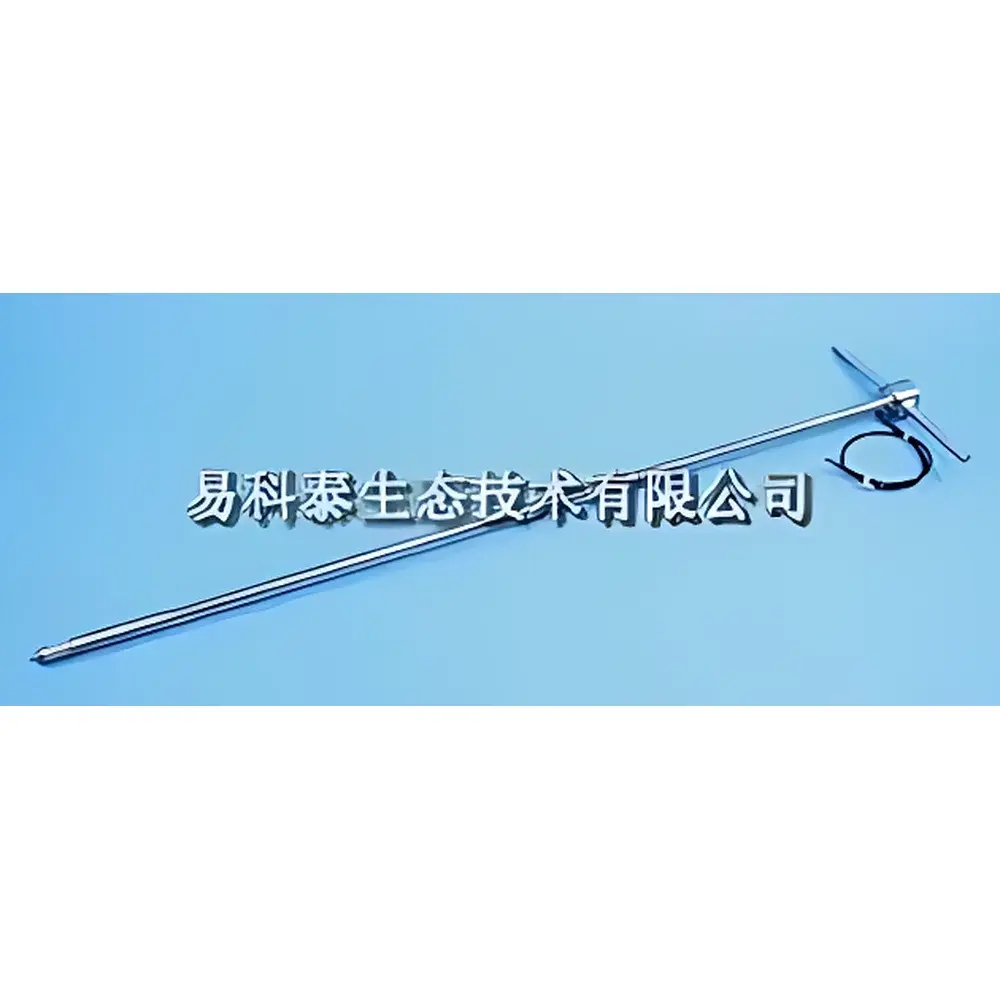
DIK-5212 Soil Gas Sampler
| Origin | Japan |
|---|---|
| Manufacturer Type | Authorized Distributor |
| Origin Category | Imported |
| Model | DIK-5212 |
| Quotation | Upon Request |
| Ceramic Probe Tip | Porous Alumina-Coated SUS316L, Ø13 mm × 20 mm |
| Pore Size | 100 µm |
| Standard Probe Length | 80 cm (customizable from 10–100 cm) |
| Drill Bit | SUS304, Ø13 mm × 16 mm, 60° tip angle |
| Optional Accessories | Portable O₂ Concentration Meter, 50 mL Vacuum Syringe |
Overview
The DIK-5212 Soil Gas Sampler is a field-deployable, passive/active soil gas extraction system engineered for reliable in situ sampling of interstitial gases from unsaturated and saturated soil zones. It operates on the principle of controlled vacuum-driven diffusion and convective gas transfer through a porous ceramic interface—designed to equilibrate with pore-space gas while minimizing soil disturbance and preferential flow artifacts. The sampler’s core component—the sintered ceramic tip—functions as a semi-permeable membrane that permits selective gas-phase ingress while excluding water and particulate matter under typical field moisture conditions (matric potentials > −10 kPa). This design enables representative sampling of volatile organic compounds (VOCs), greenhouse gases (CO₂, CH₄, N₂O), oxygen, and other gaseous analytes without requiring soil excavation or core retrieval. Its modular architecture supports both manual operation via handheld vacuum syringes and integration with regulated vacuum sources (e.g., diaphragm pumps with pressure control), ensuring compatibility with downstream analytical platforms including GC-FID, GC-MS, and portable electrochemical sensors.
Key Features
- High-integrity ceramic probe tip fabricated from alumina-coated SUS316L stainless steel—resistant to corrosion, oxidation, and microbial biofouling in acidic, alkaline, or saline soils.
- Precisely engineered 100 µm pore structure ensures consistent gas permeability while rejecting liquid-phase intrusion across a broad range of soil textures (sand to silty clay).
- Modular probe assembly: standard 80 cm length with threaded coupling; customizable lengths (10–100 cm) accommodate shallow vadose zone profiling or deep-root-zone monitoring.
- Integrated 60° conical drill bit (SUS304) enables low-torque insertion into compacted or gravelly soils without pre-augering.
- Interchangeable and cleanable ceramic tips—validated for repeated field use following ethanol rinse and air-drying per ASTM D5088-22 protocols.
- Direct coupling interface compatible with industry-standard gas-tight septa, Swagelok® fittings, and 1/8″ OD PTFE tubing for leak-free connection to analyzers or canisters.
Sample Compatibility & Compliance
The DIK-5212 is validated for use in EPA Method TO-15, ASTM D5088-22 (Standard Practice for Soil Gas Sampling), and ISO 18400-202 (Investigation of Soil Quality — Sampling — Part 202: Guidance on Sampling of Soil Gas). It meets GLP requirements for traceable sample integrity when used with documented chain-of-custody procedures. The SUS316L/SUS304 construction complies with FDA-recommended materials for environmental contact surfaces (21 CFR 178.3570). All components are non-reactive toward C₁–C₁₀ hydrocarbons, halogenated VOCs, and inorganic gases at ambient temperatures (−10 °C to +50 °C), ensuring minimal adsorption or catalytic degradation during sampling intervals ≤ 30 minutes.
Software & Data Management
While the DIK-5212 is a hardware-only sampling tool with no embedded electronics or firmware, it integrates seamlessly into digital environmental workflows. When paired with optional portable O₂ meters (e.g., electrochemical cells compliant with ISO 7241-1), real-time concentration data can be logged via Bluetooth-enabled field tablets running compliant data acquisition software (e.g., LabVIEW Runtime or EpiCollect5). All sampling events—including probe depth, vacuum duration, ambient T/P, and operator ID—are structured for export to LIMS platforms supporting ASTM E1467-20 data exchange schemas. Audit trails comply with 21 CFR Part 11 when used with validated electronic signature modules.
Applications
- Landfill gas migration studies and perimeter monitoring per EPA SW-846 Method 5021A.
- VOC plume delineation at brownfield sites undergoing remedial investigation (RI/FS).
- Soil respiration and redox profiling in ecological and agricultural research (e.g., denitrification potential, root-zone O₂ dynamics).
- Baseline characterization prior to geotechnical or construction activities per ISO 14688-1.
- Validation of vapor intrusion mitigation systems under ASTM E2600-21.
- Long-term vadose zone monitoring networks using multipoint probe arrays with time-synchronized vacuum cycles.
FAQ
What is the maximum recommended insertion depth for the DIK-5212 probe without mechanical reinforcement?
Standard probes are rated for static insertion up to 1.5 m in cohesive soils; deeper deployment requires guide rods or casing sleeves per ASTM D5088 Annex A3.
Can the ceramic tip be sterilized for microbiological soil gas studies?
Yes—autoclaving at 121 °C, 15 psi for 20 minutes is validated for ceramic tip integrity; however, repeated thermal cycling beyond five cycles may reduce pore uniformity.
Is the 50 mL vacuum syringe supplied with calibrated volume markings?
Yes—the optional syringe features Class A volumetric graduation per ISO 648, certified to ±0.5% accuracy at 20 °C.
How often should the ceramic tip be replaced under continuous field use?
Under typical usage (≤5 samples/day, non-aggressive matrices), replacement is recommended every 6 months or after 200 insertions—whichever occurs first—as verified by helium leak testing (ASTM F2391).
Does the DIK-5212 comply with EU REACH and RoHS directives?
Yes—material declarations confirm full compliance with SVHC thresholds and restricted substance limits per Regulation (EC) No 1907/2006 and Directive 2011/65/EU.
Related Products







