
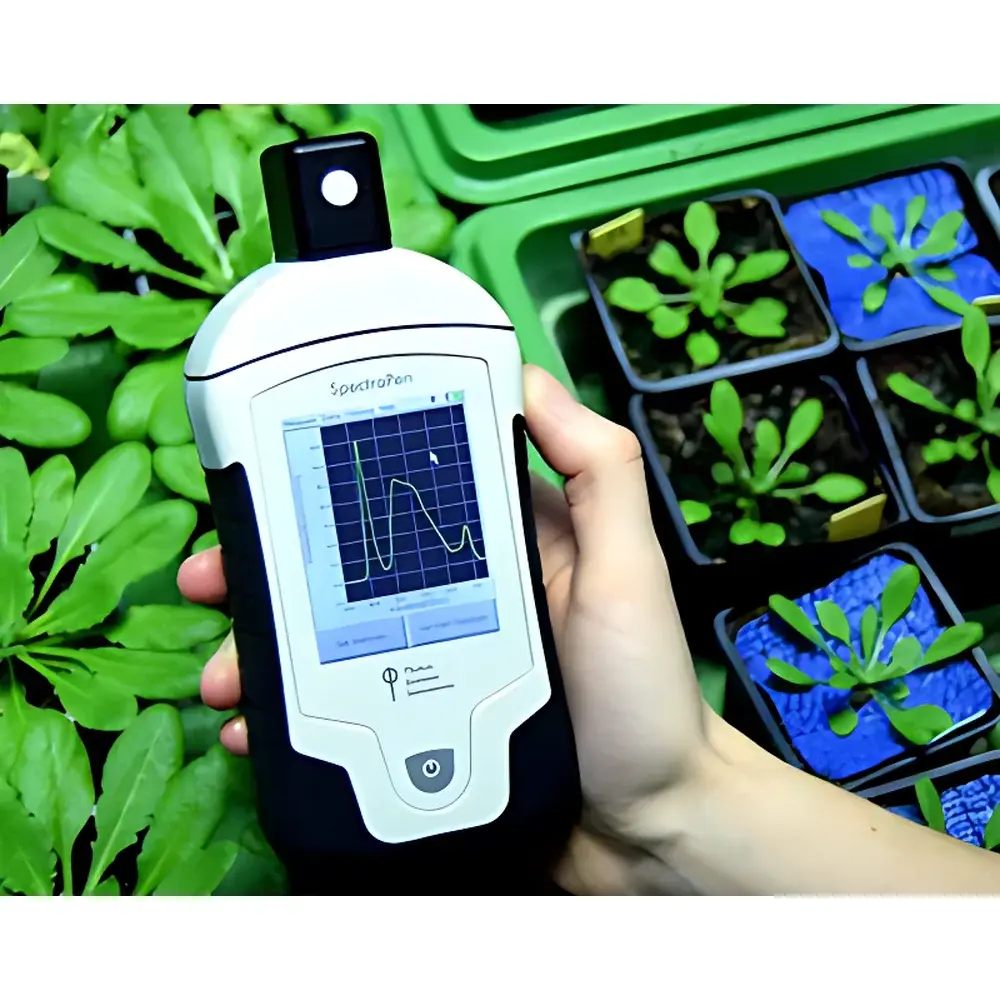
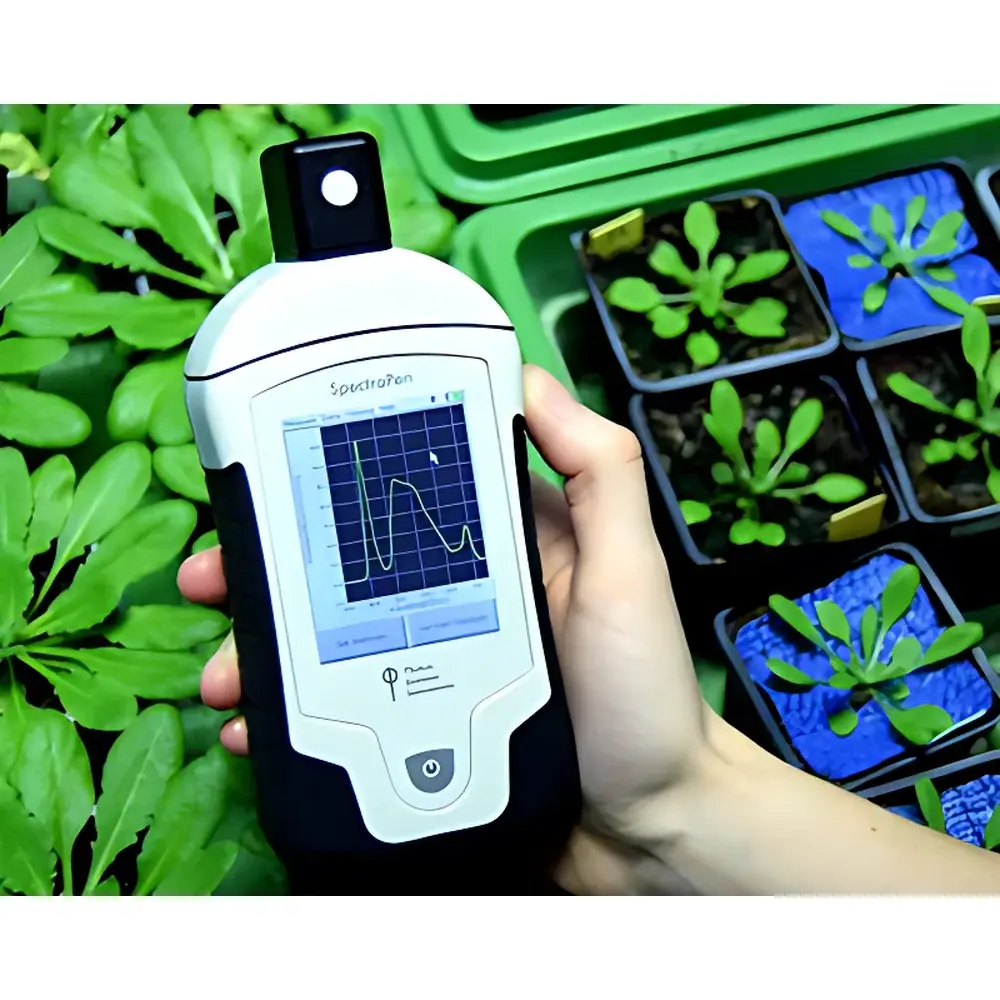
PSI SpectraPen LM510 Handheld Spectroradiometer
| Brand | PSI (Czech Republic) |
|---|---|
| Origin | Czech Republic |
| Model | SpectraPen LM510 |
| Spectral Range | UVIS 340–780 nm or NIR 640–1050 nm (configurable) |
| FWHM | 7 nm |
| Stray Light | −30 dB |
| Wavelength Repeatability | ±0.5 nm |
| Integration Time | 5 ms – 10 s |
| Detector | 256-pixel linear CCD |
| Cosine Corrector | Integrated, orientation-selectable (H or V) |
| Display | 240×320 pixel color touchscreen |
| Memory | 16 MB (≥4,000 spectra) |
| GPS | Built-in |
| Connectivity | USB + Bluetooth |
| Battery Life | Up to 48 h continuous operation |
| Dimensions | 180 × 75 × 40 mm |
| Weight | 300 g |
| IP Rating | Splash-resistant housing |
| Operating Temperature | 0–50 °C |
| Storage Temperature | −20–70 °C |
| Data Output | Irradiance (μW·cm⁻²·nm⁻¹), Photosynthetic Photon Flux Density (PPFD) spectrum (μmol·m⁻²·s⁻¹·nm⁻¹), Illuminance (lux), PAR (μmol·m⁻²·s⁻¹), CIE 1931 chromaticity coordinates, CCT, CRI, vCIE, user-defined spectral integrals |
Overview
The PSI SpectraPen LM510 Handheld Spectroradiometer is a field-deployable, high-fidelity spectroradiometric instrument engineered for quantitative optical characterization of natural and artificial light sources across terrestrial and controlled-environment applications. Based on a thermally stabilized 256-pixel linear CCD array and precision-calibrated cosine corrector optics, the LM510 implements absolute radiometric calibration traceable to NIST-traceable standards. Its dual-spectral configuration—UVIS (340–780 nm) or NIR (640–1050 nm)—enables rigorous measurement of photosynthetically active radiation (PAR), photobiologically relevant UV-A/B bands, and near-infrared reflectance signatures critical in plant phenotyping and ecosystem monitoring. Unlike broadband sensors, the LM510 delivers full spectral irradiance (μW·cm⁻²·nm⁻¹) and photosynthetic photon flux density (PPFD) spectra (μmol·m⁻²·s⁻¹·nm⁻¹) with 7 nm full-width-at-half-maximum (FWHM) resolution and <±0.5 nm wavelength repeatability—ensuring metrological consistency across repeated field campaigns and multi-site comparative studies.
Key Features
- Field-portable architecture: 300 g mass, splash-resistant enclosure, and 48-hour battery endurance support extended deployments without external power or computing infrastructure.
- Configurable cosine corrector orientation: “H” (hemispherical upward) for confined spaces (growth chambers, canopy gaps); “V” (forward-facing) for tripod-mounted outdoor profiling and directional irradiance mapping.
- Real-time onboard computation of biologically and photometrically relevant metrics—including PAR (400–700 nm), illuminance (lux), luminous flux (lumen), radiant flux (W·m⁻²), CIE 1931 chromaticity, correlated color temperature (CCT), and color rendering index (CRI).
- Integrated GPS module geotags every spectral acquisition, enabling spatially referenced light mapping in ecological transects, greenhouse zoning, or urban lighting audits.
- 16-bit analog-to-digital conversion and low-noise electronics (15 LSB RMS) ensure high dynamic range and signal fidelity across low-light (e.g., dawn/dusk, shaded understory) and high-intensity (direct solar, LED horticultural arrays) conditions.
- USB and Bluetooth 4.0 dual-mode connectivity enable both wired data synchronization and wireless telemetry for real-time remote logging in networked sensor arrays.
Sample Compatibility & Compliance
The SpectraPen LM510 is designed for non-contact, non-destructive measurement of planar or diffuse light fields—ideal for characterizing photosynthetic photon flux in crop canopies, spectral quality of horticultural LEDs, UV attenuation in aquatic systems, and daylight harvesting efficiency in architectural glazing. Its cosine response conforms to ISO/CIE standards for irradiance measurement (CIE S 014-1/E:2006), and spectral calibration is performed per ISO/IEC 17025-accredited procedures at PSI’s Czech metrology laboratory. Data integrity meets GLP-compliant requirements through timestamped, GPS-georeferenced storage and audit-ready export formats. While not FDA 21 CFR Part 11-certified as a standalone system, its raw spectral data and metadata structure support integration into validated laboratory information management systems (LIMS) for regulated photobiology workflows.
Software & Data Management
The included SpectraPen Control Suite (Windows/macOS) provides post-acquisition processing, spectral visualization, and customizable analysis pipelines. Users may define arbitrary integration bands (e.g., UV-B 280–315 nm, far-red 700–800 nm), apply Savitzky-Golay smoothing, compute spectral ratios (R/FR, B/R), and generate PPFD-weighted action spectra. The software includes a GIS plugin that overlays spectral measurements onto georeferenced maps using embedded GPS coordinates. All data export to CSV or Excel-compatible XLSX format preserves metadata (integration time, GPS position, device ID, calibration date). Firmware updates are delivered free-of-charge via secure HTTPS channel and maintain backward compatibility with legacy spectral libraries.
Applications
- Plant physiology: Quantifying spectral drivers of photomorphogenesis, stomatal conductance, and secondary metabolite synthesis under variable LED lighting regimes.
- Agricultural lighting QA/QC: Validating spectral output consistency of commercial horticultural fixtures against manufacturer specifications and industry benchmarks (e.g., ASABE S630.1).
- Ecological monitoring: Assessing UV-B exposure gradients across altitudinal transects, dissolved organic carbon (DOC)-mediated spectral attenuation in boreal lakes, and canopy light heterogeneity in forest understories.
- Environmental phototoxicity studies: Correlating solar spectral composition with ROS generation kinetics in zooplankton (as cited in Wolf et al., Front. Ecol. Evol. 2018) or DNA damage thresholds in Daphnia magna (Wolf et al., Funct. Ecol. 2017).
- Color science & material testing: Evaluating spectral power distribution (SPD) of display backlights, sunscreen efficacy against visible-light-induced pigmentation (Duteil et al., Photodermatol. Photoimmunol. Photomed. 2017), and pigment stability under accelerated aging protocols.
FAQ
What spectral calibration standards are used for the LM510?
Each unit undergoes factory calibration using NIST-traceable tungsten halogen and deuterium lamps, with wavelength accuracy verified against atomic emission lines (Hg, Ne). Certificate of Calibration includes uncertainty budgets per CIE S 026:2019.
Can the LM510 measure underwater light fields?
The splash-resistant housing is not submersible; however, it may be used above-water surface measurements of downwelling irradiance in shallow aquatic systems when paired with an optional water-immersion cosine diffuser accessory (sold separately).
Is spectral data compatible with third-party analysis platforms like R or Python?
Yes—exported CSV files contain wavelength (nm) and irradiance/PPFD columns with SI units, enabling direct ingestion into Pandas, NumPy, or ggplot2 for custom modeling, machine learning, or spectral derivative analysis.
How is PAR calculated from the raw spectrum?
PAR (400–700 nm) is computed by integrating the photosynthetic photon flux density (PPFD) spectrum (μmol·m⁻²·s⁻¹·nm⁻¹) using the CIE photopic luminosity function scaled to quantum units, per ISO 21348 definitions.
Does the LM510 support automated time-series logging?
No internal scheduler is implemented; however, external triggering via USB-serial command protocol allows integration with programmable logic controllers (PLCs) or Raspberry Pi-based autonomous stations for unattended diurnal profiling.



