
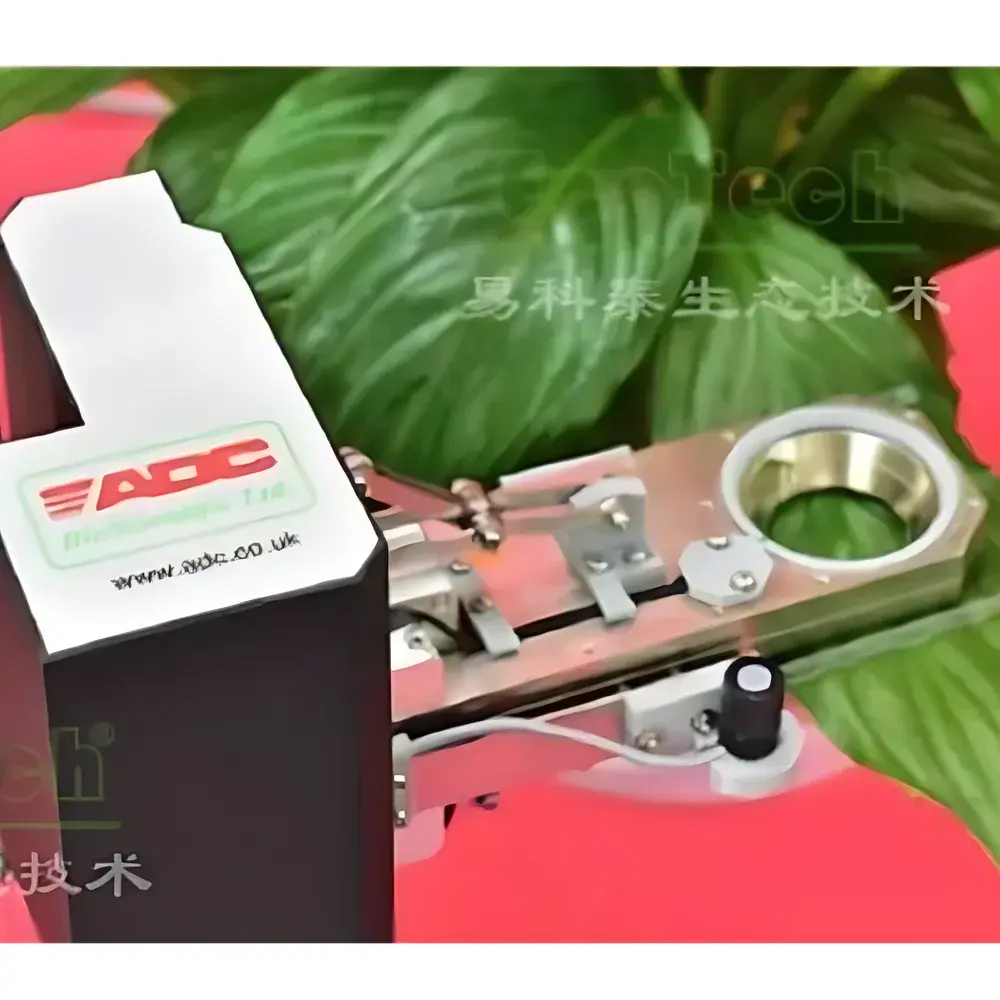
ADC Bio APS Multi-Channel Photosynthesis Measurement and Monitoring System
| Brand | ADC Bio |
|---|---|
| Origin | United Kingdom |
| Model | APS Multi-Channel |
| Configuration Options | 5-channel or 10-channel modular system |
| Gas Exchange Measurement Principle | Infrared Gas Analysis (IRGA) with integrated multi-port gas multiplexer |
| Leaf Chamber Interface | Detachable, independently controlled cuvettes connected via extended pneumatic tubing and signal cables |
| Compliance | Designed for GLP-compliant environmental physiology studies |
| Software Platform | APS Control Suite with audit trail, timestamped raw data export (CSV/NetCDF), and optional FDA 21 CFR Part 11–ready configuration |
Overview
The ADC Bio APS Multi-Channel Photosynthesis Measurement and Monitoring System is an engineered solution for high-throughput, synchronized gas exchange phenotyping across multiple plant specimens under controlled or semi-field conditions. Unlike conventional single-cuvette systems, the APS architecture integrates a central IRGA-based gas analysis unit with a programmable multi-port gas multiplexer, enabling sequential, time-synchronized measurement of CO₂ assimilation (An), stomatal conductance (gs), transpiration (E), and intercellular CO₂ concentration (Ci) across up to ten independent leaf chambers. Each chamber operates with dedicated environmental control—regulated light (PAR), temperature, humidity, and CO₂—and real-time feedback loops ensure measurement stability during long-term monitoring. The system is explicitly designed for longitudinal studies requiring reproducible, low-drift physiological data across diurnal cycles, stress induction timelines, or genotype × environment interaction trials.
Key Features
- Modular channel scalability: Configurable for 5 or 10 independently addressable leaf chambers, each with individual PID-controlled environmental regulation (light, T, RH, CO₂)
- Extended deployment capability: Pneumatic tubing and shielded signal cabling support chamber-to-host distances exceeding 30 m without signal degradation or flow latency
- Integrated multiplexing architecture: Eliminates manual cuvette switching; automated sequence scheduling ensures identical measurement timing and environmental ramping across all channels
- Real-time diagnostics: Onboard validation of IRGA zero/span drift, flow rate consistency, and chamber seal integrity with automated alert logging
- Hardware expandability: Native interface for synchronized integration with third-party optical modules including FluorPen fluorometers, Thermo-RGB thermal imaging sensors, and FluorTron® fluorescence imaging platforms
- Ruggedized field-ready design: IP54-rated enclosure, industrial-grade solenoid valves, and temperature-compensated pressure sensors suitable for greenhouse, growth chamber, and outdoor canopy deployments
Sample Compatibility & Compliance
The APS system accommodates broad leaf morphology—from narrow monocot blades (e.g., wheat, rice) to broad dicot leaves (e.g., tomato, Arabidopsis rosettes)—via interchangeable chamber gaskets and adjustable clamping mechanisms. All gas pathways employ electropolished stainless-steel fittings and PFA-lined tubing to prevent adsorption artifacts and ensure trace-level CO₂/H₂O stability. The system conforms to ISO 17025 calibration traceability requirements for gas analyzers and supports GLP documentation workflows, including electronic signature-capable audit trails, instrument calibration history tracking, and user-access-level permissions. Optional 21 CFR Part 11 compliance packages include electronic record integrity verification, change control logs, and biometric or token-based authentication.
Software & Data Management
APS Control Suite is a Windows-based application built on a deterministic real-time kernel, ensuring sub-second synchronization between gas analyzer sampling, chamber actuation, and environmental sensor acquisition. Raw data streams—including analog voltage outputs from PAR sensors, thermocouples, and IRGA detectors—are timestamped at 100 Hz and archived in dual-format: human-readable CSV (with metadata headers) and machine-optimized NetCDF-4 (supporting CF-1.8 conventions). Batch processing tools enable automated calculation of derived parameters (e.g., intrinsic water-use efficiency iWUE = An/gs, mesophyll conductance via variable J method), while API access permits integration with LIMS or statistical platforms such as R or Python-based phenomics pipelines. All software updates undergo version-controlled release testing per IEC 62304 standards.
Applications
- Plant abiotic stress phenotyping: Quantifying dynamic photosynthetic inhibition kinetics under drought, salinity, heat, or ozone exposure
- Carbon flux modeling: Generating high-resolution A/Ci and light-response curves for parameterization of Farquhar-von Caemmerer-Berry models
- SPAC continuum analysis: Coupling APS gas exchange data with sap flow sensors and soil moisture probes to resolve whole-plant hydraulic resistance partitioning
- Crop ideotype screening: High-throughput evaluation of photosynthetic capacity and stomatal responsiveness across breeding populations under controlled photoperiod regimes
- Climate change simulation: Long-term monitoring of acclimation responses (e.g., Vcmax plasticity, Rubisco activation state) across elevated CO₂ and warming treatments
- Functional genomics validation: Correlating mutant or transgenic lines with quantitative photosynthetic phenotypes under standardized environmental protocols
FAQ
How many leaf chambers can be operated simultaneously?
The APS system supports either 5 or 10 independently controlled leaf chambers, selected at time of order. Channel count is fixed per hardware configuration and cannot be upgraded post-purchase.
Can the system operate unattended for multi-day experiments?
Yes. With scheduled measurement sequences, automated zero/span calibration cycles, and battery-backed real-time clock, the APS supports continuous operation for >14 days without manual intervention.
Is remote monitoring supported?
The APS Control Suite includes optional secure remote access via TLS-encrypted VNC tunneling, enabling real-time visualization of live data streams and chamber status from off-site locations.
What calibration standards are required for IRGA maintenance?
Certified CO₂/N₂ and CO₂/air standard gases (traceable to NIST SRM 1662a) are recommended for biweekly span checks; zero gas must be CO₂-free synthetic air meeting ISO 8573-1 Class 1 purity specifications.
Does the system comply with FDA or EMA regulatory submission requirements?
When deployed with the optional 21 CFR Part 11 package—including electronic signatures, audit trail encryption, and role-based access control—the APS meets baseline data integrity requirements for preclinical plant efficacy studies referenced in FDA Guidance for Industry #229 and EMA CHMP Position Paper on Non-Clinical Plant Biostimulant Assessment.
Related Products



