
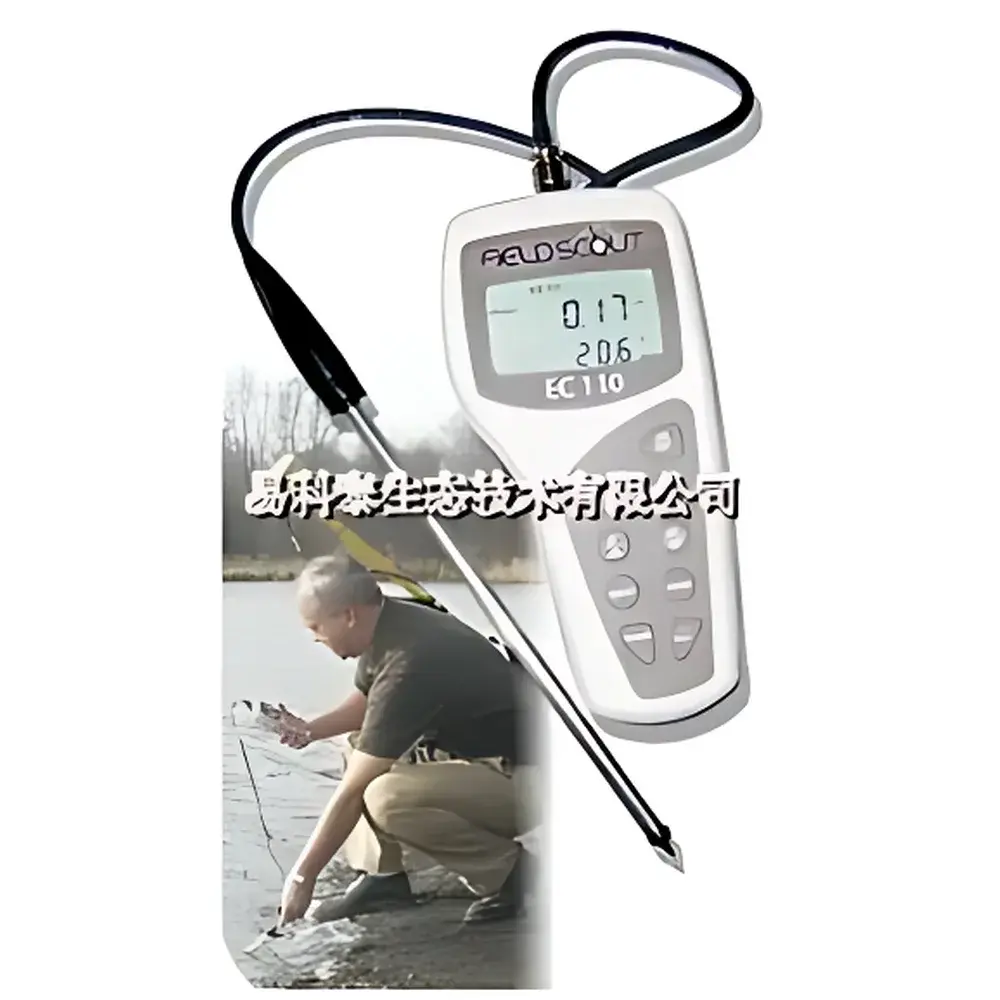
2225FS Portable Soil Salinity Meter
| Origin | USA |
|---|---|
| Manufacturer Type | Authorized Distributor |
| Origin Category | Imported |
| Model | 2225FS |
| Pricing | Upon Request |
| Measurement Range | 0.00–199.9 mS/cm |
| Accuracy | ±2% of reading |
| Data Storage Capacity | 1,000 measurements |
| Power Supply | 4 × AAA alkaline batteries (30 hours typical runtime) |
| Probe Length | 61 cm (T-type configuration) |
| IP Rating | IP67 (submersible to 1 m for 30 min) |
| Interface | USB 2.0 for data export |
| Calibration | Single-point or two-point with standard KCl solutions (e.g., 1.413 mS/cm and 12.88 mS/cm) |
Overview
The 2225FS Portable Soil Salinity Meter is an industrial-grade electrochemical field instrument engineered for rapid, in-situ measurement of electrical conductivity (EC) in heterogeneous media—including saturated soil paste extracts, surface and groundwater, irrigation runoff, hydroponic nutrient solutions, and organic solvent-based agricultural formulations. Unlike benchtop conductivity meters requiring sample extraction and filtration, the 2225FS employs a robust T-shaped stainless-steel probe with integrated temperature compensation (NTC 30 kΩ), enabling direct insertion into undisturbed soil profiles or open water bodies. Its measurement principle adheres to ASTM D2777–22 and ISO 7888:2019 standards for conductivity determination, reporting results in millisiemens per centimeter (mS/cm) — the internationally accepted unit for salinity assessment in agronomy, environmental monitoring, and water resource management. The device operates on the fundamental relationship between ion concentration and solution conductance, calibrated traceably to NIST-traceable KCl reference standards.
Key Features
- T-type probe geometry (61 cm total length) optimized for deep soil profiling and riverbed penetration without bending or breakage
- Embedded microcontroller-based data logger storing up to 1,000 timestamped EC and temperature readings with automatic date/time stamping
- IP67-rated housing certified for dust-tight operation and temporary submersion (1 m depth, 30 min), validated per IEC 60529
- Auto-ranging circuitry spanning 0.00–199.9 mS/cm with ±2% full-scale accuracy across all ranges; no manual range switching required
- On-device real-time temperature compensation (0–50 °C) using built-in thermistor, eliminating post-measurement correction
- USB 2.0 interface supporting mass-storage mode for drag-and-drop CSV file export; compatible with Windows, macOS, and Linux
- Field-calibratable via single-point (1.413 mS/cm) or dual-point (1.413 & 12.88 mS/cm) procedures using supplied certified calibration solutions
Sample Compatibility & Compliance
The 2225FS is validated for use with soils ranging from sandy loam to heavy clay (up to 40% clay content), aqueous matrices with total dissolved solids (TDS) ≤ 120 g/L, and non-aqueous systems containing ≤ 15% ethanol or methanol by volume. It complies with EPA Method 9040C for soil EC screening and supports GLP-compliant workflows through audit-ready calibration logs and user-defined operator ID tagging. All firmware and calibration routines are designed to meet FDA 21 CFR Part 11 requirements for electronic records and signatures when used in regulated agricultural research settings.
Software & Data Management
The meter interfaces natively with the optional SalinityLink Desktop Suite (v3.2+), a validated Windows application that imports raw .CSV files and generates compliance-ready reports including measurement uncertainty estimates (per GUM Guide), statistical summaries (mean, SD, CV%), and spatial mapping overlays when paired with GPS-enabled field notebooks. Data export supports ISO/IEC 17025-compliant metadata embedding — including probe serial number, calibration certificate ID, ambient temperature, and operator credentials. No cloud dependency: all processing occurs locally to preserve data sovereignty and meet institutional IT security policies.
Applications
- Rapid salinity mapping in greenhouse production systems to optimize fertigation schedules and prevent Na⁺ accumulation
- In-field screening of reclaimed irrigation water for reuse eligibility per FAO Irrigation Water Quality Guidelines
- Long-term monitoring of coastal aquifer intrusion using transect-based EC profiling at depths up to 60 cm
- Quality control of compost leachate and anaerobic digestate prior to land application under EU Regulation (EC) No 1069/2009
- Research-grade validation of soil moisture sensor networks where EC serves as a proxy for pore-water chemistry
FAQ
Does the 2225FS require laboratory-grade deionized water for rinsing between samples?
No — tap water or field-collected low-EC water is sufficient for probe cleaning; the T-type probe design minimizes residue retention.
Can the device measure EC in frozen or partially frozen soil?
No — measurements must be conducted above 0 °C; ice formation disrupts ionic mobility and invalidates conductance readings.
Is the battery compartment sealed against moisture ingress during prolonged field use?
Yes — the O-ring–sealed battery door maintains IP67 integrity and includes a visual wear indicator for seal replacement scheduling.
How frequently should calibration be performed during continuous multi-day surveys?
Calibration verification is recommended before each survey day and after every 50 measurements in high-salinity environments (>50 mS/cm).
Does the firmware support custom unit conversion (e.g., dS/m to ppm NaCl)?
Yes — configurable output units include mS/cm, dS/m, µS/cm, and TDS (ppm) with user-selectable conversion factors per ASTM D5907.





