
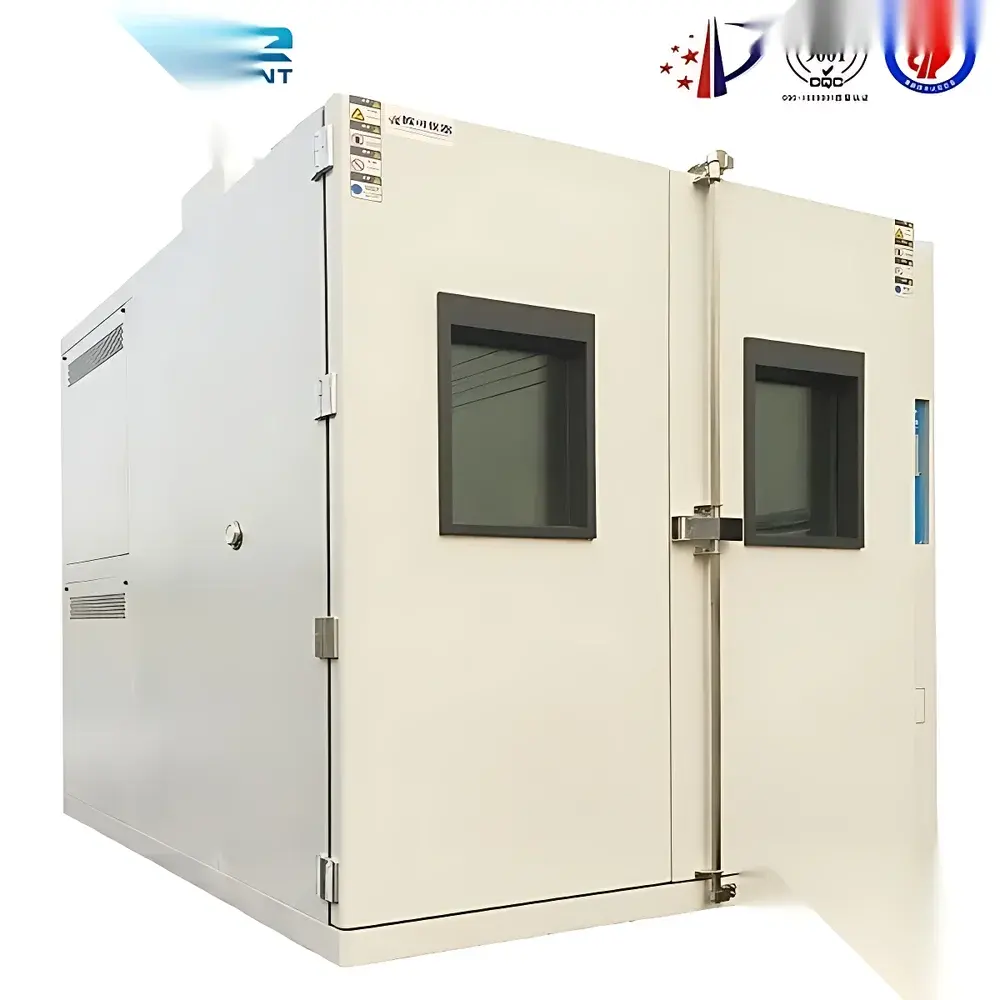
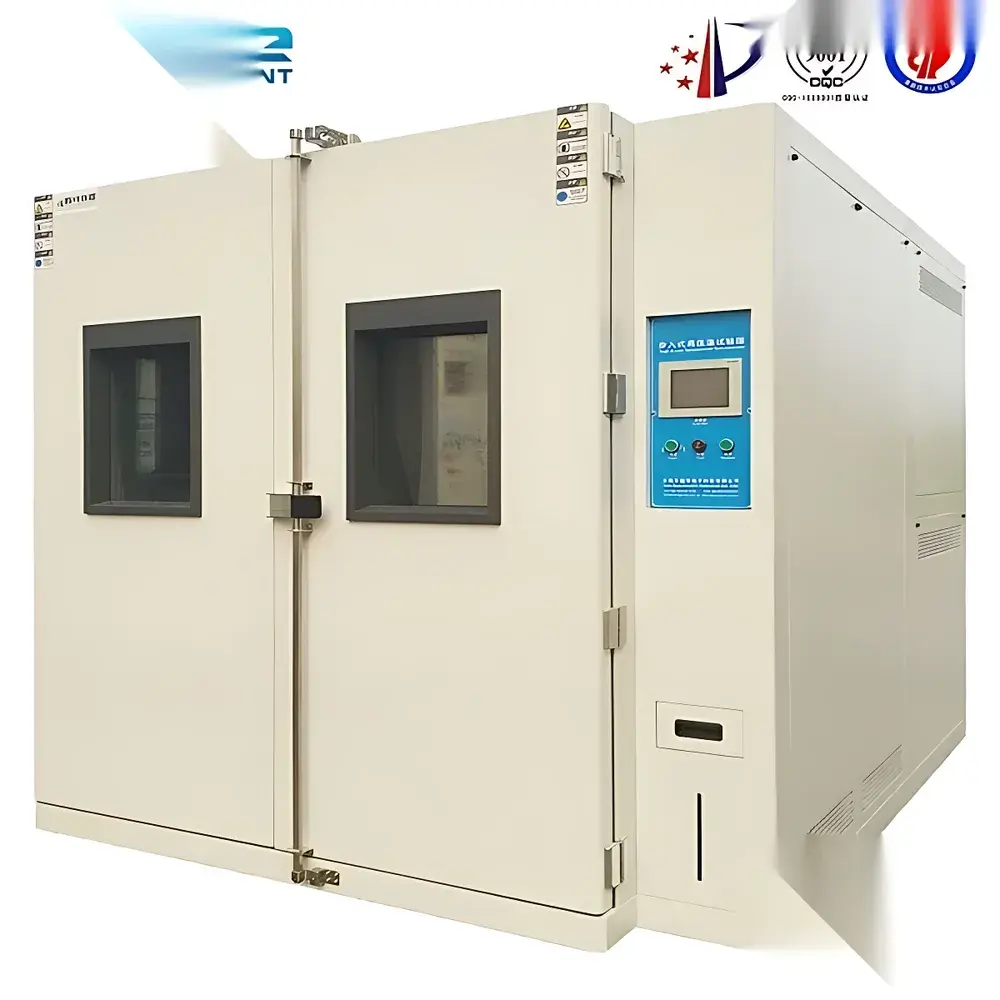
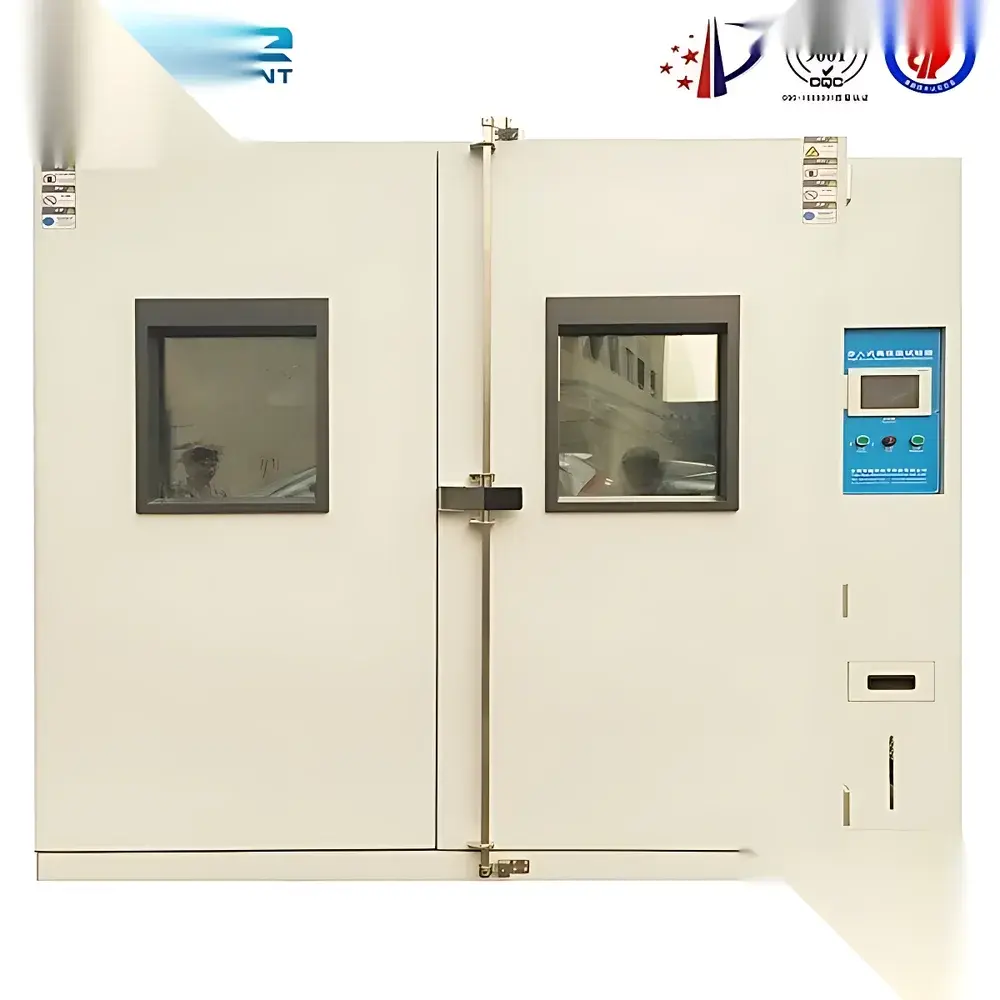
Walk-in Environmental Chamber – Customizable Temperature & Humidity Test Room
| Key | Temperature Range: -60°C to +80°C |
|---|---|
| Humidity Range | 20–98% RH (optional 5–98% RH) |
| Temp. Uniformity | ±0.5°C |
| Temp. Deviation | ±3°C (configurable) |
| Power Supply | AC 380 V, 50 Hz |
| Noise Level | ≤75 dB(A) |
| Construction | Double-skin color-coated steel insulated panels (EPS/polyurethane/rock wool, thickness 50–100 mm) |
| Structural Frame | Galvanized steel framework with aluminum or stainless-steel edging |
| Fire Rating | GB 8624–2012 Class B2 |
| Control System | Microprocessor-based PID + SSR + Timer, PLC-driven, touch-screen HMI |
| Compliance | Designed per ISO 16750-4, IEC 60068-2-1, IEC 60068-2-2, IEC 60068-2-30, and ASTM D4332 |
Overview
The Walk-in Environmental Chamber – Customizable Temperature & Humidity Test Room is an engineered solution for large-scale environmental stress testing of finished products, subassemblies, and industrial components under rigorously controlled thermal and hygrothermal conditions. Based on the principle of forced-air convection with multi-zone air distribution and precision dew-point control, this chamber maintains stable, repeatable temperature and relative humidity profiles across volumetric test spaces up to several hundred cubic meters. It supports static conditioning, cyclic ramp-soak profiles, and combined temperature-humidity stress sequences—critical for validating product reliability in automotive, aerospace, electronics, and telecommunications industries. The system’s modular construction allows full customization of internal dimensions, door configurations, viewing windows, floor finishes, and utility penetrations while maintaining structural integrity and thermal performance.
Key Features
- Modular double-wall insulated panel construction using fire-rated EPS, polyurethane, or rock wool core (50–100 mm thickness), clad with pre-painted steel (0.326–0.5 mm gauge), sealed with neutral-cure silicone for leak-tight integrity
- Robust galvanized steel load-bearing frame with aluminum or stainless-steel perimeter edging for long-term dimensional stability and corrosion resistance
- Advanced air handling unit (AHU) featuring optimized ductwork layout and multi-directional diffusers to ensure uniform airflow distribution (±0.5°C spatial uniformity at working volume)
- Environmentally compliant refrigeration system utilizing R407C or R134a refrigerant, meeting EU F-Gas Regulation (EU) No 517/2014 and EPA SNAP requirements
- Intuitive 7-inch color touchscreen HMI powered by industrial-grade PLC controller, supporting both manual setpoint operation and programmable multi-step cycles (up to 99 segments, 999 loops)
- Comprehensive safety architecture including over-temperature cutoff, high-humidity shutoff, phase failure protection, compressor high-pressure lockout, and real-time fault diagnostics with plain-language error display
- Optional data logging interface compliant with IEEE 11073-10201 for integration into centralized lab monitoring systems
Sample Compatibility & Compliance
This walk-in chamber accommodates full-size end-use equipment—including automotive ECUs, server racks, medical imaging systems, and avionics enclosures—without disassembly. Internal clearances are configurable per client specifications, with standard door openings accommodating pallet jacks and forklift access. All materials meet GB 8624–2012 Class B2 combustibility requirements; electrical components conform to IEC 61000-6-2/6-4 EMI immunity and emission standards. The system is designed to support qualification testing per ISO 16750-4 (road vehicles), IEC 60068-2-1 (cold), IEC 60068-2-2 (dry heat), IEC 60068-2-30 (damp heat cyclic), and ASTM D4332 (conditioning of plastics). Optional validation packages include IQ/OQ documentation aligned with GLP and GMP practices.
Software & Data Management
The embedded control firmware supports time-stamped event logging (start/stop, alarms, setpoint changes) with onboard storage (≥30 days of 1-second interval data). USB export enables CSV transfer for post-processing in Excel or MATLAB. Optional Ethernet connectivity enables remote supervision via Modbus TCP or OPC UA protocols. For regulated environments, a validated software add-on provides 21 CFR Part 11-compliant audit trails, electronic signatures, and role-based user access control—fully traceable to individual operator IDs and session timestamps. All data files are SHA-256 hashed to ensure immutability during archival.
Applications
- Environmental stress screening (ESS) of automotive modules prior to field deployment
- Accelerated life testing (ALT) of telecom base station cabinets under tropical humidity exposure
- Pre-conditioning of lithium-ion battery packs per UN 38.3 thermal abuse protocols
- Stability testing of Class II medical devices under IEC 60601-1 Clause 11.1.1
- Material aging studies on polymer composites, sealants, and adhesives per ASTM D3045
- Calibration verification of portable environmental sensors against NIST-traceable reference standards
FAQ
What is the minimum and maximum internal volume available for custom configuration?
Standard build capacities range from 2 m³ to 500 m³; non-standard volumes are supported subject to structural feasibility review and thermal load modeling.
Can the chamber operate continuously for extended periods (e.g., 30+ days)?
Yes—designed for unattended 24/7 operation with redundant safety interlocks, automatic defrost management, and predictive maintenance alerts based on compressor runtime and refrigerant pressure trends.
Is humidity control possible below 20% RH?
Optional desiccant dehumidification modules enable operation down to 5% RH; however, sustained sub-10% RH requires nitrogen purge integration and additional dew-point monitoring.
Does the system support automated test sequencing across multiple chambers?
Via optional central supervisory software (ChamberLink™), up to 16 units can be synchronized for coordinated profile execution, cross-chamber data correlation, and consolidated reporting.
What documentation is provided for regulatory audits?
Factory acceptance test (FAT) report, calibration certificates (NIST-traceable sensors), material declarations (RoHS/REACH), and optional IQ/OQ protocols compliant with ISO/IEC 17025 and FDA guidance for computerized systems.



