
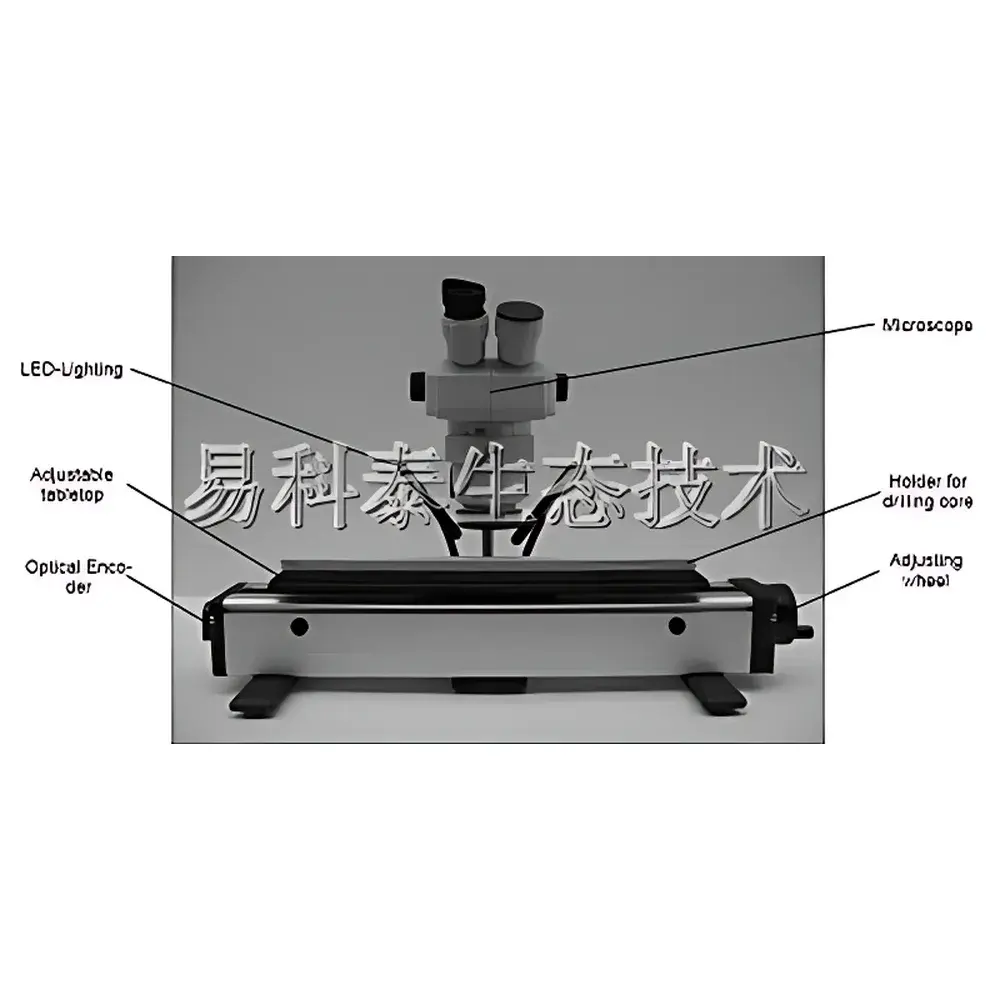
MT Year-Ring Measurement and Analysis System
| Origin | Germany |
|---|---|
| Manufacturer Type | Authorized Distributor |
| Origin Category | Imported |
| Model | MT Year-Ring Measurement and Analysis System |
| Pricing | Upon Request |
| Resolution | 5 µm |
| Max Sample Count per Session | 1000 |
| Measurement Points per Sample | Up to 500 |
| Data Memory Capacity | 256 kB / 512 kB / 1 MB (configurable) |
| Power Supply | DC 6–9 V |
| Max Annual Ring Width | 100 mm |
| Operating Temperature | 0 °C to 50 °C |
| Software | T-TOOLS LIGHT v3.x / T-TOOLS PRO v4.x |
| Data Export Formats | ASCII (tab-delimited), MST (proprietary binary format for T-TOOLS ecosystem) |
Overview
The MT Year-Ring Measurement and Analysis System is a purpose-built optical instrumentation platform engineered for dendrochronological research, combining high-precision mechanical translation, calibrated optical magnification, and deterministic digital signal acquisition. Designed in accordance with ISO 13843:2020 (Dendrochronology — Requirements for measurement of tree-ring widths) and aligned with FAO Forestry Guidelines on growth ring standardization, the system employs a motorized micrometer-driven stage coupled with a stabilized optical path to enable sub-5 µm axial displacement resolution during manual or semi-automated scanning of increment cores and cross-sectioned discs. Its architecture integrates real-time analog-to-digital conversion of positional feedback signals, enabling direct derivation of ring width, inter-annual variability indices, and early/latewood boundary detection without reliance on post-hoc image segmentation algorithms. This eliminates pixelation bias inherent in conventional digital microscopy workflows and ensures traceable metrological integrity across longitudinal field studies.
Key Features
- Precision Translation Stage: Dual-axis micrometer-controlled platform with backlash-compensated lead screws and linear encoder feedback, delivering repeatable positioning accuracy ≤ ±1 µm over full 100 mm travel range.
- Dedicated Core Holder Assembly: Modular aluminum fixture with adjustable clamping pressure and V-groove alignment guides, compatible with standard 4.3 mm, 5.15 mm, and 12 mm increment borers per DIN 4074-1 specifications.
- Integrated Electronic Control Unit: Onboard ARM Cortex-M7 processor with real-time OS; displays live measurements (ring width, cumulative age, min/max/mean width), stores raw position-time traces, and supports firmware updates via USB-C interface.
- Modular Connectivity: Shielded RS-422 differential signaling between stage controller and electronics unit ensures noise immunity in field-deployed environments; USB 2.0 host interface for PC synchronization and bulk data transfer.
- Thermally Stable Mechanical Design: Anodized aluminum chassis with coefficient of thermal expansion < 23 × 10⁻⁶ /°C; validated for continuous operation across 0–50 °C ambient range without recalibration drift exceeding ±0.3 µm/°C.
Sample Compatibility & Compliance
The system accommodates both solid wood specimens (cross-sections up to 150 mm diameter) and fragile increment cores (minimum diameter 2.5 mm). Sample mounting conforms to IUFRO Standard Protocol No. 2019-04 for core stabilization under low-vacuum desiccation. All hardware components comply with CE Directive 2014/30/EU (EMC) and 2014/35/EU (LVD); software modules meet GLP audit trail requirements per FDA 21 CFR Part 11 Annex A when used with T-TOOLS PRO v4.3+ and timestamped logging enabled. Data files generated in ASCII format adhere to ASTM D7772-17 (Standard Practice for Reporting Dendrochronological Data) metadata conventions.
Software & Data Management
T-TOOLS LIGHT serves as the foundational data retrieval and visualization module, supporting drag-and-drop import of binary logs, interactive waveform zoom, and export to CSV-compatible ASCII with configurable delimiter and encoding (UTF-8 or ISO-8859-1). T-TOOLS PRO extends functionality with ring identification assist tools—including auto-thresholding based on local contrast variance, manual override markers with versioned annotation layers, and integrated Baillie-Pilcher detrending routines. Both versions enforce immutable file hashing (SHA-256) for raw datasets and maintain hierarchical project metadata compliant with Dublin Core schema. Exported ASCII files contain mandatory header rows specifying instrument ID, operator initials, sampling date, core ID, and measurement direction (radial/tangential), satisfying FAO Forest Resources Assessment reporting templates.
Applications
This system supports multi-disciplinary applications requiring traceable, high-fidelity annual growth metrics: long-term climate reconstruction using ring-width chronologies (e.g., PAGES 2k Network protocols); forest health assessment through deviation analysis of basal area increment trends; archaeological timber dating via cross-dating against regional master chronologies (e.g., European Oak Master Chronology); validation of remote-sensing-derived productivity models using ground-truthed radial growth rates; and experimental dendroecology studies involving drought-stress gradient plots or CO₂ enrichment trials. Its portability and battery-operable design (with optional external LiFePO₄ pack) facilitate in situ measurements at permanent sample plots without compromising metrological rigor.
FAQ
Does the system require an external microscope?
No — the MT Year-Ring Measurement and Analysis System operates independently using its built-in optical encoder path; however, optional integration with stereo microscopes (e.g., Leica M205 C or Zeiss Stemi 508) is supported via third-party calibration adapters for simultaneous visual verification.
Can T-TOOLS PRO perform statistical cross-dating?
Yes — it implements the COFECHA algorithm (Holmes, 1983) with customizable correlation window sizes, interseries correlation thresholds, and outlier rejection criteria, generating standardized output files compatible with ARSTAN and dplR pipelines.
Is firmware upgrade capability available in the field?
Yes — firmware updates are delivered as signed .bin packages via the T-TOOLS desktop application; cryptographic signature verification prevents unauthorized modifications and ensures compliance with ISO/IEC 17025:2017 clause 5.9.2.
What is the maximum allowable sample curvature for accurate measurement?
The system compensates for curvature-induced parallax error up to 12 mm radius of curvature using real-time arc-length correction derived from dual-point contact sensor feedback; beyond this, flat-sawn reference surfaces are recommended per TRADA Technical Document TD8.
Are calibration certificates provided with each unit?
Yes — each system ships with NIST-traceable calibration documentation covering stage linearity (±0.8 µm over 100 mm), encoder resolution (5 µm step size verified via laser interferometry), and temperature coefficient characterization report.




