
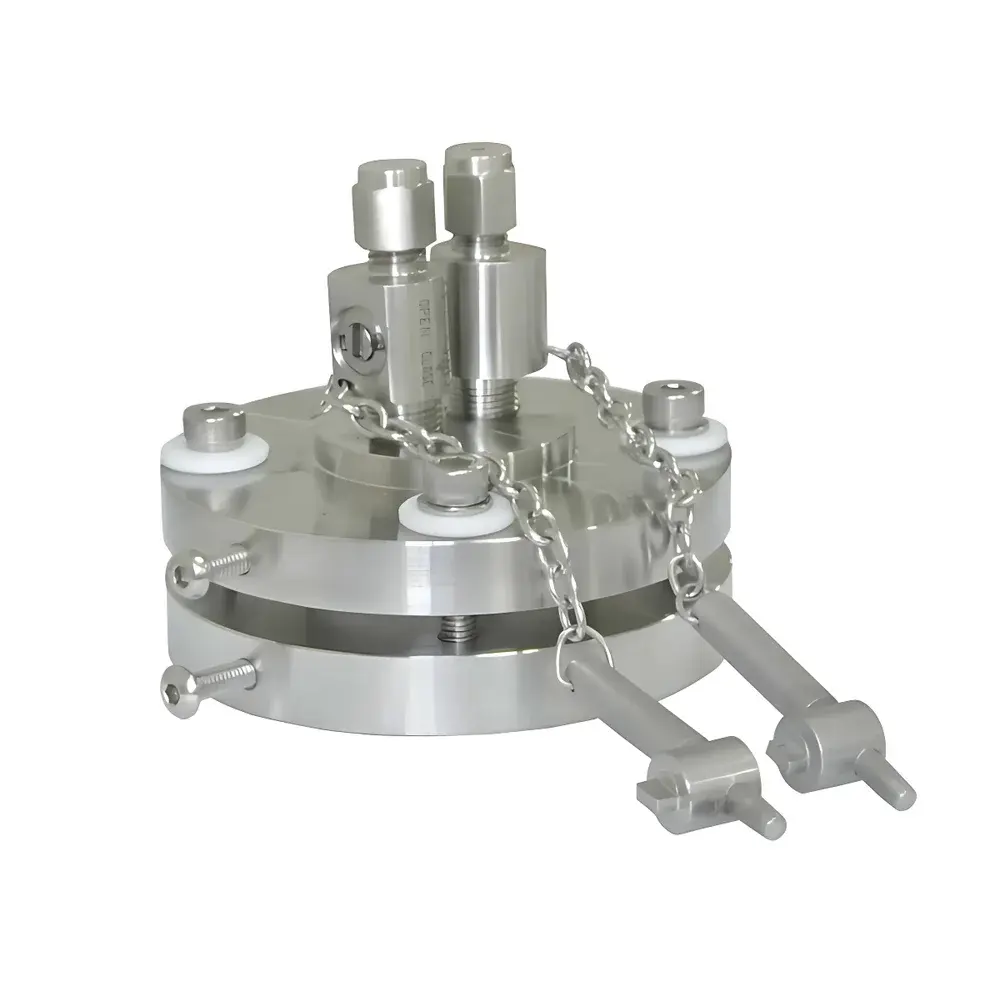
Lithium-Air Battery In Situ Characterization Cell with Quartz Window (STC-ZINCAIR-W)
| Brand | Hefei Kejing |
|---|---|
| Origin | Anhui, China |
| Manufacturer Type | Authorized Distributor |
| Country of Origin | PRC |
| Model | STC-ZINCAIR-W |
| Price Range | USD 700 – 1,400 (FOB) |
| Compatible Instrumentation | X-ray Diffraction (XRD), Fourier Transform Infrared Spectroscopy (FTIR), Synchrotron Beamlines |
| Construction Material | 316 Stainless Steel Body |
| Sealing System | PTFE Cylinder + Fluoroelastomer (FKM) O-Rings |
| Optical Window | Fused Silica (Quartz), Ø10 mm × 1 mm Thickness |
| Optional Window Materials | BaF₂, Al₂O₃, CaF₂, Sapphire |
| Maximum Electrode Diameter | Ø16 mm |
| Maximum Operating Temperature | 200 °C |
| Gas Interface | Dual 1/16″ Swagelok®-Compatible Stainless Steel Needle Valves + 1/16″ SS Tubing |
| Overall Dimensions | Ø80 mm × 62 mm |
| Certification | CE Marked |
| Warranty | 12 Months Full Coverage, Lifetime Technical Support |
| Compliance | Designed for ISO/IEC 17025-aligned laboratories |
Overview
The STC-ZINCAIR-W is a purpose-engineered in situ/operando electrochemical cell designed specifically for real-time structural and chemical characterization of lithium–air (Li–O₂) battery systems under controlled gaseous atmospheres. Unlike conventional coin- or Swagelok-type cells, this device integrates a hermetically sealed, pressure-tolerant chamber with a high-transmission optical window—enabling simultaneous electrochemical cycling and synchrotron-based or laboratory-scale X-ray diffraction (XRD), X-ray absorption spectroscopy (XAS), or Fourier-transform infrared (FTIR) measurements. Its operational principle relies on maintaining electrochemical integrity while permitting non-invasive photon penetration through the quartz window during charge/discharge, thereby capturing dynamic phase evolution (e.g., Li₂O₂ nucleation/growth, parasitic carbonate formation, catalyst degradation) with temporal resolution down to seconds under realistic O₂ or O₂/N₂ gas environments.
Key Features
- Hermetic 316 stainless steel housing engineered for corrosion resistance against reactive oxygen species (ROS), lithium peroxide, and electrolyte vapors at elevated temperatures up to 200 °C.
- Integrated fused silica (quartz) optical window (Ø10 mm, 1 mm thick) positioned at the base, optimized for broadband transmission from deep UV (185 nm) to mid-IR (3.5 µm); optional substitution with BaF₂ (UV-enhanced), Al₂O₃ (high-temp IR), or sapphire (mechanical robustness) available upon request.
- PTFE-insulated electrode assembly with dual fluorocarbon (FKM) O-ring sealing ensures gas-tight isolation between anode/cathode compartments and prevents electrolyte leakage during long-term cycling.
- Adjustable compression mechanism using calibrated stainless steel springs maintains consistent interfacial contact pressure across diverse cathode architectures—including carbon-based air electrodes, protected Li-metal anodes, and solid-state interlayers—without mechanical deformation.
- Dual 1/16″ Swagelok®-compatible stainless steel needle valves enable precise inlet/outlet gas flow control, supporting continuous O₂ purging, stoichiometric gas dosing, or inert atmosphere maintenance (e.g., Ar glovebox integration).
- Compact cylindrical form factor (Ø80 mm × 62 mm) facilitates direct insertion into standard argon-filled gloveboxes (O₂/H₂O < 0.1 ppm) and compatibility with beamline sample stages, XRD goniometers, and FTIR transmission holders.
Sample Compatibility & Compliance
The STC-ZINCAIR-W accommodates disk-shaped electrodes up to Ø16 mm and thicknesses ≤1.5 mm, including porous carbon cathodes loaded with MnO₂, Co₃O₄, or RuO₂ catalysts; Li–In or Li–Si alloy anodes; and quasi-solid polymer electrolytes. It supports liquid electrolytes (e.g., LiTFSI in TEGDME), ionic liquids, and hybrid gel systems. The cell design conforms to ISO 12100 (machinery safety), EN 61000-6-3 (EMC emissions), and CE Directive 2014/30/EU. While not intrinsically rated for explosion-proof operation, its leak-tight construction and passive thermal mass meet baseline requirements for use in ISO Class 5–7 cleanrooms and GLP-compliant battery testing facilities. Documentation includes Declaration of Conformity and material traceability reports for all wetted components.
Software & Data Management
The STC-ZINCAIR-W operates as a hardware interface—not a standalone instrument—and requires integration with external potentiostats (e.g., BioLogic VSP-300, Gamry Interface 5000E) and synchrotron/XRD/FTIR data acquisition systems. All electrochemical protocols (galvanostatic intermittent titration, voltage-limited cycling, EIS) are defined via third-party software compliant with ASTM E2917 and ISO 12100-2 standards. Raw time-stamped voltage/current logs and synchronized detector frames (e.g., Pilatus 1M, MCT detectors) are stored in vendor-agnostic HDF5 or NeXus formats. Metadata fields include gas composition, flow rate, temperature, window transmission coefficient, and seal compression history—enabling full audit trails required under FDA 21 CFR Part 11 and EU Annex 11 for regulated battery R&D.
Applications
- In situ XRD monitoring of Li₂O₂ crystallinity evolution during discharge/charge in ether-based electrolytes.
- Operando FTIR identification of surface-bound superoxide intermediates and carbonate decomposition products on carbon cathodes.
- Synchrotron XAS tracking of transition metal oxidation state changes in bifunctional catalysts under realistic current densities (0.1–0.5 mA cm⁻²).
- Thermally coupled electrochemical impedance spectroscopy (EIS) across 25–200 °C to resolve interfacial resistance contributions from Li₂O₂ film growth versus SEI aging.
- Gas-phase O₂ consumption quantification via mass spectrometry coupling through the 1/16″ gas port, correlating Faradaic efficiency with phase-selective product formation.
FAQ
Can the STC-ZINCAIR-W be used with aqueous or protic electrolytes?
No. This cell is strictly intended for aprotic Li–O₂ systems. Water-reactive lithium metal and superoxide intermediates necessitate anhydrous, O₂-permeable environments; aqueous electrolytes would compromise seal integrity and induce rapid corrosion.
Is vacuum compatibility verified?
Yes—the cell achieves ≤1×10⁻⁶ mbar base pressure after bake-out at 120 °C for 2 hours, confirmed by helium leak testing per ASTM E499. Vacuum operation requires optional high-vacuum-compatible FKM variants.
Does the quartz window support X-ray fluorescence (XRF) mapping?
Yes, provided incident energy exceeds the K-edge of target elements (e.g., >6.5 keV for Mn, >7.1 keV for Fe). Quartz introduces minimal background scattering below 10 keV; BaF₂ windows recommended for sub-keV soft X-ray applications.
How is electrical feedthrough isolation achieved?
Two gold-plated stainless steel pins pass through ceramic insulators (Al₂O₃, 96% purity) mounted within the top cap, rated for >500 V DC isolation and leakage current <1 pA at 100 V.
Are custom electrode holders or current collector geometries available?
Yes—Kejing offers OEM machining services for bespoke current collectors (e.g., mesh-backed Ti foams, patterned Au sputtered substrates) compatible with the Ø16 mm aperture and spring-loading force profile (20–80 N adjustable).



