
Shuttle Box Animal Preference Observation System
| Origin | Denmark |
|---|---|
| Manufacturer Type | Distributor |
| Origin Category | Imported |
| Model | Shuttle Box Animal Preference Observation System |
| Price Range | USD 7,000 – 14,000 |
Overview
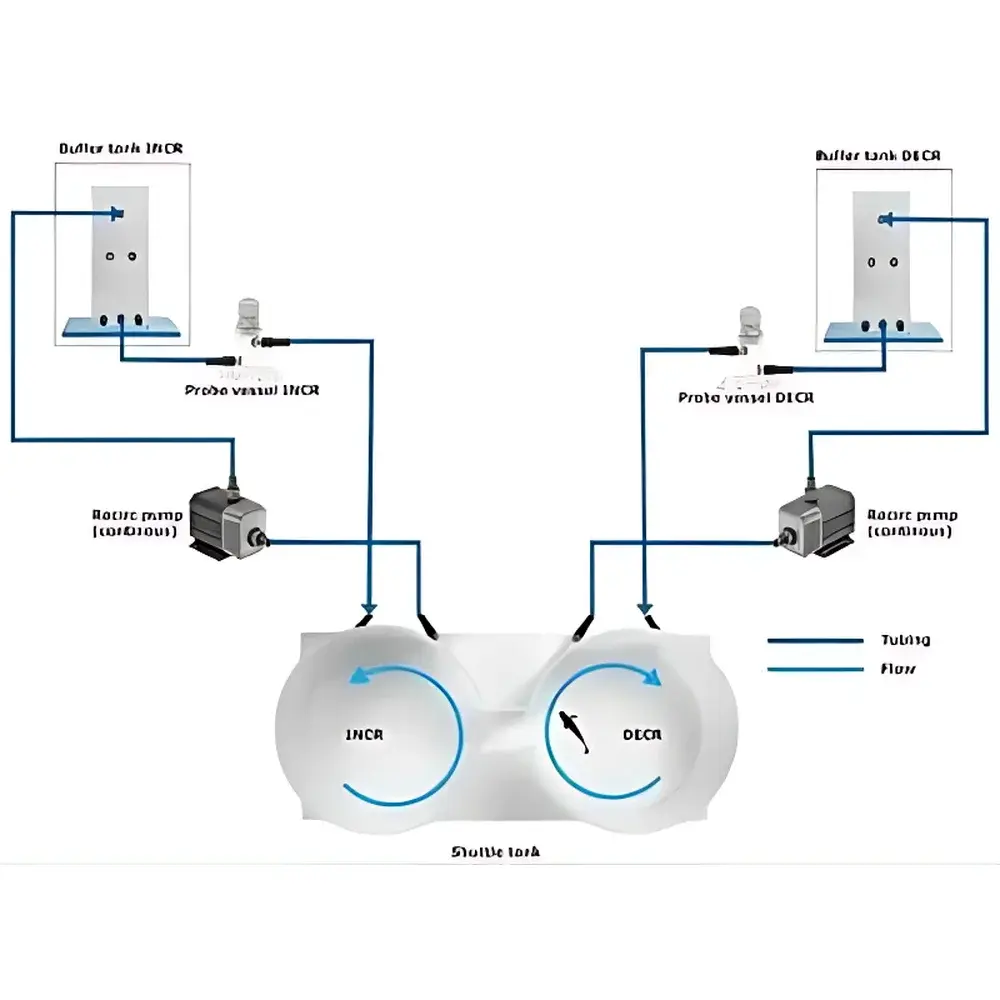
The Shuttle Box Animal Preference Observation System is a fully integrated, laboratory-grade behavioral phenotyping platform engineered for quantitative assessment of environmental preference and avoidance responses in aquatic organisms. Based on the classical shuttle box paradigm—adapted from neuroethological and ecophysiological research traditions—the system enables controlled, real-time observation of voluntary locomotor choices across two physically connected, environmentally distinct compartments. It operates on the principle of operant environmental gradient navigation: test subjects freely traverse between chambers while sensors continuously monitor and dynamically modulate key physicochemical parameters—including temperature, dissolved oxygen (DO), turbidity, salinity, pH, and CO₂—thereby allowing precise quantification of behavioral thermoregulation, oxyregulation, chemotaxis, and habitat selection strategies. Designed specifically for zebrafish, minnows (e.g., Phoxinus phoxinus), crustaceans, and other small aquatic invertebrates and vertebrates, the system supports both static gradient assays (fixed inter-chamber differences) and dynamic feedback-driven protocols (e.g., “INCR/DECR” closed-loop modulation), enabling high-reproducibility studies of physiological set-point regulation and ecological niche preferences.
Key Features
- Modular dual-compartment shuttle tank with optically transparent acrylic construction and standardized dimensions (customizable per experimental scale)
- Independent, programmable environmental control modules for temperature (±0.1 °C resolution), dissolved oxygen (0–20 mg/L, ±0.05 mg/L), turbidity (0–1000 NTU), salinity (0–70 psu), and pH/CO₂ (pH 3–12; CO₂ 0–5000 ppm)
- Real-time video tracking via high-resolution USB camera (1080p @ 60 fps) with low-light sensitivity and motion-triggered frame capture
- ShuttleSoft behavioral analysis software providing automated calculation of dwell time, path length, velocity distribution, transition frequency, and preference index (PI = [tA − tB] / [tA + tB])
- Integrated data acquisition relay module supporting synchronized logging of behavioral metrics and environmental sensor outputs at user-defined sampling intervals (100 ms to 1 min)
- Configurable feedback logic engine for dynamic protocols: e.g., entry into Chamber A triggers incremental parameter increase (INCR), while entry into Chamber B initiates decrement (DECR), establishing self-selected equilibrium conditions
Sample Compatibility & Compliance
The system accommodates a broad range of aquatic model species, including but not limited to Danio rerio, Phoxinus phoxinus, Daphnia magna, Artemia franciscana, and juvenile Salmo salar. All chamber materials comply with ISO 10993-5 (biocompatibility) and are non-leaching, autoclavable, and resistant to common aquatic disinfectants. Environmental sensors meet ASTM D888 (DO), ASTM D1889 (turbidity), and ISO 7888 (pH) calibration traceability requirements. The system architecture supports GLP-compliant workflows: ShuttleSoft includes audit-trail logging, user access levels, electronic signatures, and data export in CSV, HDF5, and MIAME-compatible formats—fully aligned with FDA 21 CFR Part 11 and OECD Test Guidelines 210, 211, and 225 for ecotoxicological preference assays.
Software & Data Management
ShuttleSoft is a Windows-based application built on Qt and OpenCV frameworks, featuring a modular GUI with live video overlay, real-time parameter dashboards, and multi-channel waveform visualization. It supports batch processing of multiple trials, ROI-based zone definition (including adaptive boundary detection), and customizable event tagging (e.g., feeding onset, chemical pulse delivery). Raw tracking data and sensor logs are stored in timestamp-synchronized binary archives with SHA-256 checksum integrity verification. Export options include metadata-rich CSV for statistical packages (R, Python pandas), MATLAB .mat files, and FAIR-aligned JSON-LD descriptors compliant with the Minimum Information About a Behavioral Experiment (MIABE) standard. Remote monitoring via Ethernet or Wi-Fi is supported through secure TLS 1.3 API endpoints.
Applications
- Quantitative determination of thermal preferenda and critical thermal maxima (CTmax) under normoxic and hypoxic conditions
- Assessment of behavioral avoidance thresholds for contaminants (e.g., heavy metals, pharmaceuticals, microplastics) in OECD-compliant ecotoxicology screening
- Investigation of CO₂-induced acidification avoidance behavior in larval fish and benthic invertebrates
- Validation of metabolic compensation hypotheses by correlating SMR (standard metabolic rate) with thermal choice behavior
- High-throughput evaluation of olfactory-mediated food preference or alarm cue aversion in neuroethological studies
- Calibration of species distribution models using empirically derived habitat suitability functions
FAQ
Is the system suitable for long-term acclimation studies?
Yes—chambers support continuous recirculating water systems with optional UV sterilization, biological filtration, and temperature stability ≤ ±0.05 °C over 72 h.
Can ShuttleSoft integrate with third-party physiological recorders (e.g., respirometers)?
Yes—via TTL trigger input/output ports and TCP/IP socket interface; synchronization accuracy < 5 ms.
What is the minimum detectable size for tracked organisms?
Subject-dependent; reliable tracking achieved for individuals ≥ 3 mm in length with contrast-enhanced illumination.
Are validation datasets and reference protocols available?
Yes—peer-reviewed methodological benchmarks, including the Killen et al. (2014, J Anim Ecol) Phoxinus thermal preference protocol, are provided with software installation.
Does the system support multi-species concurrent testing?
No—designed for single-species, individual-level behavioral assays to ensure parameter fidelity and reduce confounding social cues.
Related Products



