
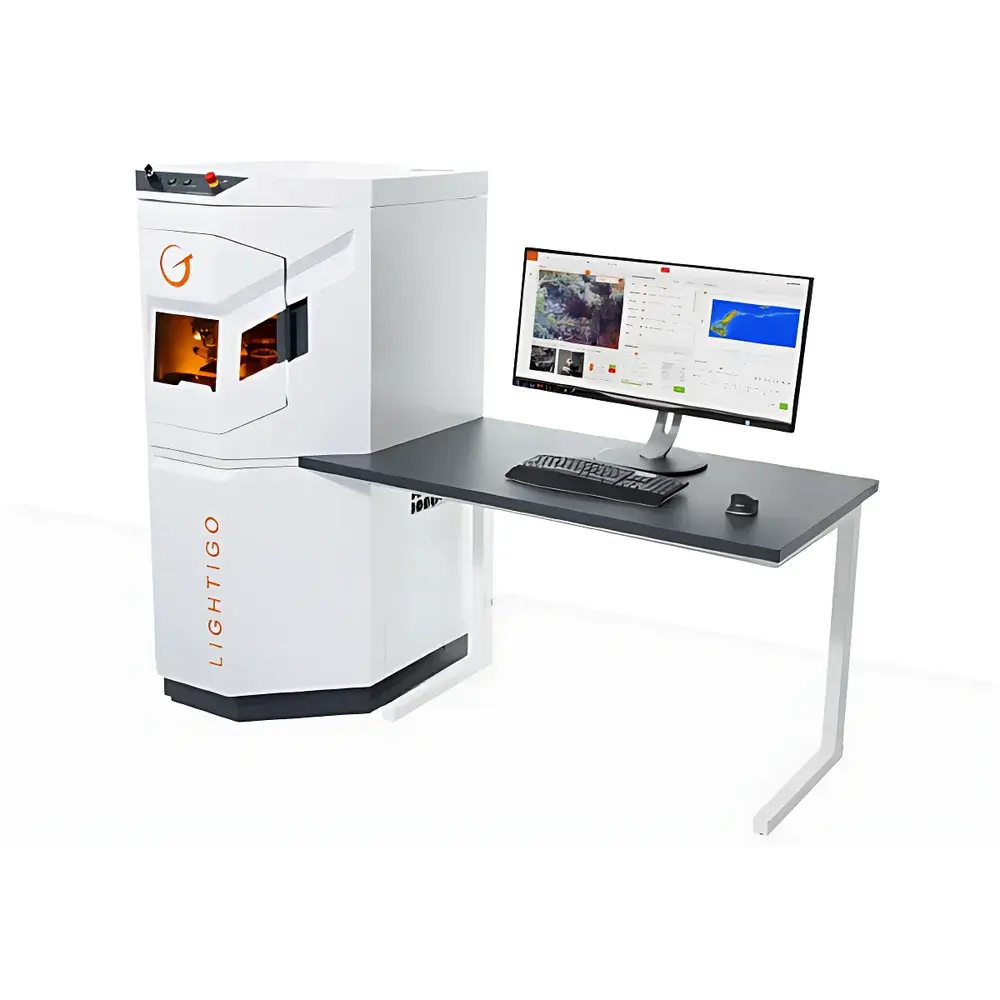
FireFly LIBS Elemental Distribution Imaging System by Lightigo
| Brand | Lightigo |
|---|---|
| Origin | Czech Republic |
| Model | FireFly |
| Measurement Principle | Laser-Induced Breakdown Spectroscopy (LIBS) |
| Detection Range | Li to U (nearly all elements in the periodic table) |
| Detection Limit | 1–100 ppm (matrix-dependent) |
| Spatial Resolution | 10–150 µm |
| Imaging Mode | 2D surface mapping & depth-resolved (line-scan or layer-by-layer ablation) |
| Max Scan Area | 100 mm × 100 mm |
| Ablation Rate | Up to 100 Hz |
| Sample Type | Solid materials only (conductive and non-conductive, no vacuum required) |
| Operating Environment | Ambient air or controlled atmosphere (N₂, Ar) |
| Compliance | CE-marked |
Overview
The FireFly LIBS Elemental Distribution Imaging System is a benchtop laser-induced breakdown spectroscopy (LIBS) platform engineered for rapid, spatially resolved elemental analysis of solid samples. Unlike conventional techniques requiring extensive sample preparation—such as acid digestion, sputtering, or vacuum-based electron excitation—the FireFly operates under ambient conditions using nanosecond-pulsed laser ablation to generate transient microplasmas on the sample surface. Emitted atomic and ionic line spectra are collected via high-throughput Czerny–Turner spectrometer and detected with a gated ICCD or scientific CMOS sensor, enabling simultaneous multi-element identification and quantification across the full periodic table (Li to U). Designed specifically for academic and industrial research laboratories, the system delivers quantitative elemental distribution maps without chemical dissolution, electrode contact, or destructive sectioning—making it ideal for preserving sample integrity in longitudinal or archival studies.
Key Features
- Automated dual-mode scanning: seamless switching between high-resolution micro-area mapping (≤15 µm step size) and wide-field survey scanning (up to 100 mm × 100 mm), programmable via intuitive GUI.
- Real-time spectral acquisition at up to 100 Hz pulse repetition rate, supporting dynamic process monitoring and high-throughput screening of heterogeneous materials.
- Integrated XYZ motorized stage with sub-micron repeatability and optional Z-height auto-focus for topography-compensated ablation on irregular surfaces.
- Modular gas environment chamber (standard N₂ purge; optional Ar or He compatibility) to enhance signal-to-noise ratio for light elements (e.g., C, N, O, Li, Be).
- Self-calibrating wavelength reference using internal Ne/Ar lamp, ensuring long-term spectral stability and traceable calibration per ISO 17025 metrological guidelines.
- Rugged optomechanical architecture with vibration-isolated optical path and thermally stabilized spectrometer housing for day-long operational reliability.
Sample Compatibility & Compliance
The FireFly accepts a broad range of solid specimens—including geological sections, plant tissues, metal alloys, ceramics, polymers, biological hard tissues (bone, teeth), and food matrices—without conductive coating or vacuum pumping. Its non-contact, low-ablation-depth operation (<100 nm per shot) ensures minimal mass removal and negligible thermal damage, satisfying ASTM E2926-22 criteria for minimally invasive forensic and archaeological analysis. The system meets CE safety directives (2014/35/EU, 2014/30/EU) and supports audit-ready data handling aligned with FDA 21 CFR Part 11 requirements when deployed with optional electronic signature and audit trail modules. All spectral raw data and metadata are stored in HDF5 format, facilitating interoperability with third-party chemometric tools and institutional LIMS platforms.
Software & Data Management
Acquisition and processing are managed through Lightigo’s proprietary FireStudio software suite, built on Qt/C++ with Python API extension support. Key capabilities include real-time spectral preview, automatic peak identification using NIST Atomic Spectra Database references, multivariate curve resolution (MCR), PCA-based clustering, and pixel-wise univariate/multivariate quantification using matrix-matched or synthetic calibration standards. Data export options include GeoTIFF (for GIS integration), CSV (for statistical packages), and MGF (for proteomics-aligned workflows). Software logs retain full experimental provenance—including laser energy, gate delay, integration time, stage coordinates, and environmental parameters—enabling full traceability in GLP/GMP-regulated environments.
Applications
The FireFly serves diverse interdisciplinary use cases: elemental co-localization in plant root-soil interfaces (e.g., Fe/Mn/Zn translocation under stress); metallurgical phase boundary mapping in additive-manufactured alloys; trace metal profiling in calcified marine biostructures (coral skeletons, foraminifera); spatially resolved toxicology in rodent tissue sections (Pb, Cd, As distribution); and authenticity verification in premium foods (geographic origin fingerprinting via Sr/Ca/B ratios in olive oil or wine grapes). Its speed and lack of consumables reduce per-sample cost to near-zero after initial capital investment—particularly advantageous for large cohort studies or high-volume quality control screening.
FAQ
Does FireFly require vacuum or inert gas for routine operation?
No—ambient-air operation is standard. Optional gas purging enhances sensitivity for light elements but is not mandatory for most applications.
Can FireFly quantify elements semi-quantitatively without certified reference materials?
Yes—using internal standard normalization (e.g., Ca or Fe lines) or relative intensity ratios, though absolute quantification requires matrix-matched standards per ISO 14802.
Is depth profiling supported, and what is the typical ablation rate per layer?
Yes—sequential layer ablation with adjustable pulse count per position enables controlled depth profiling; typical single-layer removal is 20–80 nm depending on material and laser fluence.
How is spectral calibration maintained over extended use?
An integrated Ne/Ar hollow-cathode lamp provides daily automated wavelength validation; drift correction algorithms apply real-time spectral registration during acquisition.
What file formats are generated, and how is data archived for regulatory compliance?
Raw spectra (.h5), processed maps (.tiff/.csv), and full experiment logs (.json) are generated; optional secure database archiving supports 21 CFR Part 11 audit trails and electronic signatures.



