
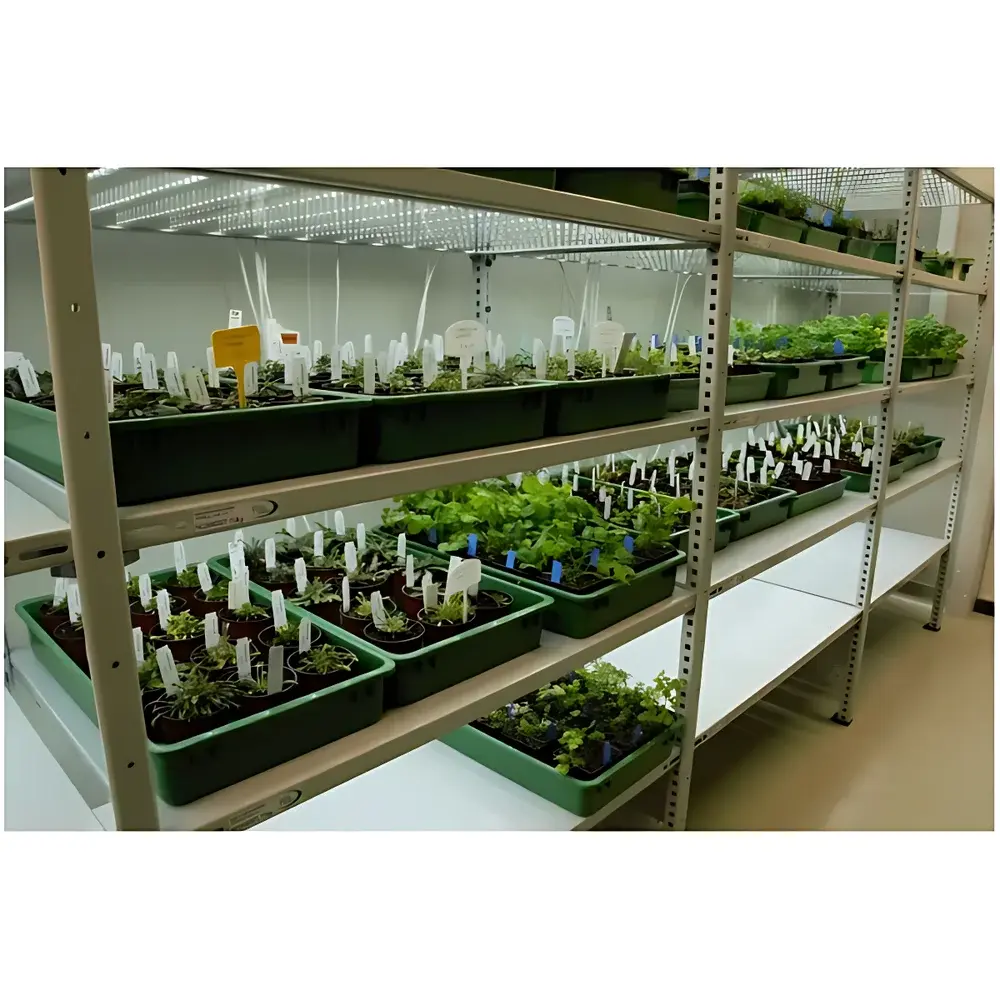
Smart LED Plant Growth Rack – CS Series with LC200 Controller
| Origin | Czech Republic |
|---|---|
| Manufacturer Type | Authorized Distributor |
| Origin Category | Imported |
| Model | CS 250/300_5_3, CS 250/300_5_2.4, CS 250/200_7_4.2, CS 250/200_7_3.4 |
| Max Photosynthetic Photon Flux Density (PPFD) | 250 µmol·m⁻²·s⁻¹ (at 30 cm or 20 cm, depending on model) |
| LED Panel Area | 100×60 cm² or 80×60 cm² |
| Shelf Layers | 5 or 7 |
| Total Cultivation Area | 3–4.2 m² |
| External Dimensions (W×D×H) | 106×65×220 cm or 86×65×220 cm |
| Weight | 75–85 kg |
| Power Consumption | 300–1200 W |
| Light Spectrum | White + Far-Red (customizable with Red, Blue, etc.) |
| LC200 Controller Capacity | Up to 16 Racks |
| Control Resolution | Second-level timing precision |
| Optional Modules | Chlorophyll Fluorescence Monitoring (Ft, QY, OJIP) |
Overview
The Smart LED Plant Growth Rack – CS Series is a modular, research-grade controlled-environment plant cultivation system engineered for reproducible photobiological experimentation in laboratories, phenotyping facilities, and controlled-environment agriculture (CEA) research centers. Unlike conventional growth chambers, this system decouples lighting infrastructure from environmental control—enabling precise, independent regulation of photosynthetically active radiation (PAR) and far-red (FR) light without thermal interference. Each unit integrates high-efficiency, narrow-band LED arrays emitting white light (400–700 nm) and far-red (700–750 nm) spectra, optimized for photomorphogenesis, shade avoidance response studies, and circadian rhythm investigations. The core architecture comprises standardized illumination racks—each accommodating up to eight vertically stacked trays—and the LC200 intelligent controller, which delivers deterministic, multi-parameter light scheduling across up to 16 independent racks. Designed and assembled in the European Union (Czech Republic), the system complies with IEC 61000-6-3 (EMC emission) and IEC 62471 (photobiological safety) standards, supporting GLP-compliant experimental workflows.
Key Features
- Modular rack design: Configurable shelving (5 or 7 layers) with uniform PPFD distribution—≥80% homogeneity across total cultivation area (3–4.2 m² per unit)
- Dual-spectrum LED source: Factory-calibrated white + far-red output; optional spectral customization (e.g., monochromatic red, blue, green, UV-A) with independent intensity control per channel
- LC200 standalone controller: Four-button interface with non-volatile memory; no PC required for routine operation; supports firmware updates via USB
- Precision photoperiod programming: Programmable light/dark cycles with resolution down to 1 second; up to 224 sequential stage transitions per custom protocol
- Dynamic light modulation modes: Continuous, pulsed, sinusoidal, triangular, and stochastic cloud-simulation profiles—enabling ecologically relevant irradiance variability modeling
- Optional chlorophyll fluorescence module: Integrated pulse-amplitude-modulated (PAM) sensor for automated, non-invasive acquisition of Ft, QY (quantum yield of PSII), and OJIP transient kinetics at user-defined intervals
- Robust mechanical construction: Powder-coated steel frame; height-adjustable inner clearance; IP20-rated electronics; CE-marked power supplies (300–1200 W input range)
Sample Compatibility & Compliance
The CS Series accommodates standard plant growth vessels—including Petri dishes (90 mm), Magenta boxes, square trays (25 × 25 cm), and hydroponic rafts—without modification. Tray spacing is adjustable to accommodate seedlings, rosette-stage Arabidopsis, or mature Brassica crops. All optical components meet ISO 11664-1:2019 (colorimetry) and CIE S 026/E:2018 (photobiological safety for plants) specifications. The LC200 controller logs timestamped operational events (e.g., protocol start/stop, parameter changes) with optional audit-trail export—supporting adherence to ISO/IEC 17025:2017 clause 7.7 (control of data integrity) and facilitating traceability in regulated academic or contract research settings.
Software & Data Management
While fully functional as a stand-alone system, the LC200 supports optional USB-to-PC connectivity for batch protocol upload/download and event log retrieval in CSV format. No proprietary runtime or subscription is required. Firmware version history, calibration metadata, and rack-specific configuration files are stored internally with SHA-256 checksum validation. For laboratories operating under 21 CFR Part 11 requirements, third-party LIMS integration is achievable via Modbus RTU (RS-485) interface—enabling electronic signature capture and role-based access control when paired with validated middleware.
Applications
- Phytochrome-mediated signaling studies (e.g., Pfr/Pr ratio manipulation via white + FR co-illumination)
- High-throughput phenotyping under dynamic light regimes (e.g., diel simulation, stress-induced photoinhibition assays)
- LED spectral optimization trials for crop quality traits (anthocyanin accumulation, stomatal conductance, biomass partitioning)
- Non-destructive physiological monitoring using integrated OJIP analysis for early detection of abiotic stress responses
- Training and standardization of plant science technicians in controlled-environment protocols compliant with ASTM E3087-17 (standard guide for plant growth chamber performance verification)
FAQ
Is the LC200 controller compatible with third-party environmental monitoring systems?
Yes—via RS-485 Modbus RTU, enabling synchronization with external sensors (e.g., CO₂, RH, temperature) for closed-loop lighting adjustments.
Can PPFD uniformity be verified independently?
Each rack ships with a NIST-traceable PPFD calibration certificate (measured at 30 cm or 20 cm height per model); users may validate using any PAR meter compliant with DIN 5032-7 Class L.
What is the expected lifetime of the LED modules?
Rated L90 > 50,000 hours at nominal drive current; spectral output stability maintained within ±3% over rated lifetime per IES LM-80-15.
Does the system support remote diagnostics or firmware updates over network?
No—updates require local USB connection; network connectivity is intentionally excluded to ensure electromagnetic compatibility and operational isolation in sensitive lab environments.
Are replacement panels available for individual spectral configurations?
Yes—interchangeable LED panels (white+FR, red+blue, full-spectrum, etc.) are stocked and field-replaceable without tools; part numbers correspond to CS-series model suffixes.



