
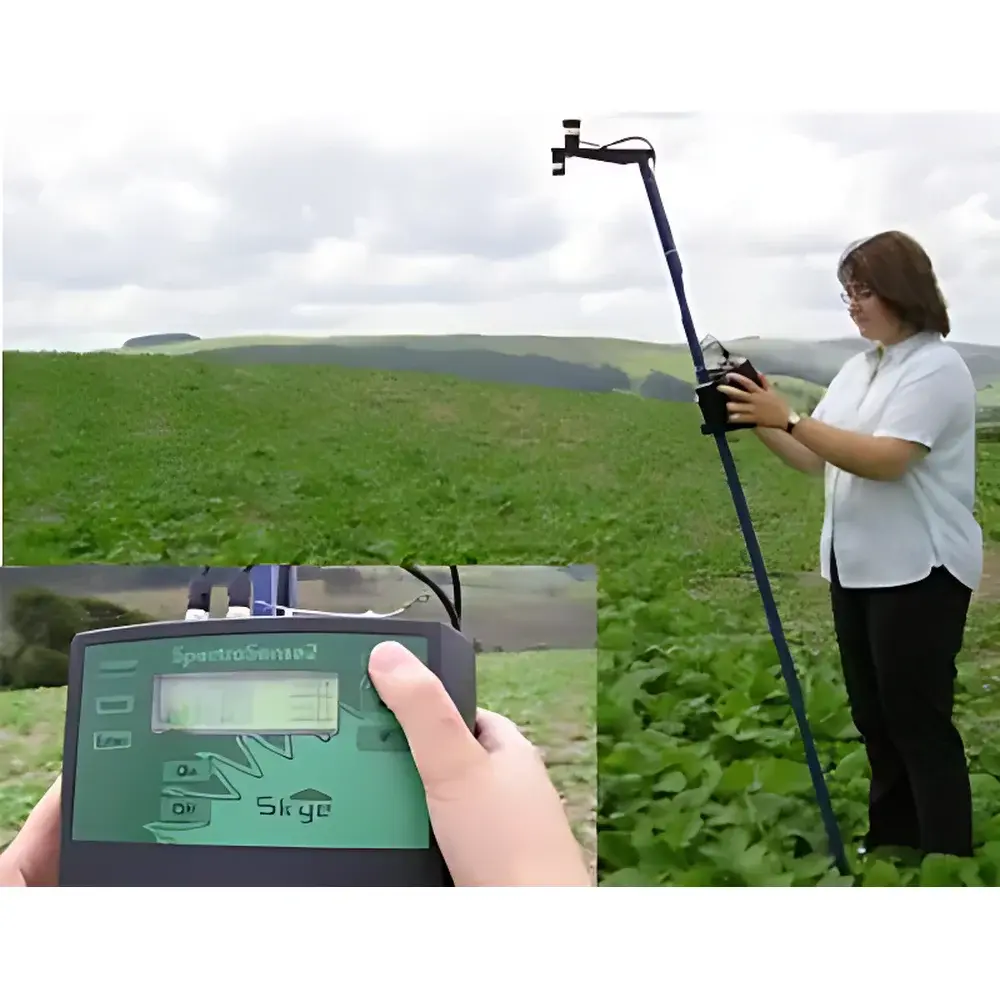
SpectroSense2 Canopy Spectral Measurement System
| Origin | UK |
|---|---|
| Manufacturer Type | Distributor |
| Origin Category | Imported |
| Model | SpectroSense2 |
| Price | Upon Request |
Overview
The SpectroSense2 Canopy Spectral Measurement System is a field-deployable, multi-sensor spectral monitoring platform engineered for precise, real-time acquisition of reflectance and radiance spectra across terrestrial surfaces—including plant canopies, soil, snow, and artificial substrates. Operating on the principle of discrete-band spectral radiometry, the system captures incident and reflected irradiance simultaneously across user-selectable wavelength channels using calibrated photodiode-based sensors with traceable optical filters. Unlike full-spectrum spectrometers, the SpectroSense2 employs a modular, band-specific architecture optimized for vegetation biophysics and ecological remote sensing validation—enabling robust calculation of normalized difference vegetation index (NDVI), fraction of absorbed photosynthetically active radiation (fPAR), and other spectral indices critical to agronomy, ecosystem modeling, and satellite ground-truthing workflows.
Key Features
- Modular sensor architecture supporting up to 8 concurrently connected, factory-calibrated sensors—including PAR (400–700 nm), Red/Far-Red (660 nm / 730 nm), Total Solar Radiation (280–3000 nm), Lux, UVA (315–400 nm), and UVB (280–315 nm) detectors
- IP54-rated black ABS housing with integrated 20×4 LCD display; SpectroSense2 features 8 programmable keys, SpectroSense2+ extends functionality with 12 dedicated keys
- Extended operational range: −20 °C to +70 °C ambient temperature, 0–100% relative humidity
- Dual power options: internal 9 V PP3 battery (40–50 h in display mode; up to 300 h in data logging mode) or external 12 V DC supply via RS232 interface, solar panel, or mains adapter
- Onboard memory stores up to 2,000 timestamped readings per sensor channel with automatic ratio computation (e.g., Red/Far-Red, NDVI = (NIR − Red)/(NIR + Red))
- All waterproof sensors rated IP64 or higher—validated for submersion up to 4 m depth; non-waterproof variants (e.g., for growth chamber use) comply with BS EN 60529 standards
- Traceable calibration certificates provided for each sensor, including spectral responsivity curves and uncertainty budgets referenced to UK National Physical Laboratory (NPL) standards
Sample Compatibility & Compliance
The SpectroSense2 is designed for direct field deployment on tripods, masts, or custom mounting frames, enabling stable, repeatable measurements over heterogeneous terrain and dynamic vegetation canopies. Sensor geometry supports cosine-corrected irradiance collection per ISO 9060:2018 (Class C) and ASTM E892–22 guidelines. All optical sensors meet UK national standards for photometric and radiometric accuracy, with documented linearity, temperature dependence, and angular response characteristics. The system supports GLP-compliant data acquisition when used with time-stamped logging and external metadata tagging—fully compatible with ISO/IEC 17025-accredited environmental monitoring protocols. Non-waterproof sensors are restricted to controlled environments (e.g., phytotrons, climate chambers) where condensation and mechanical ingress risks are mitigated.
Software & Data Management
Data export occurs via RS232 serial interface to Windows-compatible desktop software (included), which provides sensor configuration, real-time visualization, batch processing, and automated NDVI/fPAR time-series generation. Export formats include CSV and Excel (.xlsx) with embedded metadata headers (sensor ID, UTC timestamp, environmental conditions, calibration coefficients). Software supports audit trail logging and user-access controls aligned with FDA 21 CFR Part 11 requirements for regulated research environments. Raw sensor voltages and computed ratios are stored separately to preserve traceability; all calibration files are digitally signed and version-controlled within the software environment.
Applications
- Ground validation of satellite and UAV-based multispectral imagery (e.g., Sentinel-2, Landsat, PlanetScope)
- Long-term phenological monitoring of crop canopies under variable irrigation, nutrient, or stress regimes
- Quantification of photosynthetic efficiency via fPAR and PRI (Photochemical Reflectance Index) derivation
- UV-B exposure assessment in alpine, polar, or high-altitude ecosystems
- Calibration transfer studies between laboratory-grade spectroradiometers and field-deployable sensor networks
- Ecophysiological modeling input for CLM, DALEC, and SCOPE frameworks
FAQ
What spectral bands are supported natively by the SpectroSense2?
The system supports discrete-band measurement across PAR (400–700 nm), Red (660 nm), Far-Red (730 nm), Total Solar Radiation (280–3000 nm), Lux, UVA (315–400 nm), and UVB (280–315 nm); additional custom bandpasses are available upon request.
Is the SpectroSense2 compliant with international radiometric standards?
Yes—each sensor carries NPL-traceable calibration documentation and conforms to ISO 9060:2018 (Class C) for solar irradiance measurement and BS EN 60529 for ingress protection ratings.
Can the SpectroSense2 operate unattended for extended periods?
Yes—when powered externally and configured for scheduled logging intervals, the device supports autonomous operation for weeks; onboard memory capacity and low-power firmware ensure data integrity under variable thermal and moisture conditions.
How is sensor drift managed over time?
Users receive annual recalibration recommendations; factory recalibration services include spectral responsivity re-measurement, temperature coefficient verification, and updated digital calibration files compatible with legacy and current software versions.
Does the system support integration with third-party IoT platforms?
RS232 output enables protocol translation via standard serial-to-MQTT gateways; API documentation and register maps are provided for custom middleware development under NDA.



