
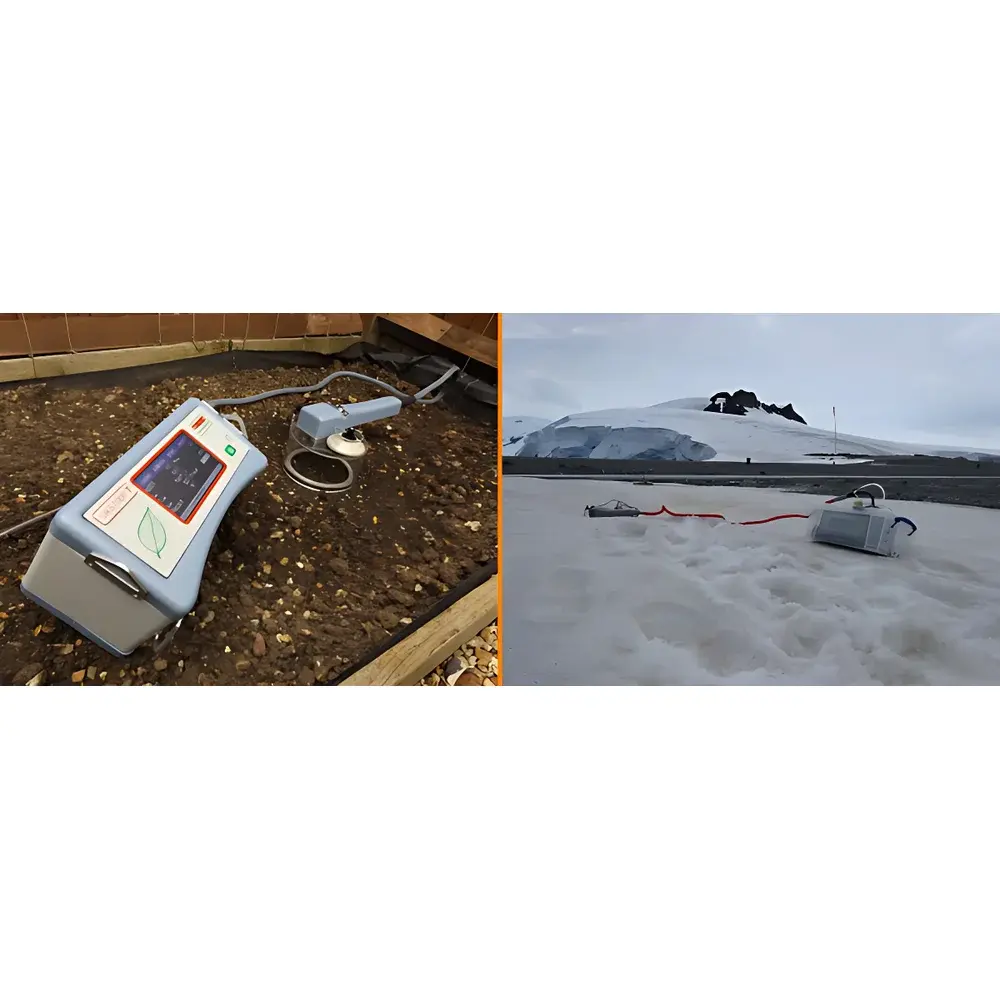
ADC Bio SRS-1000 T Portable Soil Respiration System
| Brand | ADC Bio |
|---|---|
| Origin | United Kingdom |
| Model | SRS-1000 T |
| CO₂ Range | 0–2000 ppm |
| CO₂ Resolution | 1 ppm |
| H₂O Range | 0–75 mbar |
| H₂O Resolution | 0.1 mbar |
| PAR Sensor Range | 0–3000 µmol·m⁻²·s⁻¹ |
| Soil Temperature Probe Range | 5–50 °C |
| Chamber Volume | 1 L |
| Chamber Diameter | 130 mm |
| Stainless Steel Collar Height | 75 mm |
| Acrylic Chamber Height | 70 mm |
| Operating Temperature | 5–45 °C |
| Battery Life | 10 h (2.8 Ah, 12 V lead-acid) |
| Display | 480 × 272 pixel WQVGA color touchscreen (95 × 53.9 mm) |
| Data Storage | SD card (up to 32 GB) |
| Interface | Mini-B USB & RS232 (9-pin D-sub) |
| Flow Rate | 68–340 µmol·m⁻²·s⁻¹ |
| Warm-up Time | 5 min @ 20 °C |
Overview
The ADC Bio SRS-1000 T Portable Soil Respiration System is a field-deployable, open-path gas exchange instrument engineered for high-fidelity, in situ measurement of soil CO₂ efflux—the primary component of ecosystem respiration and a critical metric in terrestrial carbon cycle research. Built upon the LCi T photosynthesis platform, the SRS-1000 T integrates a miniaturized, gold-coated, time-domain differential infrared gas analyzer (IRGA) directly within the ergonomic hand-held controller—eliminating sample line delay and minimizing diffusion-related lag in CO₂ response. Its open-system architecture continuously flushes ambient air through the 1 L acrylic chamber and stainless-steel collar assembly, maintaining near-ambient pressure and microclimatic conditions above the soil surface. This design preserves natural soil–atmosphere boundary layer dynamics and avoids chamber-induced artifacts such as pressure build-up or thermal stratification. The system operates on first-principles physical chemistry: CO₂ concentration is derived from Beer–Lambert absorption at 4.26 µm, with real-time temperature and barometric pressure compensation; water vapor is quantified via dual high-stability laser-trimmed humidity sensors; and photosynthetically active radiation (PAR) is measured using calibrated silicon photodiodes traceable to NIST standards.
Key Features
- Integrated miniaturized IRGA with time-domain differential detection—eliminates zero-drift associated with traditional dual-beam IRGAs and removes need for frequent balance calibration.
- Open-path, dynamic flow design ensures minimal disturbance to soil microenvironment and enables accurate flux calculation using the non-steady-state (change-in-concentration) method per ISO 16634-2 and ASTM D6558.
- Stainless-steel collar (75 mm height, 325 g) provides consistent insertion depth and mechanical stability across heterogeneous soils; acrylic chamber (70 mm height, 320 g) offers optical clarity and low thermal mass.
- Onboard GPS module records georeferenced metadata (latitude, longitude, elevation) synchronized with every CO₂ flux timestamp—essential for spatial interpolation and GIS-based carbon mapping.
- Ruggedized control console (2.4 kg, 125 × 140 × 240 mm) features a sunlight-readable 480 × 272 WQVGA touchscreen with 360° viewing angle, intuitive menu navigation, and real-time graphical overlay of CO₂, H₂O, PAR, and temperature traces.
- Field-configurable sampling protocol: users define interval duration (1 min to 24 h), number of replicates, and automatic start/stop triggers—enabling unattended diel or seasonal monitoring campaigns.
- Robust environmental tolerance: IP54-rated enclosure withstands high humidity (>95% RH), dust ingress, and temperature extremes (5–45 °C operational range).
Sample Compatibility & Compliance
The SRS-1000 T supports standardized measurement protocols for soil respiration across diverse edaphic contexts—from arctic tundra to tropical agroecosystems. Its modular chamber interface accommodates optional PVC adapters for rapid, low-cost deployment across large-area grids (e.g., long-term ecological research sites or land-use change transects). When paired with compatible accessories—including narrow/wide leaf chambers, fruit/respiration chambers, transparent community chambers, and canopy chambers—the system extends beyond soil flux to enable comparative carbon budgeting across trophic levels. All CO₂ and H₂O measurements comply with QA/QC requirements outlined in USDA ARS Technical Bulletin 1939 and align with GLP-aligned data integrity principles: full audit trail, operator ID tagging, and immutable timestamping. Raw sensor outputs are stored in ASCII-delimited format on removable SD cards, facilitating third-party validation and integration into FAO’s Global Soil Organic Carbon Map (GSOCmap) workflows.
Software & Data Management
Data acquisition and visualization are managed via the embedded firmware with no external PC dependency. Each measurement cycle exports a structured CSV file containing: timestamp (UTC), GPS coordinates, CO₂ (ppm), H₂O (mbar), PAR (µmol·m⁻²·s⁻¹), chamber temperature (°C), soil temperature (°C), flow rate (µmol·m⁻²·s⁻¹), and calculated CO₂ flux (µmol·m⁻²·s⁻¹) using the standard finite-difference approximation. Files are organized by date and session ID for traceability. Post-acquisition, data may be transferred via Mini-B USB or RS232 to laboratory workstations running MATLAB, R, or Python-based flux modeling tools (e.g., REddyProc, EddyPro). Optional ADC Bio LogView software provides batch processing, outlier detection, temperature-response curve fitting (Q₁₀ modeling), and export to CF-compliant NetCDF for submission to ICOS or FLUXNET repositories.
Applications
- Quantifying soil carbon efflux gradients across land-use transitions (e.g., forest-to-agriculture, wetland drainage, urban expansion).
- Assessing climate feedback mechanisms: temperature sensitivity (Q₁₀), moisture thresholds, and freeze–thaw pulse dynamics in permafrost-affected soils.
- Evaluating ecological restoration efficacy: comparing CO₂ flux recovery trajectories in rehabilitated mine spoils, post-fire landscapes, or degraded grasslands.
- Validating process-based biogeochemical models (e.g., CENTURY, DAYCENT) with field-derived flux constraints.
- Supporting IPCC Tier 2/3 inventory reporting under UNFCCC Article 3.3 (afforestation/reforestation) and national greenhouse gas inventories.
- Integrating with drone-based remote sensing: ECODRONE® platforms equipped with hyperspectral and thermal cameras provide co-located spectral indices (e.g., NDVI, CWSI) and surface temperature fields for upscaling plot-level fluxes.
FAQ
What calibration procedures are required before field deployment?
The SRS-1000 T performs automatic zero-point correction using internal reference gas cells; no external span gas is needed for routine operation. For traceable calibration, users may perform two-point verification (zero air + 1000 ppm CO₂ standard) following ISO 12039 guidelines.
Can the system operate unattended for multi-day deployments?
Yes—programmable sampling intervals and onboard 32 GB SD storage support continuous logging for >30 days at 5-minute resolution. External 12 V DC power input enables indefinite operation when paired with solar chargers.
Is the stainless-steel collar suitable for rocky or compacted soils?
The collar is designed for mineral and organic soils with moderate penetration resistance. For high-density substrates, optional percussion drivers or pre-augering are recommended to maintain collar–soil contact integrity.
How does the system handle condensation during high-humidity measurements?
Dual humidity sensors operate in differential mode with active thermal stabilization; the IRGA optical path includes hydrophobic coating and laminar airflow management to suppress dew formation on windows.
Does the SRS-1000 T meet FDA 21 CFR Part 11 requirements for regulated environmental monitoring?
While not certified for pharmaceutical GxP applications, its audit-trail functionality, electronic signature support (via optional password-protected user roles), and raw-data immutability satisfy core ALCOA+ principles for environmental GLP studies.







