
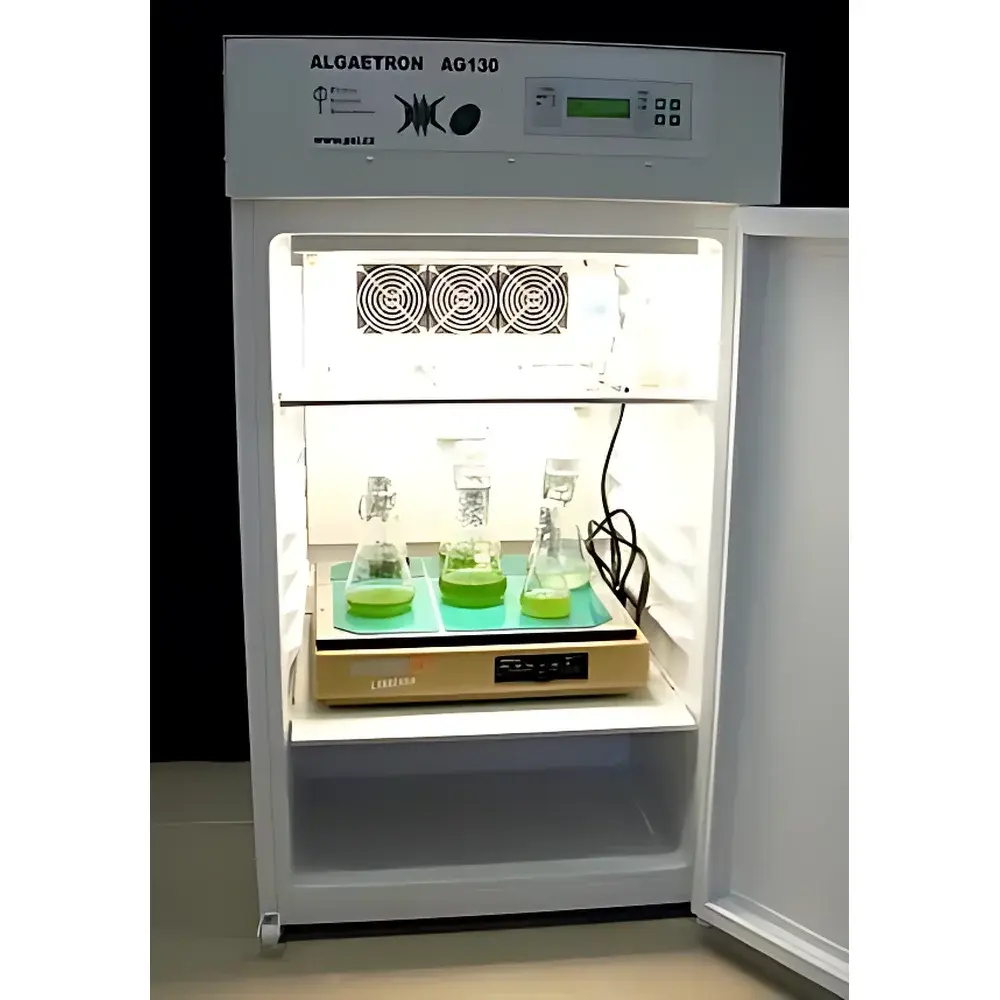
AlgaeTron AG 130-ECO Algal Growth Chamber
| Origin | Czech Republic |
|---|---|
| Manufacturer Type | Authorized Distributor |
| Origin Category | Imported |
| Model | AG 130-ECO |
| Price | Upon Request |
| Temperature Range | +7 °C to +50 °C (dark), +15 °C to +50 °C (max illumination), optional upgrade to +10 °C to +55 °C |
| Illumination | Up to 500 µmol(photon)/m²·s (warm white), up to 1,000 µmol(photon)/m²·s (cool white) |
| LED Area | 25 × 35 cm |
| Internal Volume | 124 L |
| External Dimensions (H×W×D) | 100 × 55 × 62 cm |
| Oscillation Speed | 40–400 RPM |
| Oscillator Load Capacity | 3 kg |
| Refrigerant | R134a |
| Compressor Power | 160 W, 220–240 V, ~50 Hz |
| Total Input Power | 500 W |
| Weight | 55 kg (base unit), 70 kg (fully equipped) |
| Warranty | 1-year limited |
Overview
The AlgaeTron AG 130-ECO is a vertically integrated, programmable algal growth chamber engineered for reproducible, multi-parameter environmental control in photobiological research. Designed around the principles of controlled-environment physiology, it integrates precision thermoregulation, spectrally tunable LED illumination, and orbital shaking within a single compact footprint—enabling standardized cultivation of microalgae, cyanobacteria, and photosynthetic model organisms under defined abiotic conditions. Unlike conventional incubators or shakers, the AG 130-ECO implements simultaneous, time-resolved modulation of light intensity (photosynthetic photon flux density, PPFD), spectral composition, temperature ramping profiles, oscillation frequency, and optional relative humidity and gas composition—making it suitable for experimental designs aligned with ISO 14442 (microalgal culture standardization), ASTM D8297 (photosynthetic efficiency testing), and OECD Test Guideline 201 (freshwater algal growth inhibition assays).
Key Features
- Programmable dual-channel LED lighting system (standard: warm white + far-red; optional RGB, red-blue, or custom spectra) with 1–100% linear PPFD control across 25 × 35 cm irradiated area
- Microprocessor-controlled refrigerated chamber with ±0.3 °C temperature stability and programmable ramp rates (e.g., gradual diurnal shifts from 18 °C to 28 °C over 12 h)
- Integrated orbital shaker platform (39 × 32 × 9 cm) delivering 40–400 RPM with low-vibration, brushless DC motor drive and adjustable amplitude
- High-resolution graphical display showing real-time setpoints and actual values for all active parameters—including dynamic feedback on compressor duty cycle and LED thermal load
- Modular expansion architecture supporting GMS150 gas mixing system (N₂/CO₂/O₂/air blending), RH sensor module (10–90% RH, ±3% accuracy), and integrated PAM fluorometry interface (optional)
- Space-optimized cabinet design (100 × 55 × 62 cm external, 124 L internal volume) with corrosion-resistant stainless steel interior and R134a-based cooling circuit compliant with EU F-Gas Regulation (EU No 517/2014)
Sample Compatibility & Compliance
The AG 130-ECO accommodates standard microbiological vessels including 35 × 50 mL Erlenmeyer flasks, 8 × 500 mL flasks, or mixed configurations up to 3 kg total load. Its uniform illumination field and laminar airflow distribution ensure consistent photon delivery across all positions—critical for inter-replicate comparability in GLP-compliant toxicity screening or strain phenotyping. The chamber meets IEC 61000-6-3 (EMC emission limits) and IEC 61010-1 (safety requirements for lab equipment). Optional RH and gas modules support protocols requiring strict atmospheric control per USP (water for injection testing environments) and ISO 14644-1 Class 8 cleanroom-equivalent air handling.
Software & Data Management
Control firmware supports up to 99 independent programs, each with up to 16 time-segmented steps for temperature, light, shaking, and (if installed) humidity or gas setpoints. All parameter logs—including timestamped PPFD, chamber temperature, oscillator RPM, and compressor status—are stored internally (16 MB non-volatile memory) and exportable via USB-C as CSV files compatible with MATLAB, Python pandas, or JMP for downstream statistical analysis. Audit trails comply with FDA 21 CFR Part 11 requirements when used with optional user access control and electronic signature modules. Remote monitoring is available via Ethernet-enabled gateway (sold separately), enabling integration into centralized lab infrastructure management systems.
Applications
- Phenotypic characterization of wild-type and genetically modified algal strains under controlled photoperiodic and thermal stress regimes
- Standardized assessment of nutrient limitation effects (e.g., N/P depletion) on growth kinetics and lipid accumulation
- Photosynthetic acclimation studies using dynamic light quality switching (e.g., blue-to-red ratio modulation) to probe phytochrome signaling
- Multi-stress exposure experiments simulating climate change drivers: elevated CO₂ + warming + UV-B co-stress
- Pre-cultivation of inocula for photobioreactor scale-up, ensuring physiological synchrony prior to transfer
- Education and training in plant physiology and environmental microbiology labs where space-constrained facilities require high-functionality benchtop systems
FAQ
What is the maximum achievable PPFD with the standard LED configuration?
The standard warm white + far-red array delivers up to 500 µmol(photon)/m²·s at the flask base plane; the cool white option reaches 1,000 µmol(photon)/m²·s under identical geometry and drive conditions.
Can the AG 130-ECO maintain temperature stability during extended high-intensity illumination cycles?
Yes—the refrigeration system is rated for continuous operation at full LED load, with thermal management validated across 72-h stability tests at 50 °C setpoint under 1,000 µmol/m²·s illumination.
Is the orbital shaker independently controllable from the chamber environment settings?
Yes—shaking parameters (RPM, on/off schedule) are fully decoupled and can be programmed asynchronously with temperature or light profiles.
Does the system support validation documentation for regulated environments?
Factory-installed units include IQ/OQ documentation templates aligned with ISO/IEC 17025 and ASTM E2500; PQ execution requires site-specific protocol development by qualified personnel.
What maintenance intervals are recommended for long-term reliability?
Compressor oil and refrigerant integrity should be verified annually; LED driver calibration is recommended every 24 months; shaker belt tension inspection is advised quarterly under continuous 24/7 operation.



