
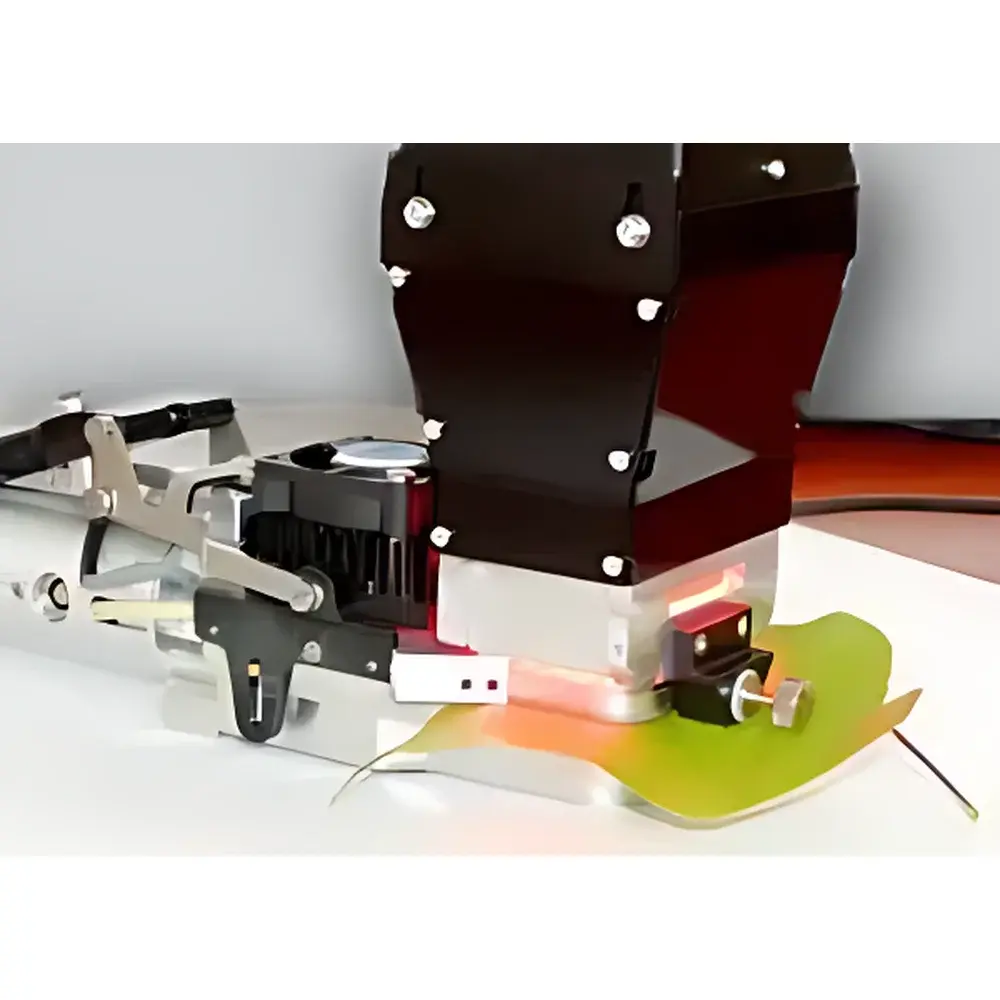
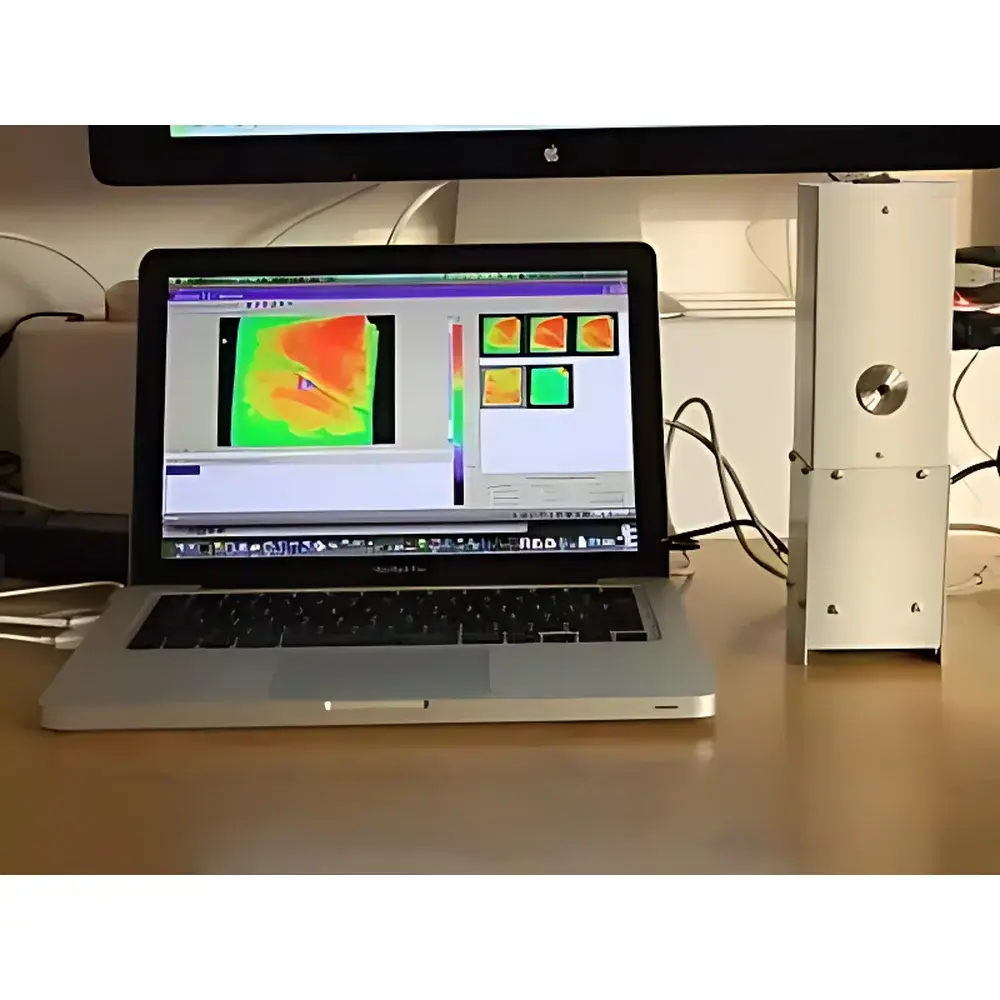
FluorCam Portable Photosynthesis-Coupled Chlorophyll Fluorescence Imaging System
| Brand | PSI (Czech Republic) |
|---|---|
| Origin | Czech Republic |
| Model | FluorCam |
| Detector | High-sensitivity CCD (400–1000 nm, 512×512 px, 8.2×8.4 µm pixel size) |
| Frame Rate | Up to 50 fps |
| Fluorescence Parameters | F₀, Fₘ, Fᵥ, F₀′, Fₘ′, Fᵥ′, QY(II), NPQ, ΦPSII, Fᵥ/Fₘ, Fᵥ′/Fₘ′, Rfd, qN, qP, ETR, and >50 additional derived parameters |
| Actinic Light Sources | White, blue (450 nm), red (620 nm) |
| Measuring Light | 620 nm red LED, pulse width 10–100 µs adjustable |
| Far-Red Light | 735 nm IR LED |
| Uniform Illumination Area | 2.5 × 2.5 cm |
| Excitation Modes | Static or dynamic light regimes |
| Software-Controlled Protocols | Fᵥ/Fₘ, Kautsky induction kinetics, fluorescence quenching analysis, light-response curves, custom script-based experiments |
| Data Interface | USB 2.0 |
| Power Supply | AC adapter or rechargeable battery (field operation) |
| Weight | 1.8 kg |
| Optional Accessories | Handheld OJIP fluorometer module, rugged tablet-based industrial PC |
Overview
The FluorCam Portable Photosynthesis-Coupled Chlorophyll Fluorescence Imaging System is an engineered solution for non-invasive, spatially resolved quantification of photosynthetic performance in intact plant tissues. Based on the principles of pulse-amplitude modulation (PAM) fluorometry and steady-state chlorophyll fluorescence imaging, the system captures dynamic photochemical responses across leaf surfaces with high temporal fidelity (up to 50 frames per second) and spectral sensitivity (400–1000 nm). Unlike point-measurement fluorometers, FluorCam delivers two-dimensional maps of quantum yield of PSII (ΦPSII), non-photochemical quenching (NPQ), electron transport rate (ETR), and other biophysically grounded parameters—enabling researchers to detect heterogeneity in photosynthetic efficiency caused by stress gradients, developmental variation, or genetic mosaicism. Its modular architecture supports seamless integration with commercial gas exchange systems—including Li-Cor 6400, LCpro-SD, and other IRGA-based platforms—allowing concurrent acquisition of CO₂ assimilation, stomatal conductance, transpiration, and fluorescence-derived photochemical metrics under controlled or field conditions.
Key Features
- Modular integration capability: Direct mounting onto standard leaf cuvettes of major photosynthesis systems (e.g., Li-Cor 6400, ADC LCpro-SD) for synchronized gas exchange and fluorescence imaging
- Field-deployable design: 1.8 kg total mass, dual power options (AC + internal rechargeable battery), and ruggedized housing rated for ambient temperature ranges from 5°C to 40°C
- Programmable experimental control: Script-based protocol editor supporting time-series illumination sequences, variable actinic intensities, flash durations, and multi-phase measurement logic
- Dual operational modes: Continuous measuring light imaging for slow kinetics (e.g., dark adaptation recovery) and high-frequency PAM protocols (e.g., rapid light curves, OJIP transient capture)
- Optimized optical configuration: Four uniform LED panels delivering collimated excitation over a 2.5 × 2.5 cm area; selectable wavelengths (620 nm measuring light, 450/620 nm actinic options, 735 nm far-red) with microsecond-level timing precision
- Expandable functionality: Optional handheld OJIP fluorometer for single-point fast induction curve acquisition (20+ derived parameters), and industrial-grade tablet PC for extended autonomous field deployments
Sample Compatibility & Compliance
The FluorCam system accommodates a broad range of photosynthetic samples, including intact leaves of herbaceous and woody species, seedlings, detached leaf discs, mosses, lichens, and algal biofilms mounted on solid substrates. Its non-destructive imaging approach conforms to internationally accepted methodologies described in ISO 10211 (optical measurement of plant physiological traits) and aligns with experimental standards referenced in ASTM E2912 (guidelines for chlorophyll fluorescence-based stress assessment). All firmware and software modules support audit-trail logging and user-access controls compliant with GLP documentation requirements. While not certified as medical or clinical equipment, the system meets CE marking directives for electromagnetic compatibility (2014/30/EU) and low-voltage safety (2014/35/EU).
Software & Data Management
FluorCam Control & Analysis Software provides a unified interface for hardware configuration, real-time visualization, ROI-based statistical extraction, and export-ready data formatting. It includes pre-validated measurement protocols—Fᵥ/Fₘ screening, Kautsky induction kinetics, NPQ relaxation analysis, and PAR-dependent light-response curves—with full parameter customization (e.g., flash duration, interval timing, intensity ramping). Image processing tools support background subtraction, flat-field correction, false-color mapping, and temporal stacking. Output formats include TIFF stacks, CSV time-series matrices, PNG/JPEG annotated images, and interactive HTML reports containing embedded graphs and histograms. Data files are timestamped, metadata-tagged (including instrument ID, operator name, environmental log entries), and structured to facilitate downstream analysis in MATLAB, Python (via NumPy/Pandas), or R environments.
Applications
- Abiotic stress phenotyping: Spatial mapping of drought-, heat-, cold-, and salinity-induced photoinhibition across leaf laminae
- Herbicide mode-of-action studies: Quantifying inhibition kinetics of PSII inhibitors (e.g., atrazine, diuron) at sub-lethal concentrations
- Mutant screening in functional genomics: High-throughput identification of photosynthetic defects in TILLING or CRISPR-edited lines
- Ecophysiological field surveys: Comparative analysis of canopy-level fluorescence heterogeneity in natural or agroecosystems
- Post-harvest physiology: Monitoring chloroplast integrity during storage of horticultural crops
- Algal biotechnology: Optimizing light utilization efficiency in photobioreactor cultures through spatial fluorescence profiling
FAQ
Can FluorCam be used without a gas exchange system?
Yes. The system operates autonomously in standalone mode for fluorescence-only experiments, including dark-adapted Fᵥ/Fₘ screening, light-response curve generation, and stress time-course imaging.
What is the minimum sample size required for reliable imaging?
A minimum illuminated area of 1.5 × 1.5 cm is recommended to ensure adequate pixel coverage and signal-to-noise ratio; smaller samples may be measured using the optional handheld OJIP module.
Is the software compatible with macOS or Linux?
FluorCam software is natively supported on Windows 10/11 (64-bit). Data files (TIFF, CSV) are platform-agnostic and can be processed on macOS or Linux using open-source scientific computing tools.
Does the system support remote monitoring during long-term field deployments?
When paired with the optional industrial tablet PC, FluorCam enables scheduled unattended measurements with local data storage; remote access requires external network infrastructure (e.g., cellular router) and is managed via user-configured file transfer protocols.
How is calibration maintained across field and lab environments?
The system uses factory-calibrated LEDs and CCD gain settings; no routine user calibration is required. For inter-laboratory reproducibility, users are advised to perform daily reference measurements using standardized fluorescent reference tiles (NIST-traceable, optional accessory).





