
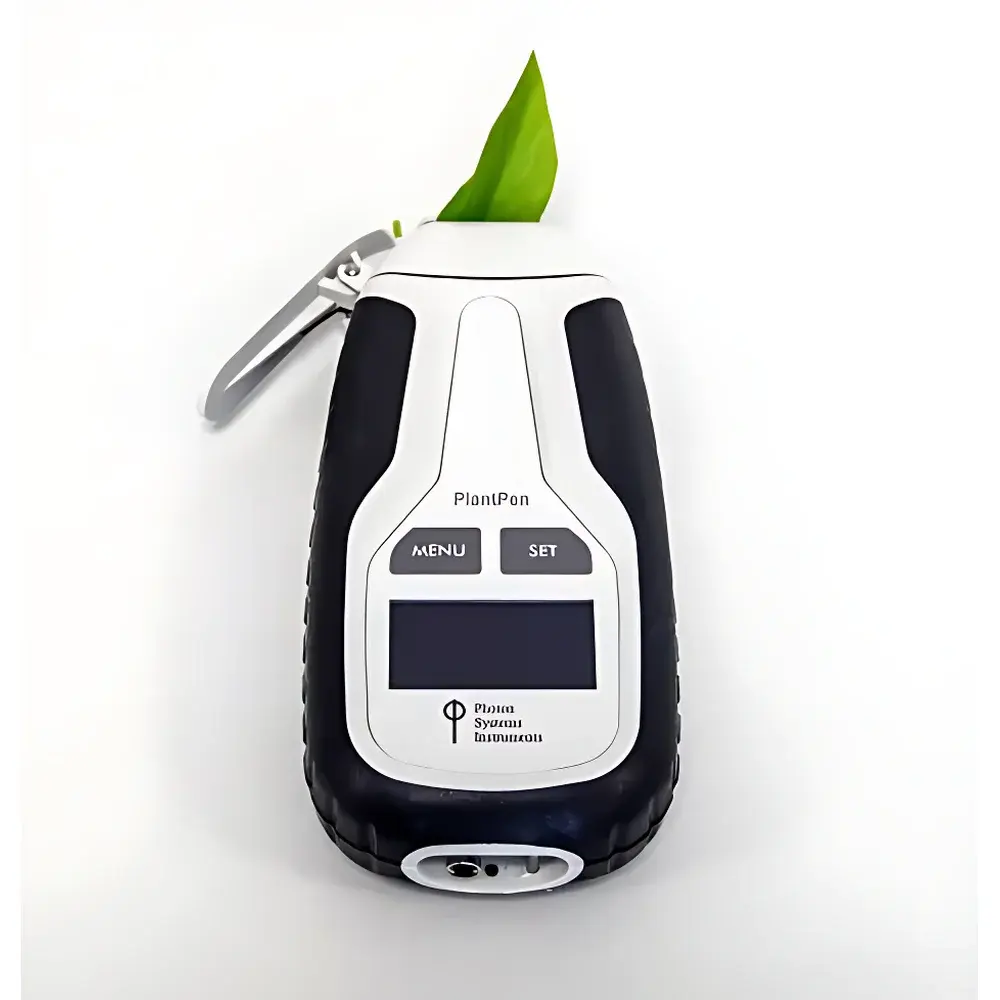
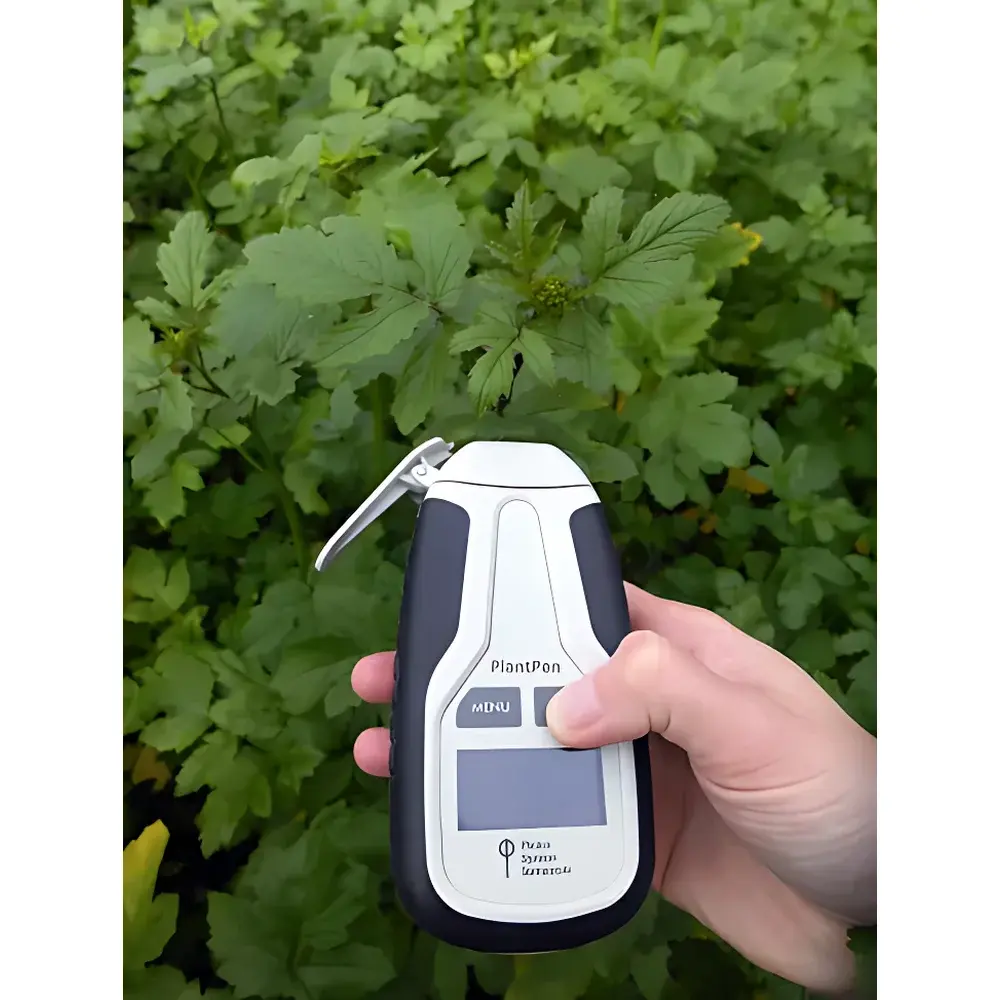
PSI PlantPen Portable Leaf-Clip PRI & NDVI Spectral Index Meter
| Brand | PSI (Czech Republic) |
|---|---|
| Model | PlantPen PRI 210 / NDVI 310 |
| Measurement Principle | Dual-wavelength reflectance ratio spectroscopy |
| PRI Band | 531 nm & 570 nm (detection range: 500–600 nm) |
| NDVI Band | 635 nm (red) & 760 nm (NIR) (detection range: 620–750 nm) |
| PRI Calculation | (R₅₃₁ − R₅₇₀) / (R₅₃₁ + R₅₇₀) |
| NDVI Calculation | (Rₙᵢᵣ − Rᵣₑ ) / (Rₙᵢᵣ + Rᵣₑ ) |
| Data Storage | 100,000 measurements (16 MB internal flash) |
| Connectivity | Bluetooth 1.1 + USB 2.0 |
| GPS | Integrated |
| Display | Graphical LCD |
| Power | Rechargeable Li-ion battery (70 h continuous operation) |
| Dimensions | 135 × 65 × 33 mm |
| Weight | 188 g |
| Operating Temp. | 0–55 °C |
| Relative Humidity | 0–95% RH (non-condensing) |
| IP Rating | Sealed waterproof keypad |
Overview
The PSI PlantPen Portable Leaf-Clip PRI & NDVI Spectral Index Meter is a field-deployable, non-destructive optical instrument engineered for rapid, in situ quantification of two biophysically critical vegetation indices: the Photochemical Reflectance Index (PRI) and the Normalized Difference Vegetation Index (NDVI). Designed around dual-wavelength reflectance ratio spectroscopy, the PlantPen operates on the principle that subtle shifts in leaf spectral reflectance at specific narrow bands correlate directly with photosynthetic pigment dynamics and structural integrity. The PRI 210 variant targets the 531 nm and 570 nm wavelengths—centered on the xanthophyll cycle’s epoxidation state—to deliver a sensitive proxy for radiation-use efficiency, electron transport rate, and early-stage abiotic stress responses such as drought or CO₂ limitation. The NDVI 310 variant employs 635 nm (red) and 760 nm (near-infrared) bands to assess chlorophyll concentration, canopy light absorption, and overall photosynthetic capacity. Unlike broad-spectrum spectroradiometers, the PlantPen integrates calibrated, temperature-stabilized LEDs and silicon photodiodes optimized for high signal-to-noise ratio at these discrete bands—enabling reproducible, operator-independent measurements under variable ambient light conditions.
Key Features
- True leaf-clip design ensures consistent optical geometry and eliminates ambient light contamination during measurement.
- Dual-band optical architecture with factory-calibrated, narrowband LED sources and matched photodetectors for traceable reflectance ratio accuracy.
- Integrated GPS module geotags every measurement with latitude, longitude, altitude, and UTC timestamp—essential for spatially explicit ecological monitoring and longitudinal field trials.
- Bluetooth 1.1 and USB 2.0 interfaces support real-time remote control, firmware updates, and batch data export; no proprietary drivers required.
- Sealed, two-button waterproof keypad enables reliable operation in humid, dusty, or rain-exposed field environments (IP65-rated enclosure).
- Onboard 16 MB flash memory stores up to 100,000 index values with full metadata (timestamp, GPS coordinates, battery level, sensor diagnostics).
- Rechargeable lithium-ion battery provides ≥70 hours of continuous use; low-battery warning and auto-shutdown after 5 minutes of inactivity prevent data loss.
Sample Compatibility & Compliance
The PlantPen is validated for direct contact measurement on intact, non-wilted leaves of herbaceous and woody species—including monocots (e.g., rice, wheat), dicots (e.g., Arabidopsis, tomato), and bryophytes/lichen systems cited in peer-reviewed physiological studies. Its 135 × 65 × 33 mm form factor accommodates leaves ≥20 mm wide with minimal clamping pressure (<0.5 N), preserving stomatal conductance and avoiding artifact-inducing compression. While not certified to ISO/IEC 17025 for metrological traceability, the instrument adheres to ASTM E2432-22 (Standard Guide for Field Use of Reflectance-Based Plant Stress Indicators) and supports GLP-compliant data capture through time-stamped, immutable measurement logs. All firmware and data export protocols comply with FDA 21 CFR Part 11 requirements for electronic records and signatures when used in regulated agricultural research settings.
Software & Data Management
Data are exported in UTF-8 encoded CSV format compatible with Excel, R, Python (pandas), and GIS platforms (QGIS, ArcGIS). Each record includes: UTC timestamp (ISO 8601), WGS84 coordinates (DD format), PRI or NDVI value (to 4 decimal places), raw R₅₃₁/R₅₇₀ or R₆₃₅/R₇₆₀ voltage ratios, battery voltage, and internal temperature. The optional PSI PlantPen Control Suite (Windows/macOS) enables scheduled measurement sequences, spectral calibration verification, and batch metadata annotation (e.g., treatment ID, plot number, observer initials). Audit trails log all user-initiated actions—including firmware version, calibration date, and export events—satisfying basic GxP documentation needs for academic and contract research organizations.
Applications
- Early detection of water deficit stress via PRI decline preceding visible wilting or stomatal closure—validated in Oryza sativa and Triticum aestivum field trials (Fenghua et al., 2016; Trnková et al., 2017).
- Quantifying nitrogen-use efficiency across genotypes using NDVI–leaf N concentration regression models (Leemans et al., 2017).
- Monitoring photoprotective dynamics in polar cyanobacterial mats under desiccation (Jabran et al., 2018; Barták et al., 2015).
- Long-term phenotyping of crop cultivars under elevated CO₂ and temperature gradients (Calderón et al., 2016).
- Teaching laboratory exercises in plant ecophysiology, remote sensing fundamentals, and spectral index theory.
FAQ
Can the PlantPen measure both PRI and NDVI simultaneously?
No—the PRI 210 and NDVI 310 are distinct hardware configurations. Each unit contains fixed-wavelength LEDs and detectors optimized for its respective index; simultaneous dual-index acquisition requires separate instruments or a full-range spectrometer like the PolyPen RP410.
Is factory recalibration required annually?
PSI recommends annual verification against NIST-traceable reflectance standards (e.g., Spectralon® 99% white tile) using the built-in diagnostic mode. Full recalibration is only necessary if physical damage occurs or if verification deviations exceed ±0.005 PRI units or ±0.01 NDVI units.
Does the GPS module support differential correction (e.g., SBAS/WAAS)?
Yes—the integrated GPS receiver supports WAAS/EGNOS for sub-3-meter horizontal accuracy under open-sky conditions; no external base station is needed.
How does the PlantPen handle specular reflection from waxy or hairy leaf surfaces?
The leaf-clip’s 45° incident illumination geometry and diffuse-referenced optical path minimize specular artifacts; validation studies show 500 measurements on Brassica napus and Zea mays with high cuticular wax load.
Can measurement data be synchronized with third-party environmental loggers?
Yes—via timestamp alignment using UTC; the PlantPen’s millisecond-precision internal clock allows post-hoc fusion with HOBO, Onset, or Campbell Scientific logger datasets in R or Python.




